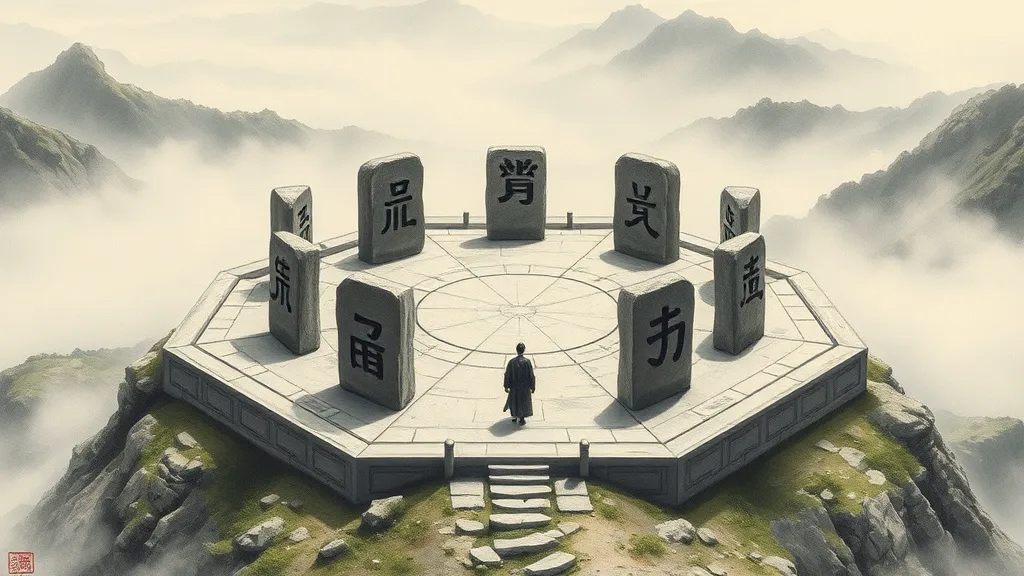
The Eight Trigrams as a Classification System: The Shuogua Zhuan
The Discussion of the Trigrams doesn't explain the hexagrams. It explains the building blocks — the eight trigrams — and reveals that they were never just symbols. They were a complete taxonomy of the natural world.
Part 2 of The Ten Wings Explained — the commentarial tradition that transformed divination into philosophy.
The Periodic Table of Everything
Most people encounter the eight trigrams as decorative motifs — those three-lined figures on Korean flags and martial arts studio walls. The Shuogua Zhuan (說卦傳), the “Discussion of the Trigrams,” is the Wing that explains what these figures actually do. And what they do is ambitious: they classify everything.
Not metaphorically. The Shuogua assigns each trigram a direction, a season, a family member, a body part, an animal, a quality, a natural element, and dozens of extended correspondences — jade and ice for Qian, cloth and cauldrons for Kun, dragons and bamboo for Zhen. It is the I Ching's periodic table: eight categories into which all phenomena can be sorted.
This matters because without the Shuogua, hexagram interpretation is guesswork. When you read that Hexagram 31 (Xian, Mutual Influence) has Lake above Mountain, and you want to know what that means, you need to know what Lake is and what Mountain is. The Shuogua tells you: Lake is joy, the mouth, the youngest daughter, the west, autumn, the sheep. Mountain is stillness, the hand, the youngest son, the northeast, the gate. These correspondences are not decorative. They are the vocabulary from which every hexagram reading is constructed.
How the Sage Built the System
The Shuogua opens with a brief cosmological narrative: “In ancient times, when the sage created the Changes, he secretly assisted spiritual illumination and produced the yarrow stalks.” This is not mere myth-making. The text is establishing that the system has a design logic. The sage “observed the changes of yin and yang to establish the hexagrams” and “exhausted principle and fully realized human nature, thereby reaching destiny.”
In plain terms: the trigrams are not arbitrary symbols. They are derived from observing how yin and yang actually behave in the world. The sage didn't invent the categories; he recognized patterns that were already there. This is the Shuogua's foundational claim, and everything that follows is an elaboration of it.
Two Maps of the World: Earlier Heaven and Later Heaven
Here is what most introductions to the I Ching get wrong: they present one arrangement of the trigrams as though it were the only one. The Shuogua contains two, and they serve completely different purposes.
The first arrangement appears in Chapter 2: “Heaven and Earth establish their positions. Mountain and Lake communicate their vapors. Thunder and Wind drive against each other. Water and Fire do not oppose each other. The eight trigrams interlock.” This is the Earlier Heaven (先天, xiāntiān) arrangement, attributed to the legendary Fuxi. It organizes the trigrams by structural opposition: Heaven faces Earth, Mountain faces Lake, Thunder faces Wind, Water faces Fire. Every trigram is paired with its complement. This is the order of pure principle — the way the universe is organized before it moves.
The second arrangement appears in Chapter 3: “The Sovereign comes forth in Zhen, brings things to order in Xun, things see each other in Li, are put to service in Kun, are pleased in Dui, do battle in Qian, are toiled in Kan, and are brought to completion in Gen.” This is the Later Heaven (後天, hòutiān) arrangement, attributed to King Wen. It organizes the trigrams by temporal sequence — the cycle of the year, the rotation of seasons, the process by which things come into being, mature, decline, and begin again.
In the Later Heaven sequence, Zhen (Thunder) occupies the east and spring — the beginning, the stirring. Li (Fire) occupies the south and summer — full illumination. Dui (Lake) occupies the west and autumn — harvest and joy. Kan (Water) occupies the north and winter — toil, endurance, the dark period before renewal. The text even notes that “the sage faces south to give audience to all under Heaven, turns toward the light to govern” — a passage that influenced the literal orientation of Chinese imperial thrones for two millennia.
The two arrangements are not contradictory. The Earlier Heaven shows how things are structured; the Later Heaven shows how things move. One is the blueprint, the other is the process. Serious I Ching interpretation uses both.
The Trigram Family: Eight Categories of Being
Chapter 8 of the Shuogua introduces the trigram family, and this is where the classification system becomes concrete. Qian (☰, three unbroken lines) is Heaven, is the father. Kun (☷, three broken lines) is Earth, is the mother. The six remaining trigrams are their children, generated by a process the text calls “seeking” (索, suǒ):
- Zhen ☳ — seeking once and obtaining a male. The eldest son. One yang line at the bottom, two yin above. Thunder. Movement. The dragon.
- Xun ☴ — seeking once and obtaining a female. The eldest daughter. One yin line at the bottom, two yang above. Wind. Penetration. The rooster.
- Kan ☵ — seeking twice and obtaining a male. The middle son. Yang in the middle, yin above and below. Water. Danger. The pig.
- Li ☲ — seeking twice and obtaining a female. The middle daughter. Yin in the middle, yang above and below. Fire. Clinging. The pheasant.
- Gen ☶ — seeking three times and obtaining a male. The youngest son. Yang at the top, two yin below. Mountain. Stillness. The dog.
- Dui ☱ — seeking three times and obtaining a female. The youngest daughter. Yin at the top, two yang below. Lake. Delight. The sheep.
The “seeking” refers to the structural generation of trigrams: Zhen takes the first (bottom) line of Kun's all-yin pattern and replaces it with yang; Xun takes the first line of Qian's all-yang pattern and replaces it with yin. The position of the odd line out determines the birth order: bottom line = eldest, middle line = middle child, top line = youngest. Yang lines produce sons; yin lines produce daughters. This is not mysticism. It is a combinatorial logic: three positions, two states, yielding six offspring plus two parents.
Names and Natures: What Each Trigram Does
Chapter 5 gives each trigram a one-word definition. These are not optional flavor text; they are the operational definitions that drive all hexagram interpretation:
- Qian (乾) — vigor (健, jiàn). Heaven revolves ceaselessly.
- Kun (坤) — compliance (順, shùn). Earth receives and supports without resistance.
- Zhen (震) — movement (動, dòng). Thunder stirs all things into action.
- Xun (巽) — entering (入, rù). Wind penetrates everywhere without exception.
- Kan (坎) — entrapment (陷, xiàn). Water flows into hollows and dangerous places.
- Li (離) — clinging (麗, lì). Fire must attach to something to burn.
- Gen (艮) — stopping (止, zhǐ). A mountain is still and does not move.
- Dui (兌) — delight (說, yuè). The lake refreshes and pleases.
When you encounter a hexagram with Kan below and Li above (Hexagram 63, Ji Ji, Already Completed), you are looking at “entrapment” supporting “clinging” — danger beneath clarity, water beneath fire, each in its proper place. When you reverse them (Hexagram 64, Wei Ji, Not Yet Completed), fire is below water — clinging beneath entrapment, heat that has not yet reached its purpose. The single-word definitions do real work.
The Spirit of Transformation
Chapter 4 introduces what may be the Shuogua's most important concept: the six trigrams (excluding Qian and Kun) as agents of natural transformation. “For stirring the myriad things, nothing is swifter than Thunder. For bending the myriad things, nothing is swifter than Wind. For drying the myriad things, nothing is more parching than Fire. For delighting the myriad things, nothing is more pleasing than the Lake. For moistening the myriad things, nothing is more moistening than Water. For ending the myriad things and beginning them anew, nothing is more powerful than the Mountain.”
Notice that Qian and Kun are absent from this list. The commentary explains why: they are the parents who preside over the six children. Qian and Kun set the conditions; the six children do the actual work of transformation. Thunder stirs. Wind shapes. Fire illuminates. Lake gladdens. Water nourishes. Mountain completes and renews. Together, they describe the full cycle of how anything in nature comes into being, operates, and transforms.
The chapter concludes: “Water and Fire reach each other; Thunder and Wind do not oppose each other; Mountain and Lake communicate their vapors — and only then can transformation take place and the myriad things be brought to completion.” This is the ecological principle at the heart of the system: nothing transforms alone. Every trigram requires its complement.
Body and Animal: Correspondences Near and Far
Chapters 6 and 7 map the trigrams onto animals and body parts, and these mappings reveal the logic of the whole system. The commentary tradition divides these into “taking from nearby” (近取諸身, the body) and “taking from afar” (遠取諸物, the natural world).
The body correspondences follow the trigram's structural position: Qian is the head (honorable, above all else). Kun is the belly (stores and contains). Zhen is the foot (moves and acts). Xun is the thigh (follows the foot's lead). Kan is the ear (the northern trigram governs hearing). Li is the eye (the southern trigram governs sight). Gen is the hand (stops and holds). Dui is the mouth (the western trigram governs speech).
The animal correspondences follow the trigram's character: Qian is the horse (vigorous, ceaseless motion). Kun is the ox (bears heavy loads with patience). Zhen is the dragon (change and sudden movement). Xun is the rooster (knows the hours, crows at the right time — a creature of precision). Kan is the pig (dwells in wet, low places). Li is the pheasant (brilliant plumage — brightness attached to form). Gen is the dog (guards the threshold, prevents entry). Dui is the sheep (docile, social, yielding).
None of these assignments are arbitrary. Each follows from the trigram's core nature (its one-word definition) extended into a different domain. The system's power lies precisely in this: once you understand what Kan is — entrapment, danger, depth — you can derive its animal (the pig in its wallow), its body part (the ear that listens in darkness), its season (winter), its direction (north), and its extended correspondences (ditches, canals, concealment, the moon, the thief).
The Extended Correspondences: Chapter 9
The final chapter of the Shuogua is its longest: an exhaustive catalog of everything each trigram represents. Qian is not just Heaven and the horse. It is also jade, metal, cold, ice, deep red, the fine horse, the old horse, the lean horse, the piebald horse, and tree fruit (“fruit attached to the tree resembles stars attached to Heaven,” the commentary notes). Kun is not just Earth and the ox. It is cloth, the cauldron, parsimony, evenness, the cow with calf, the great wagon, and black soil.
This chapter is the reference manual. When a hexagram text mentions a horse, it points toward Qian. When it mentions a wagon, it points toward Kun. When it mentions a dragon or green bamboo, it points toward Zhen. The extended correspondences are the decoder ring for the hexagram and line texts, which use images drawn from this exact vocabulary.
Some correspondences are startling: Xun (Wind/Wood) corresponds to “profit in the marketplace tripled.” The commentary explains: Wind enters everywhere, and commerce penetrates all markets. Kan (Water) corresponds to thieves and the moon. Water conceals, flows unseen, operates in darkness. Dui (Lake) corresponds to the shaman. The commentary: “Dui means joy in serving the spirits.”
Why This Wing Matters
The Shuogua Zhuan is the foundation beneath every other Wing. The Tuan Zhuan (彖傳) explains hexagram judgments by analyzing how the upper and lower trigrams interact — but you cannot follow that analysis without knowing what each trigram represents. The Xiang Zhuan (象傳) derives moral lessons from trigram images — “Wind above Earth: Contemplation” — but the lesson makes no sense unless you know that Wind means penetration and Earth means receptivity.
More fundamentally, the Shuogua establishes the I Ching as a system rather than a collection. Without it, the 64 hexagrams are 64 individual oracles with no structural relationship to each other. With it, every hexagram is a specific combination of two specific forces, each with a defined nature, and the meaning of the hexagram emerges from how those forces interact in that specific configuration.
This is what the Shuogua reveals, and what people miss when they treat the trigrams as mere decorative figures: they are the I Ching's classification system. Eight categories that account for all phenomena. Father, mother, and six children. Heaven, Earth, and the six forces that make things happen between them. Every direction, every season, every body part, every animal, every quality of experience — mapped onto three lines, two states, eight possibilities.
Everything has a trigram. The Shuogua tells you which one.
Sources
Primary text: Shuogua Zhuan (說卦傳), from the Zhouyi Zhushu (周易注疏), with commentary by Han Kangbo (韓康伯) and sub-commentary by Kong Yingda (孔穎達). Siku Quanshu edition (欽定四庫全書本).
The Shuogua is one of the Ten Wings (十翼), the commentarial appendices traditionally attributed to Confucius. Modern scholarship dates most Wings to the Warring States period (475–221 BCE), with the Shuogua likely among the earlier compositions due to its systematic character.