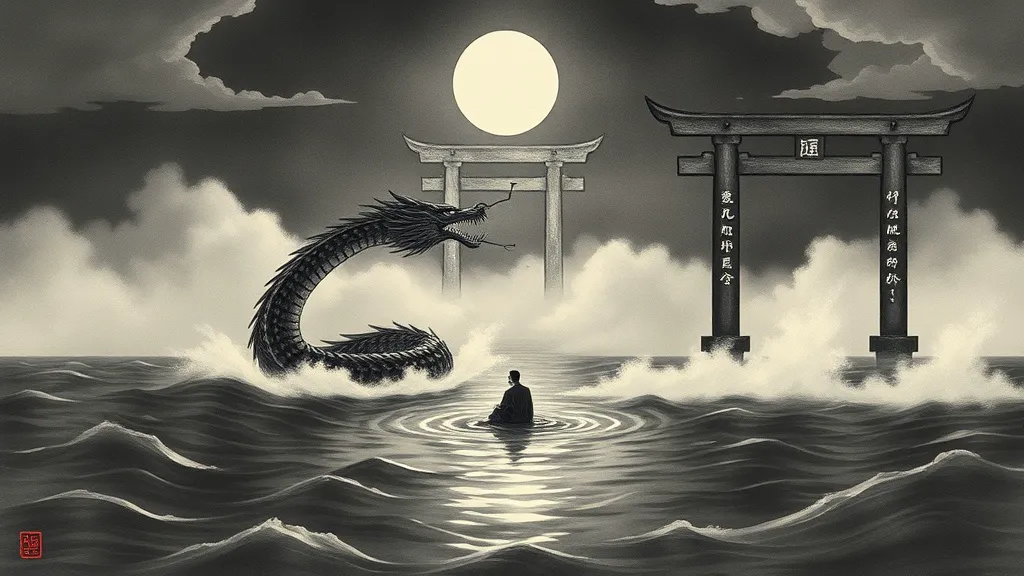
The Hidden Dragon Surfaces: The Wenyan Commentary on Qian and Kun
The entire Ten Wings tradition produces ten commentaries on sixty-four hexagrams. The Wenyan Zhuan ignores sixty-two of them. It lavishes all of its attention on just two — Qian (乾, The Creative) and Kun (坤, The Receptive) — and in doing so produces the most concentrated philosophical text in the I-Ching corpus.
Part 3 of The Ten Wings Explained — the commentarial tradition that turned an oracle into a philosophical system.
Why Only Two Hexagrams
Here's what people miss about the Wenyan Zhuan (文言傳): its selectivity is the point. Of the Ten Wings, the Tuan Zhuan covers all sixty-four hexagrams. The Xiang Zhuan covers all sixty-four hexagrams. The Xici Zhuan builds a cosmic philosophy around the entire system. The Wenyan looks at all of that and says: actually, everything you need to understand is already present in hexagrams one and two.
Kong Yingda's sub-commentary explains the logic: the Wenyan exists because “the virtue of Qian and Kun is great” (以乾坤德大), and these two hexagrams are the “gate of the Changes” (易之門戶). The gate metaphor recurs throughout the commentarial tradition. You enter the hexagram system through Qian and Kun the same way you enter a building through its door. Every other hexagram is a specific combination of yin and yang lines. Qian and Kun are pure yang and pure yin — the raw materials from which every other combination is assembled. If you understand these two, you understand the principle. The other sixty-two are applications.
The Four Virtues of Qian: What 元亨利貞 Actually Means
The Wenyan opens with the most influential reading of four characters in the Chinese philosophical tradition:
元者,善之長也。亨者,嘉之會也。利者,義之和也。貞者,事之幹也。
Yuan is the head of all goodness. Heng is the assembly of all beauty. Li is the harmony of all rightness. Zhen is the trunk of all affairs.
Most translations render 元亨利貞 as a single phrase: “great success, favorable, perseverance.” The Wenyan refuses that reading. It insists these are four separate virtues, each describing a distinct aspect of how creative force operates in the world. Yuan (元) is the originating power — the capacity to begin, to initiate, to be the source. Heng (亨) is the power of connection — the ability to bring things into harmonious assembly. Li (利) is the power of proper benefit — not profit, but the kind of advantage that arises when things are aligned with what is right. Zhen (貞) is the power of steadfast completion — the structural integrity that makes things endure.
The Wenyan then maps these four virtues onto human practice: “The junzi embodies ren and is thereby fit to lead others. Beautiful assembly is sufficient to accord with ritual. Benefiting things is sufficient to harmonize with rightness. Steadfast solidity is sufficient to manage affairs.” This is the Confucian move. The four cosmic virtues of Heaven become four practical virtues of the noble person. Yuan maps to ren (仁, humaneness). Heng maps to li (禮, ritual propriety). Li maps to yi (義, rightness). Zhen maps to the capacity to get things done.
Kong Yingda's sub-commentary adds the seasonal correspondence: Yuan belongs to spring, when things begin. Heng belongs to summer, when things flourish. Li belongs to autumn, when things are harvested in right measure. Zhen belongs to winter, when things consolidate and endure. The four virtues are simultaneously cosmic principles, ethical imperatives, and seasonal rhythms. The Wenyan holds all three levels at once.
From Hidden Dragon to Arrogant Dragon: The Six-Stage Theory of Power
The heart of the Qian Wenyan is its line-by-line commentary on the six stages of the dragon. This is not metaphor for metaphor's sake. It is a complete theory of how power should be wielded — when to hold back, when to act, when to advance, and when excess destroys what strength has built.
Initial Nine: “Hidden dragon, do not act.” (潛龍勿用) The Wenyan explains: “The dragon virtue is hidden and concealed.” The commentary tradition reads this as the stage of preparation. The person of ability is present but not yet visible. The talent exists, but the conditions for its exercise have not arrived. Wang Bi's annotation is characteristically terse: “The Wenyan is sufficient.” He defers entirely to this commentary rather than adding his own, which tells you how definitive he considered it.
Nine in the second place: “Appearing dragon in the field, favorable to see the great person.” (見龍在田,利見大人) The dragon has surfaced but remains grounded — in the field, not in the sky. The Wenyan reads this as the stage where virtue becomes visible but has not yet assumed formal authority. The “great person” (大人) who should be seen is the person who has cultivated inner virtue to the point where others naturally recognize it.
Nine in the third place: “The junzi is ceaselessly creative all day long; in the evening he is cautious as if in danger.” (君子終日乾乾,夕惕若,厲,無咎) This is the line where the text shifts from dragon imagery to junzi imagery. Wang Bi's commentary explains why: “Nine in the third — being diligent morning and evening — is not a dragon virtue.” The figure at this stage is between worlds, departing the lower trigram and approaching the upper, neither fully hidden nor fully arrived. The appropriate posture is relentless vigilance. The double use of “qian” (乾乾) — the hexagram's own name repeated — suggests effort that mirrors Heaven's own ceaselessness.
Nine in the fourth place: “Perhaps leaping in the abyss, no blame.” (或躍在淵,無咎) The word “perhaps” (或) is the key. The Wenyan reads this as the moment of strategic ambiguity: the figure could advance or retreat, and either option is viable. The commentary states that the fourth position is “neither in heaven, nor in the field, nor in the human realm” — a place of radical indeterminacy. The “abyss” is not failure. It is the depth from which the final leap becomes possible.
Nine in the fifth place: “Flying dragon in Heaven, favorable to see the great person.” (飛龍在天,利見大人) The dragon has arrived. The fifth position is the sovereign's position in the hexagram structure — central and correct. The Wenyan deploys its most elaborate philosophical passage here: “Things of the same tone respond to each other. Things of the same vital breath seek each other out. Water flows toward what is wet. Fire moves toward what is dry. Clouds follow the dragon. Wind follows the tiger. When the sage arises, all creatures look to him.” The logic is resonance: the great person in the sovereign position naturally attracts the response of all things, not through force, but through the principle that like recognizes like.
Top Nine: “Arrogant dragon, there is regret.” (亢龍有悔) The final stage. The dragon has overreached. The Wenyan is blunt: “Noble but without position. High but without people. The worthy are in positions below but offer no assistance. Therefore there is regret in any action.” This is the political warning that runs through the entire sequence: power that ascends beyond its proper station isolates itself. The “arrogant dragon” is not a villain. It is someone who was once great — Hidden Dragon, Appearing Dragon, Flying Dragon — but who did not know when to stop.
The Sage Who Knows When to Stop
The Qian Wenyan culminates in one of the most quoted passages in the I-Ching tradition:
知進退存亡而不失其正者,其唯聖人乎。
To know advance and retreat, survival and loss, without losing one's uprightness — is this not the sage alone?
This sentence is the moral architecture of the entire dragon sequence. The Hidden Dragon knows when to retreat. The Flying Dragon knows when to advance. The Arrogant Dragon knows neither. The sage is defined not by always advancing or always retreating, but by the capacity to judge which is appropriate and to maintain moral integrity regardless of which path is chosen. The dragon metaphor, in the end, is not about power. It is about the wisdom to wield power correctly.
The Four Layers of Reading
One of the Wenyan's structural innovations is that it reads the six lines of Qian four separate times, each from a different analytical angle. Kong Yingda's sub-commentary identifies these as distinct “sections” (節):
- First reading: the four virtues (元亨利貞) and the dragon stages as ethical principles — the junzi as moral agent.
- Second reading: the lines as descriptions of concrete human situations — the political dimension, with explicit references to historical figures and governance.
- Third reading: the lines as natural processes — “Hidden dragon, do not act” becomes “below” (下也); “appearing dragon in the field” becomes “the time of taking office” (時舍也); “flying dragon in heaven” becomes “governing above” (上治也).
- Fourth reading: the lines mapped onto the natural cycle of qi — “appearing dragon in the field” becomes “all under heaven is illuminated” (天下文明); “the junzi is ceaselessly creative” becomes “moving together with the time” (與時偕行).
This four-layered structure is what makes the Wenyan unique among the Wings. It doesn't offer a single interpretation. It demonstrates that the same six lines can be read ethically, politically, practically, and cosmologically — and that all four readings are simultaneously valid. The hexagram is not a code with one key. It is a structure that generates meaning at every level of analysis.
Kun: The Power of Yielding
The second half of the Wenyan turns to Hexagram 2, Kun (坤, The Receptive). Where the Qian commentary elaborates, the Kun commentary condenses. Where Qian has four readings, Kun has essentially one — denser, more direct, and built around a different model of strength.
The Kun Wenyan opens with a parallel to the four virtues, but with a crucial difference. Where Qian's creative power initiates, Kun's receptive power completes. The text uses the imagery of the mare (牝馬) — the female horse that can travel great distances with endurance rather than speed, strength expressed as capacity to sustain rather than to ignite.
The key line of the Kun Wenyan is at the sixth place:
陰疑於陽必戰。為其嫌於無陽也,故稱龍焉。
When yin rivals yang, there must be battle. Because it is suspected of having no yang, it is therefore called “dragon.”
This is the passage where yin at its extreme begins to take on yang qualities — the dragon appears in a hexagram that is entirely composed of broken lines. The philosophical point is that yielding, pushed to its limit, becomes its opposite. Receptivity is not passivity. At the extreme of Kun, yin itself fights. The commentary warns that this battle produces mutual destruction (“its blood is dark and yellow”), and the lesson is the same one Qian teaches from the other direction: excess destroys. The Arrogant Dragon of Qian and the Battling Yin of Kun are mirror images of the same structural failure.
The Junzi as Model Reader
The Wenyan introduces a figure who recurs throughout its commentary: the junzi (君子), typically translated as “noble person” or “superior person.” This is the Confucian layer of the text. The junzi is not just described in the Wenyan — the junzi is the implied reader. The entire dragon sequence presupposes a reader who is asking: what should I do in this situation? How should power be exercised? When should I act and when should I wait?
The Wenyan's answer, consistent across both the Qian and Kun sections, is that the junzi reads situations the way the hexagram system reads reality: by understanding the underlying principle of change. The junzi who encounters the “hidden dragon” does not rage against concealment. The junzi who encounters the “flying dragon” does not become intoxicated with success. In every case, the model reader maintains what the text calls “uprightness” (正) — alignment with the principle, not attachment to the circumstance.
This is why the Wenyan, despite treating only two hexagrams, became the most intensively studied Wing in the Confucian educational tradition. It doesn't just explain Qian and Kun. It teaches you how to be the kind of person who can read the Changes properly.
The Great Person and the Four Harmonies
The nine-in-the-fifth section contains the Wenyan's most expansive vision of what the fully realized person looks like:
夫大人者,與天地合其德,與日月合其明,與四時合其序,與鬼神合其吉凶。
The great person's virtue merges with Heaven and Earth, his brilliance with the sun and moon, his order with the four seasons, his sense of fortune and misfortune with the spirits.
This is not hyperbole. It is a description of complete alignment — a person whose moral structure mirrors the structure of reality itself. The “great person” (大人) does not impose his will on the world. He resonates with the world so perfectly that his actions and the world's patterns coincide. “He acts before Heaven, and Heaven does not contradict him. He acts after Heaven, and he follows Heaven's timing.” (先天而天弗違,後天而奉天時)
This passage became one of the most cited in all of Chinese philosophy. It defines the ethical ideal not as obedience to rules but as attunement to patterns. The sage does not follow commands. The sage perceives the structure of the situation and acts in accordance with it. The hexagram system is the training tool for developing that perception.
What the Wenyan Changed
The Wenyan Zhuan did something no other Wing attempted: it took divination text and read it as ethical philosophy. The line statements of Qian — “hidden dragon,” “appearing dragon,” “flying dragon” — were originally oracle responses. The Wenyan transforms them into a curriculum. Each stage of the dragon becomes a stage of moral development. Each line becomes a lesson in timing, restraint, and the proper exercise of power.
This interpretive move is what made the I-Ching available to the Confucian tradition. Without the Wenyan, the hexagrams are oracular images — vivid, mysterious, useful for divination. With the Wenyan, they become ethical instruction. The “hidden dragon” is no longer a prediction about your fortune. It is advice about how to live when circumstances demand concealment. The “arrogant dragon” is no longer a warning about bad luck. It is a diagnosis of a character flaw — the inability to recognize when power has exceeded its proper bounds.
The Wenyan Commentary on the Words of the Text. Two hexagrams. Four virtues. Six dragons. And the single most important question in the entire I-Ching tradition: do you know when to stop?
References
Primary Source
文言傳 (Wenyan Zhuan), from 欽定四庫全書本《周易注疏》卷一 (Zhouyi Zhushu, volume 1, Siku Quanshu edition). Hexagram 1 (乾) and Hexagram 2 (坤) Wenyan sections. Commentary by 王弼 (Wang Bi, 226–249). Sub-commentary by 孔穎達 (Kong Yingda, 574–648).
Key Passages Referenced
Qian Wenyan: Section 1 (元者善之長也, four virtues) · Section 2 (潛龍勿用 through 亢龍有悔, line-by-line ethical reading) · Section 3 (潛龍勿用下也, line-by-line political reading) · Section 4 (潛龍勿用陽氣潛藏, line-by-line cosmological reading) · Section 5 (乾元者始而亨者也, Qian's nature) · Section 6 (大人者與天地合其德, the four harmonies).
Kun Wenyan: 坤至柔而動也剛 (Kun's yielding strength) · 陰疑於陽必戰 (yin at its extreme).