What the 1915 Page Actually Prints
Three layers, and only one of them is the prophecy.
Part 1 of The Prophecy That Names Nobody
Start with the object. Not the reputation, not the summaries — the object. Here is a leaf of the 1915 printing, at the resolution the scan gives:
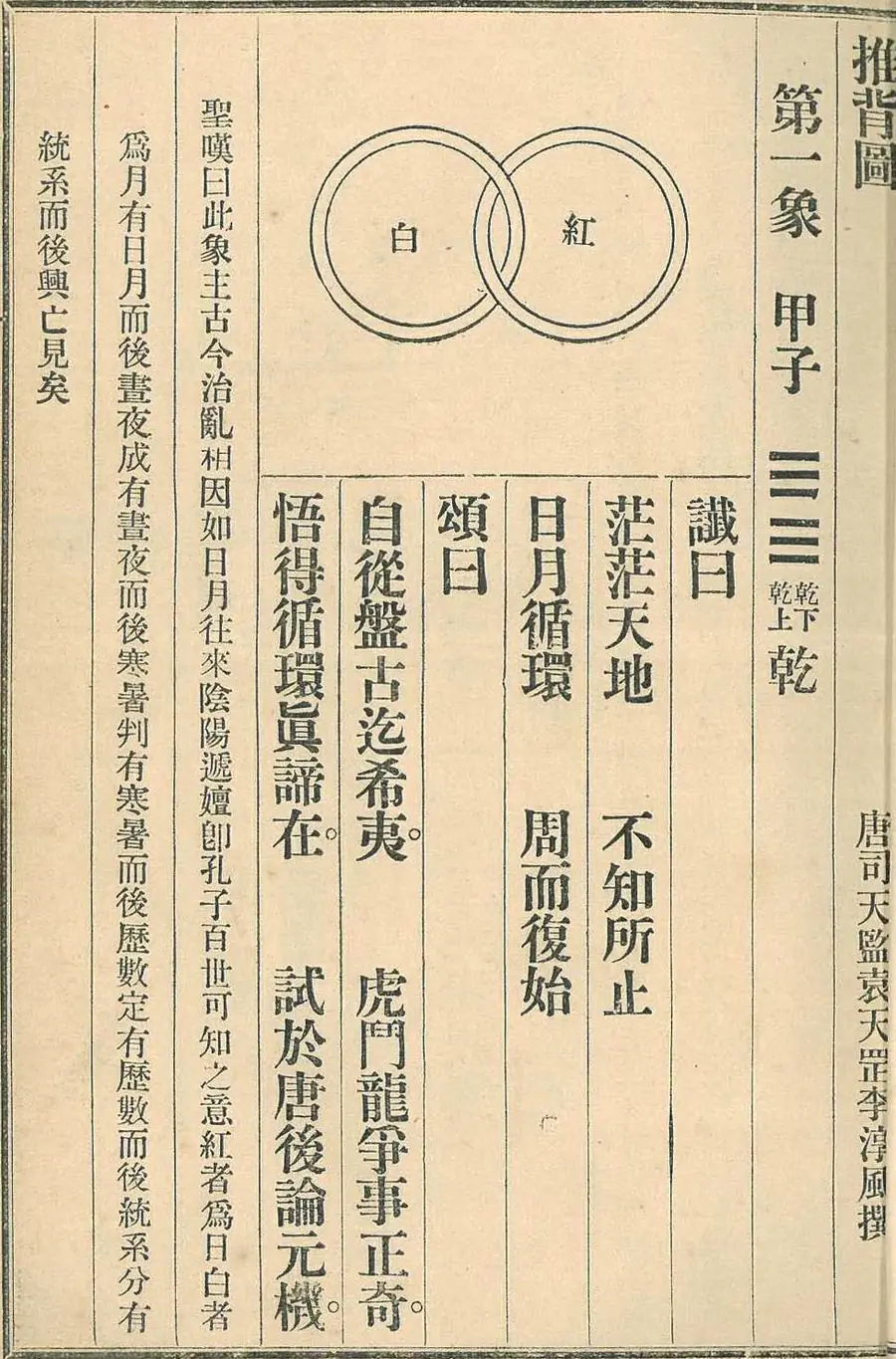
象1 of the 1915 printing. Click through for the full-size scan and the transcription of this section.
Four things are on that page. A hexagram, with its trigram gloss. A four-line verse headed 讖. A second four-line verse headed 頌. And a block of commentary in smaller type, headed 聖歎曰 — Shengtan says. Fifty-nine of the sixty leaves are built exactly this way.
象21 is the sixtieth. It carries its hexagram and both verses and then simply stops: where every other leaf has a commentary, 象21 has nothing. Not a hedge, not a shorter gloss — the page is blank where the gloss would go. It is worth naming early, because this series keeps inviting you to go and check things, and a reader who checks will find it within a minute.
Three layers, and they are not the same kind of thing
The single most useful move you can make with this book is to stop calling it one text. It is three, stacked:
| Layer | What it is | Names historical people? |
|---|---|---|
| verse (讖 + 頌) | the prophecy proper, 2,598 characters | no — 盤古 and 空王 occur and are not historical |
| printed commentary (聖歎曰) | the edition’s gloss, 2,526 characters | yes, extensively, before 象34 |
| manuscript annotation | later handwriting on this copy | yes |
Those two character counts are the whole book. The verse — every 讖 and every 頌 across sixty leaves — comes to 2,598 characters. The commentary comes to 2,526. They are almost the same size, which is itself worth noticing: roughly half of what you are reading when you read a 推背圖 is commentary on the other half.
The prophecy names nobody
Fifty historical persons are glossed across this corpus. Thirty-four of them occur literally in the printed commentary — 武曌, 安祿山, 秦檜, 黃巢, 鐵木眞, 文天祥, 陸秀夫, and on. The commentary names people constantly, and often with dates.
Two occur in the verse. They are 盤古 and 空王 — the cosmogonic first man, and an epithet of the Buddha. Neither is a historical person.
So: across the sixty leaves, the verse names no historical person at all. In this witness, then, any historical name attached to a leaf came from somewhere other than the verse — from the printed commentary, or from a layer added later. Distinguishing those layers is what the rest of this series does.
What the commentary actually sounds like
Here is a complete commentary, 象39’s, as printed. Click it to see the scan it was read from:
Shengtan says: this image, it is suspected, concerns foreign peoples fighting and throwing the Central Plain into disorder; it must reach a 酉 year before it is settled.
Twenty-three characters. One hedge (疑, it is suspected), one direction, and a date that is not a date. That is the register of the second half of this book, and articles 2 and 3 are about how it got there.
Which copy this is
Everything above is read off one physical object: the 1915 Shanghai printing of 《中國預言七種》 (Seven Chinese Prophecy Texts), printed by 進步書局 and issued by 中華書局 and 文明書局, in which 推背圖 is the second of the seven. It is the sixty-image recension carrying commentary attributed to 金聖嘆 — the attribution is what the edition claims, not something established.
The transcription, leaf by leaf with the scan beside it, is published at bookofchanges.academy/texts/tuibeitu. Every Chinese phrase quoted in this series has a dotted underline; clicking it shows you the pixels the phrase was read from, which leaf and page it sits on, and what the transcription of that column is rated. If a crop does not show what the sentence claims, you can see that immediately. That is the point of putting them there.
These are three layers. That is a claim about the page — you can see the verse, the gloss and the handwriting are distinct things, in distinct type and ink. It is not yet a claim about when any of them was written, or by whom. That question is real, it is harder than it looks, and it is the last article in this series.