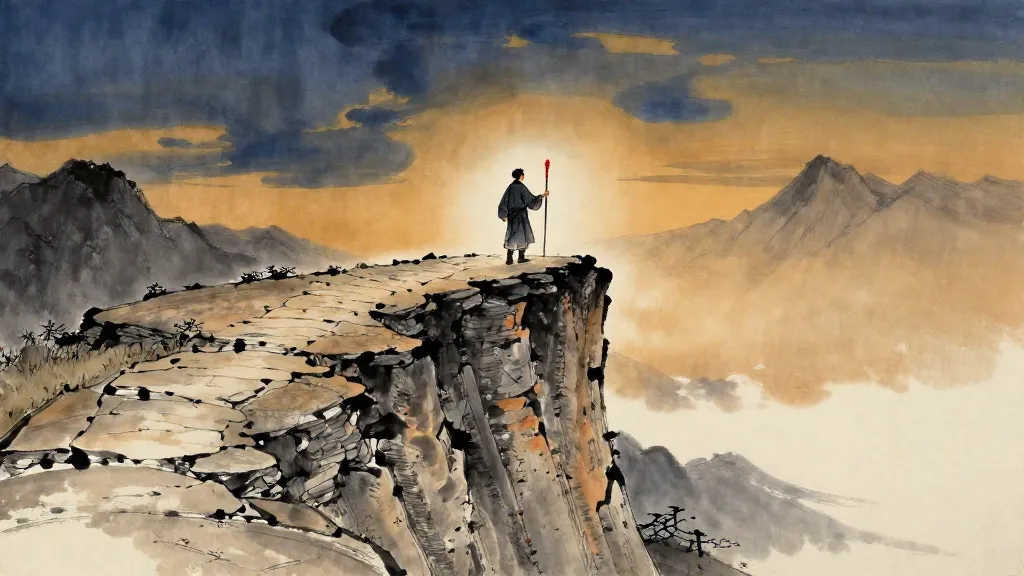
Bad Outcome, No Fault
凶 does not condemn the situation. It warns the move.
Part 6 of The Coded Language of the Changes — how inherited terms in the I-Ching function as compressed philosophical language.
The Verdict English Readers Fear
凶 (xiōng) appears fifty-eight times across the canonical text. It is the verdict English readers fear most: misfortune, calamity, doom. When it appears in a reading, the modern reader flinches. The cosmos has pronounced against them. Something terrible is coming. They are being warned, or worse, condemned.
This reading imports a frame the Changes does not use. 凶 is not a cosmic punishment. It is not a moral indictment. It is not a forecast of catastrophe. It is a structural assessment: the configuration tends toward loss for this move.
The Xici (繫辭 xì cí) defines the pair directly:
吉凶者,言乎其失得也。
“Auspicious and inauspicious speak of loss and gain.”
失得 (shī dé) — loss and gain — is the structural register. 凶 is “loss” in the configuration sense: the structure is oriented toward loss for this action. Not punishment. Not cosmic displeasure. Loss in the configuration. The same chapter adds:
吉凶悔吝者,生乎動。
“Auspicious, inauspicious, regret, chagrin: these are born from action.”
Born from action — 生乎動 (shēng hū dòng). The adverse verdict is not pre-assigned to the actor. It is generated by the relationship between a move and the configuration. Without the move, there is no 凶. The doom reading requires a pre-existing cosmic disposition against the reader. The structural reading requires only an action in a configuration that does not support it.
凶 Attaches to the Move
The dominant grammatical form of 凶 in the corpus is action-conditioned: 征凶 (zhēng xiōng, “advancing: inauspicious”). The adverse verdict is explicitly conditional on a specific move. If you take this action-path, the trajectory is adverse. If you do not take it, the verdict may not apply.
This is the corpus's primary evidence that 凶 is a structural projection, not a static state. A curse does not care whether you advance or hold still. A structural verdict does. The distinction is simple and consistent: 凶 binds to the move, not the situation.
Consider the judgment of Hexagram 6 (訟 sòng, Conflict), which ends 終凶 (zhōng xiōng, “in the end: inauspicious”). The adverse trajectory resolves at the end of the arc, not at the outset. The moment is not statically cursed. The arc, if pursued to its conclusion, tends toward loss. This is a temporal assessment, not a cosmic one.
Misfortune Without Blame
The first article in this series introduced a line that carries both 凶 and 无咎 simultaneously. We return to it now from the other side — not to explain 无咎, but to explain 凶.
The top line of Hexagram 28 (大過 dà guò, Great Exceeding):
過涉滅頂,凶。無咎。
“Crossing over submerges the head. Misfortune. No misstep.”
凶 and 无咎 in the same clause, the same act. The outcome is adverse. The actor has not committed a fault. These are independent assessments. The world can go badly without you being wrong.
This is the inverse of Part 1's argument. Part 1 showed that 无咎 is not acquittal. This article shows that 凶 is not indictment. The two are structural mirrors: one strips the moral comfort from no-blame; the other strips the moral condemnation from misfortune. Together they establish that the Changes is not in the business of judging the reader at all.
When Action and Position Diverge
The second and final line in the corpus that pairs 凶 with 无咎 is the top line of Hexagram 51 (震 zhèn, Thunder):
震索索,視矍矍,征凶。震不于其躬,于其鄰,無咎。
“The shock: scattering, scattering. Looking: alarmed, alarmed. Advancing: inauspicious. The shock is not centered on oneself — on one's neighbor. No blame.”
This line separates 凶 and 无咎 by scope rather than by direct juxtaposition. The adverse verdict attaches to the action (征凶: advancing is inauspicious). The no-fault verdict attaches to a positional condition (the shock landing on the neighbor rather than on oneself). Two different structural targets within the same moment. 凶 binds to the move; 无咎 binds to where the shock lands.
Across the entire corpus, only these two lines contain both 凶 and 无咎. This is not an anecdotal finding — it is the complete set. The book goes to the trouble of pairing them exactly twice, and in two structurally distinct ways: once by direct juxtaposition (H28.6), once by split scope (H51.6). That the text makes this separation explicit in exactly two different ways is evidence that the system is deliberate. It does not casually mix misfortune and blame. When it needs to separate them, it does so with precision.
凶 Is Not 咎
The critical distinction the English reader misses: 凶 and 咎 (jiù) are different verdicts entirely.
| Term | What it evaluates | Register |
|---|---|---|
| 凶 | Trajectory of the move | Structural — tends toward loss |
| 咎 | Relation of actor to configuration | Positional — the move is a misstep |
You can be issued 凶 without 咎. The trajectory can be adverse without the actor being wrong. H28.6 proves this directly: the crossing submerges the head (凶), but the crossing was not a misstep (无咎). The English reader who hears “misfortune” and assumes they did something wrong has collapsed two independent assessments into one.
The Four Adverse Verdicts
English collapses all negative signals into “bad.” The book does not. The full adverse-verdict vocabulary:
| Term | Count | Type of adverse signal |
|---|---|---|
| 凶 (xiōng) | 58 | Adverse trajectory — tends toward loss |
| 悔 (huǐ) | 34 | Small misalignment — correctable deviation |
| 厲 (lì) | 27 | Precarious position — footing unstable |
| 吝 (lìn) | 20 | Friction / stuckness — options narrowed |
凶 is the only one of these that describes an outcome trajectory. 悔 describes a corrective signal. 厲 describes a position. 吝 describes an option-space. They are four different kinds of difficulty, four different structural assessments, and the book issues them separately because they mean different things. A reader who reads 凶 and feels “doom” has heard the wrong kind of bad news. The news is structural: the move is shaped to lose. The position may still be correct. The actor may still be without fault. The difficulty may still be recoverable.
What to Carry Away
When you encounter 凶 in a reading, notice what it binds to. Is it 征凶 — the adverse verdict on advancing specifically? Is it 貞凶 — the adverse verdict on holding-fast? The complement tells you what action-path the system is warning against. The warning is structural: if you proceed along this path, the configuration tends toward loss.
凶 is not a curse. It is not doom. It is not a judgment on your character. It is a mapping from configuration to consequence — and the mapping can be read, respected, and navigated. The world can go badly without you being wrong. The Changes says so twice, and both times to prove the same point.