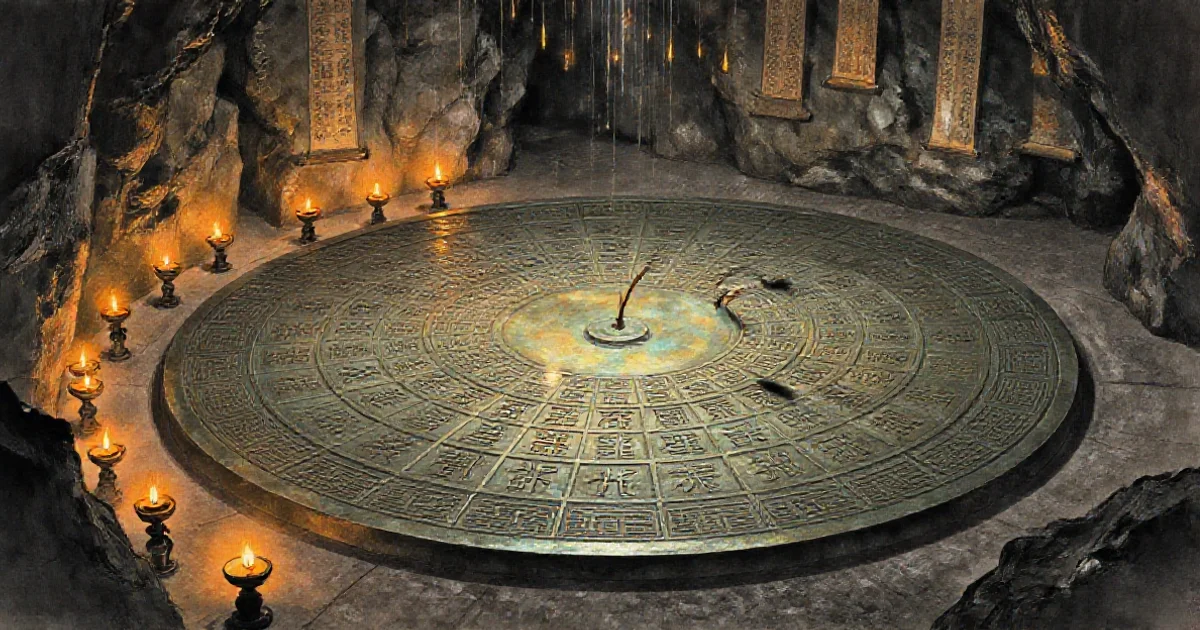
The Sixty Jiazi and the Nayin
Sixty stem-branch pairs cycle through time. Each carries an elemental signature—the Nayin—that the Sanming Tonghui treats as the first layer of any reading. The cycle, the pairings, and what they encode.
Chinese Divination Systems series, Part 2
The Sixty Pairs
Ten Heavenly Stems multiplied by twelve Earthly Branches should produce 120 combinations. In practice the system yields only 60, because yang stems pair exclusively with yang branches and yin stems with yin branches. 甲 (yang wood) pairs with 子 (yang water), 乙 (yin wood) with 丑 (yin earth), and so on. Yang never meets yin across the stem-branch join. Half the theoretical space is structurally forbidden.
The resulting sixty pairs form the Jiazi (甲子) cycle, named after its first entry. Every year, month, day, and double-hour in the Chinese calendar is expressed as one of these sixty pairs. The cycle takes sixty years to complete a full revolution. A person who lives to see their birth-year pair return has completed one Jiazi—the traditional marker of a full life.
The four pillars of a Bazi chart are four of these sixty pairs, one each for the year, month, day, and hour of birth. The entire system of Four Pillars fate calculation operates within this closed set of sixty.
The Nayin: Sound into Element
Each pair of consecutive Jiazi entries shares a Nayin (納音) element. 甲子 and 乙丑 are both “Gold in the Sea” (海中金). 丙寅 and 丁卯 are both “Fire in the Furnace” (爐中火). There are thirty Nayin pairings total, not sixty—each covering one yang-yin couplet within the cycle.
The Nayin derives from musical pitch-pipe theory (律呂). The word itself means “absorbed sound”—the element that a stem-branch pair absorbs when mapped onto the twelve-tone system. The Sanming Tonghui explains the derivation by analogy to the Yijing's Najia method:
嘗觀《筆談》論六十甲子納音,本六十律,鏇相為宮,法也。納音與《易》納甲同法:乾納甲、坤納癸,始於乾而終於坤。納音始於金,金,乾也,終於土,土,坤也。五行之中,惟有金鑄而為器,則音響彰,納音所以先金。
— 《三命通會》卷一,總論納音
The passage states that Nayin follows the same structural logic as the Yijing's assignment of stems to trigrams: Qian absorbs Jia, Kun absorbs Gui, beginning with Qian and ending with Kun. Nayin begins with Metal because Metal, when cast into an instrument, produces audible sound—it is the element whose nature is most sonorous. The sequence runs from Metal (Qian, the creative) to Earth (Kun, the receptive), mapping the Five Phases onto the same cosmological arc.
The Complete Nayin Table
The thirty pairings, grouped by element. Each row shows the stem-branch pair, the Nayin image in Chinese, and its English translation.
Metal (金)
| Pair | Nayin | Image |
|---|---|---|
| 甲子 乙丑 | 海中金 | Gold in the Sea |
| 壬寅 癸卯 | 金泊金 | Gold Foil Metal |
| 庚辰 辛巳 | 白蠟金 | White Wax Metal |
| 甲午 乙未 | 沙中金 | Gold in the Sand |
| 壬申 癸酉 | 劍鋒金 | Sword-Edge Metal |
| 庚戌 辛亥 | 釵釧金 | Hairpin Metal |
Wood (木)
| Pair | Nayin | Image |
|---|---|---|
| 壬子 癸丑 | 桑柘木 | Mulberry Wood |
| 庚寅 辛卯 | 松柏木 | Pine and Cypress Wood |
| 戊辰 己巳 | 大林木 | Great Forest Wood |
| 壬午 癸未 | 楊柳木 | Willow Wood |
| 庚申 辛酉 | 石榴木 | Pomegranate Wood |
| 戊戌 己亥 | 平地木 | Flatland Wood |
Water (水)
| Pair | Nayin | Image |
|---|---|---|
| 丙子 丁丑 | 澗下水 | Water beneath the Ravine |
| 甲寅 乙卯 | 大溪水 | Great Stream Water |
| 壬辰 癸巳 | 長流水 | Ever-Flowing Water |
| 丙午 丁未 | 天河水 | Heavenly River Water |
| 甲申 乙酉 | 井泉水 | Well Spring Water |
| 壬戌 癸亥 | 大海水 | Great Sea Water |
Fire (火)
| Pair | Nayin | Image |
|---|---|---|
| 戊子 己丑 | 霹靂火 | Thunderbolt Fire |
| 丙寅 丁卯 | 爐中火 | Fire in the Furnace |
| 甲辰 乙巳 | 覆燈火 | Lantern Fire |
| 戊午 己未 | 天上火 | Heavenly Fire |
| 丙申 丁酉 | 山下火 | Fire beneath the Mountain |
| 甲戌 乙亥 | 山頭火 | Fire atop the Mountain |
Earth (土)
| Pair | Nayin | Image |
|---|---|---|
| 庚子 辛丑 | 壁上土 | Earth on the Wall |
| 戊寅 己卯 | 城頭土 | Earth atop the Rampart |
| 丙辰 丁巳 | 沙中土 | Earth in the Sand |
| 庚午 辛未 | 路旁土 | Roadside Earth |
| 戊申 己酉 | 大驛土 | Great Post-Road Earth |
| 丙戌 丁亥 | 屋上土 | Earth on the Roof |
Why the Images Matter
The Nayin images are not arbitrary labels. The Sanming Tonghui explains them through a life-cycle logic mapped onto the twelve Earthly Branches:
子醜二位,陰陽始孕,人在胞胎,物藏根,未有涯際;寅卯二位,陰陽漸開,人漸生長...辰巳二位,陰陽氣盛,物當華秀...午未二位,陰陽彰露,物已成齊...申酉二位,陰陽肅殺,物已收成...戌亥二位,陰陽閉塞,物氣歸根...
— 《三命通會》卷一,論納音取象
The twelve branches map to a human lifespan. 子丑 is conception and gestation—yin and yang first merging, the person still in the womb, things hidden at the root with no definite form. 寅卯 is gradual growth. 辰巳 is flourishing maturity. 午未 is full manifestation. 申酉 is autumn harvest and decline. 戌亥 is closure and return to the root.
The Nayin image for each pair reflects the state of its element at that particular life stage. Take Metal through the cycle:
At 子丑, Metal is embryonic—hidden, unformed, submerged beneath the waters of gestation. Hence 海中金, Gold in the Sea. The metal exists, but it has not yet been extracted or shaped. It is potential without form.
At 寅卯, Metal is in early growth—thin, delicate, newly emerged. Hence 金泊金, Gold Foil Metal. Leaf-thin, decorative, not yet strong enough to cut or bear weight.
At 辰巳, Metal is gaining substance but still pale and soft. Hence 白蠟金, White Wax Metal—lustrous but not yet tempered.
At 午未, Metal is fully manifest but still embedded in its matrix. Hence 沙中金, Gold in the Sand—present and real, waiting to be sifted out.
At 申酉, Metal reaches its mature peak. 申 and 酉 are Metal's own native branches—this is the element in its home season, at maximum strength. Hence 劍鋒金, Sword-Edge Metal. Forged, tempered, lethal. The sharpest expression of Metal's nature.
At 戌亥, Metal is in retirement. The cutting edge is past. What remains is ornamental, refined, no longer functional as a weapon. Hence 釵釧金, Hairpin Metal—elegant jewelry, beautiful but no longer dangerous.
The same life-cycle logic applies to every element. Wood at 子丑 is the humble mulberry (桑柘木); at 辰巳 it is the great forest (大林木); at 戌亥 it is flatland scrub (平地木). Fire at 子丑 is a thunderbolt (霹靂火)—sudden, violent, brief; at 午未 it is the sun itself (天上火). The images are a mnemonic system encoding the element's strength and character at each stage of its life.
Nayin and the Ziping Method
The status of Nayin within serious Bazi practice is contested. Ren Tieqiao (任鐵樵), the most influential Qing dynasty commentator, explicitly dismisses it. In his commentary on the Ditiansu, he groups Nayin with spirit stars and exotic named formats as fabrications unrelated to actual fate mechanics:
至於奇格異局,神煞納音諸名目,乃好事妄造,非關命理休咎。
— 任鐵樵,《滴天髓闡微》知命
“As for exotic formats, spirit stars, Nayin, and other such labels—these are fabrications by the enthusiastic, unrelated to the actual workings of fate.”
But the Sanming Tonghui, compiled two centuries earlier by Wan Minying, devotes its entire first volume to Nayin theory. The derivation from pitch-pipe acoustics, the life-cycle logic of the images, the element-by-element analysis—all receive extensive, systematic treatment. For Wan Minying, Nayin is not folklore. It is foundational.
The tension is real and unresolved. The rationalist Ziping tradition, as articulated by Ren Tieqiao, treats the Four Pillars and Five Phases as the complete system—everything else is noise. The encyclopedic tradition, as represented by the Sanming Tonghui, preserves Nayin as a distinct layer of interpretation that predates and operates independently from the Ten Gods framework. In popular practice, Nayin remains widely used, particularly for quick year-based assessments. The debate between these approaches runs through the entire history of Chinese fate calculation.
What Comes Next
The Nayin gives each pillar an elemental image—a poetic shorthand for the quality of the element at a particular life stage. But the core engine of the Ziping method operates on a different axis: the relationship between each element in the chart and the Day Master. Those relationships are formalized as the Ten Gods—the subject of the next article in this series.