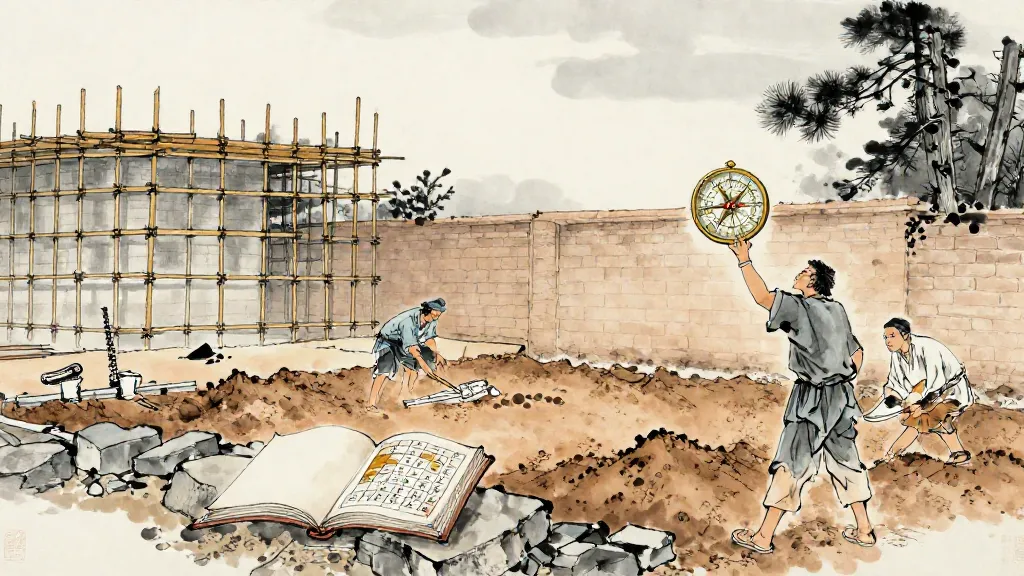
Breaking Ground: What the Imperial Almanac Says About Construction
Seven construction activities, each with its own list of approved and forbidden days. The system isn't mystical—it's a scheduling protocol built around one central fear: disturbing the earth at the wrong time.
Part 1 of The 67 Imperial Activities — what the Xieji Bianfang Shu actually says about each activity.
You're About to Put a Shovel in the Ground
Say you're building a house. Not in the metaphorical sense—literally building one. You've got the site, the materials, the crew. The question is: when do you start?
If you asked this question in 18th-century China, you wouldn't get a shrug. You'd get a system. The Xieji Bianfang Shu (欽定協紀辨方書), compiled under Emperor Qianlong in 1739, dedicates two full volumes—juan 11 and 12—to listing every activity that requires date selection, along with the precise astronomical conditions that make a day suitable or forbidden for each one. The text identifies 67 distinct activities across imperial, civil, and agricultural life. Seven of those activities form a construction cluster.
Those seven are: 興造動土 (breaking ground), 修造 (renovation), 營建宮室 (building residences), 豎柱上梁 (raising pillars and beams), 繕城郭 (repairing city walls), 築隄防 (building dikes), and 修倉庫 (repairing storehouses). They range from the foundational act of turning soil to the structural milestone of setting a roof beam. And they share a pattern that, once you see it, explains most of what the almanac is doing.
The Construction Cluster
The first thing you notice is that 興造動土 (breaking ground) and 修造 (renovation/construction) are treated as identical. The text says it in two characters:
興造動土——修造同
"Breaking ground for construction—same as renovation."
That's it. No additional rules, no special cases. If you're starting new construction or renovating an existing structure, the same days apply. This kind of compression is typical of the Xieji Bianfang Shu: the editors aren't interested in proliferating categories. They consolidate wherever the underlying logic is the same.
Next, 營建宮室 (building residences). Here the text provides a full specification:
營建宮室
宜天德、月德、天德合、月德合、天赦、天願
忌月建、土府、月破、平日、收日、閉日、劫煞、災煞、月煞、月刑、月厭、大時、天吏、四廢、五墓、土符、地囊、土王用事
Suitable: Heavenly Virtue, Monthly Virtue, their combinations, Heavenly Pardon, Heavenly Wish. Taboo: Month Builder, Earth Treasury, Month Breaker, Balance Day, Receive Day, Close Day, plus twelve more conflict stars—including four earth-specific ones.
Six suitable stars. Eighteen taboo conditions. The ratio alone tells you something: in the almanac's logic, construction is high-risk. There are far more ways to choose the wrong day than the right one.
The Earth Taboos
Here's what people miss. Scan the taboo lists across all seven construction activities, and four items appear everywhere: 土府 (Earth Treasury), 土符 (Earth Talisman), 地囊 (Earth Sac), and 土王用事 (Earth Phase in Effect). These are earth-spirit taboos. They show up in 營建宮室, 修宮室, 繕城郭, 築隄防, 豎柱上梁, and 修倉庫. No construction activity escapes them.
土王用事 is the most interesting. It refers to the 18-day period before each seasonal transition when the Earth phase dominates the five-phase cycle. There are four such periods per year—one before each season change—for a total of 72 days when the earth is considered active and sensitive. During these periods, you don't dig. You don't break ground. You don't pour foundations.
This is not a superstition about angry earth gods. It's a scheduling constraint derived from five-phase cosmology. In the five-phase model, each element governs a season: wood governs spring, fire governs summer, metal governs autumn, water governs winter. But earth doesn't have its own season. Instead, it occupies the transitional periods between seasons. During these transitions, the earth is understood to be in flux—and you don't start a construction project on unstable ground.
The practical effect: roughly 20% of the year is automatically excluded from construction starts, before you even check for other conflicts.
Raising the Roof
豎柱上梁 (raising pillars and setting beams) gets its own entry because it represents the structural milestone of a building project. In traditional Chinese construction, the moment the main beam is set atop the pillars marks the transition from framework to enclosure. It was celebrated with ceremony. And the almanac treats it with corresponding seriousness.
豎柱上梁
宜天德、月德、天德合、月德合、天赦、天願、月恩、四相、時德、三合、開日
忌月建、土府、月破、平日、收日、閉日、劫煞、災煞、月煞、月刑、月厭、大時、天吏、四廢、五墓、土符、地囊、土王用事
Eleven suitable conditions. Eighteen taboo conditions. Notice something: the suitable list for raising beams is nearly twice as long as for building residences. The text adds 月恩 (Monthly Grace), 四相 (Four Phases), 時德 (Seasonal Virtue), 三合 (Triple Harmony), and 開日 (Open Day). The almanac is more generous here—more days qualify—because beam-raising is a completion event, not an initiation event. Starting is riskier than continuing.
Infrastructure: Walls, Dikes, Storehouses
The remaining three activities serve the state rather than individual households. 繕城郭 (repairing city walls) has the same earth taboos but a generous suitable list that includes 福德 (Fortune Virtue):
繕城郭
宜天德、月德、天德合、月德合、天赦、天願、月恩、四相、時德、三合、福德、開日
築隄防 (building dikes and embankments) is striking for its brevity. Only two days qualify:
築隄防
宜成日、閉日
Suitable: Completion Day, Close Day.
成日 (Completion) and 閉日 (Close)—both from the Jianchu twelve-day officer cycle—are about finishing and sealing. Dike construction is pure containment: you're building something whose entire purpose is to hold things in or keep things out. The almanac selects days whose character matches the function. This is not random. It's correspondence logic applied to scheduling.
修倉庫 (repairing storehouses) introduces a different vocabulary. Its taboo list adds financial-loss stars absent from other construction activities: 大耗 (Great Depletion), 天賊 (Heavenly Thief), 四耗 (Four Depletions), 四窮 (Four Poverty). Storehouses hold grain and goods. The almanac knows the difference between a wall and a vault.
修倉庫
宜天德、月德、天德合、月德合、天赦、天願、三合、滿日
又牧日、母倉、六合、五富、天倉
Primary suitable: virtue stars, Triple Harmony, Full Day. Additional suitable: Pasture Day, Mother Granary, Six Harmonies, Five Abundances, Heavenly Granary—when they coincide with the primary suitable conditions.
That conditional clause—"when they coincide" (日併者)—is a refinement. The secondary suitable stars don't work alone. They amplify a day that already qualifies under the primary list. The almanac is layering criteria, not just listing them.
The System Beneath the Lists
Step back and look at all seven activities together, and the system's logic becomes clear.
Initiation activities have shorter suitable lists. Breaking ground and building residences get only 6 suitable conditions. Beam-raising gets 11. Wall repair and storehouse repair get 8–12. Starting something new is harder to schedule than continuing or completing it.
Earth taboos are non-negotiable. Every construction activity that touches the ground shares 土府, 土符, 地囊, and 土王用事. These are the system's hard constraints. No amount of favorable stars overrides an active earth conflict.
Function determines taboo vocabulary. Building a wall and repairing a storehouse involve different risks—structural failure versus financial loss—and the almanac assigns different taboo stars accordingly. The system distinguishes between physical construction and economic infrastructure.
Compression is a feature. The editors of the Xieji Bianfang Shu don't waste entries. When two activities share the same logic, they say "same" (同) and move on. When an activity has no specifically suitable days, the closing commentary clarifies: "Apart from the taboo days, every day is suitable" (無宜日除所忌之外無日不宜也). This is an editorial team that valued precision over exhaustiveness.
Why This Is Not What You Think It Is
The modern instinct is to read almanac construction rules as superstition: people were afraid of ghosts in the dirt, so they picked "lucky days" to avoid them. That reading is wrong in a specific way.
The Xieji Bianfang Shu is not a folk almanac. It was compiled by a team of court astronomers and five-phase specialists under imperial commission, precisely because the folk almanacs were full of contradictions. The emperor's preface frames the project as reducing "all the practitioners' unfounded, cumbersome, and contradictory theories" to the rational core of "the four seasons, the five phases, generation and conquest, flourishing and decline" (舉術家附會不經、繁碎多礙之說,一訂以四時五行生克衰旺之理).
What you're looking at is a scheduling system built on correspondence logic. Certain astronomical configurations create conditions that correspond to certain activities. Earth-phase transitions correspond to earth-disturbing work. Completion-type day officers correspond to containment-type projects. Wealth-loss stars correspond to wealth-storage facilities.
You don't have to believe in the correspondence to see that the system is internally consistent. And internal consistency is exactly what the Qianlong editors were after.
What Six Lines Does With This
Six Lines implements the Xieji Bianfang Shu's activity system as part of its daily almanac feature. When the app tells you a day is suitable or unsuitable for construction, it's checking exactly these star conditions against the astronomical data for that date. Not a simplified score. Not a popularity-based rating. The original rules from the 1739 text, applied to today's calendar.
The construction cluster is the first of several activity groups we'll walk through in this series. Next: marriage activities—where the suitable lists get longer and the taboos get personal.
References
Primary Source
欽定協紀辨方書 (Qinding Xieji Bianfang Shu), juan 11: 用事 (Activities). Compiled under Emperor Qianlong, 1739. Siku Quanshu edition.
Construction Activities Referenced
興造動土 (Breaking Ground) · 修造 (Renovation) · 營建宮室 (Building Residences) · 豎柱上梁 (Raising Pillars and Beams) · 繕城郭 (Repairing City Walls) · 築隄防 (Building Dikes) · 修倉庫 (Repairing Storehouses)
All extracted from juan 11, folios 17–19, pages 35–39 of the Siku Quanshu manuscript copy.