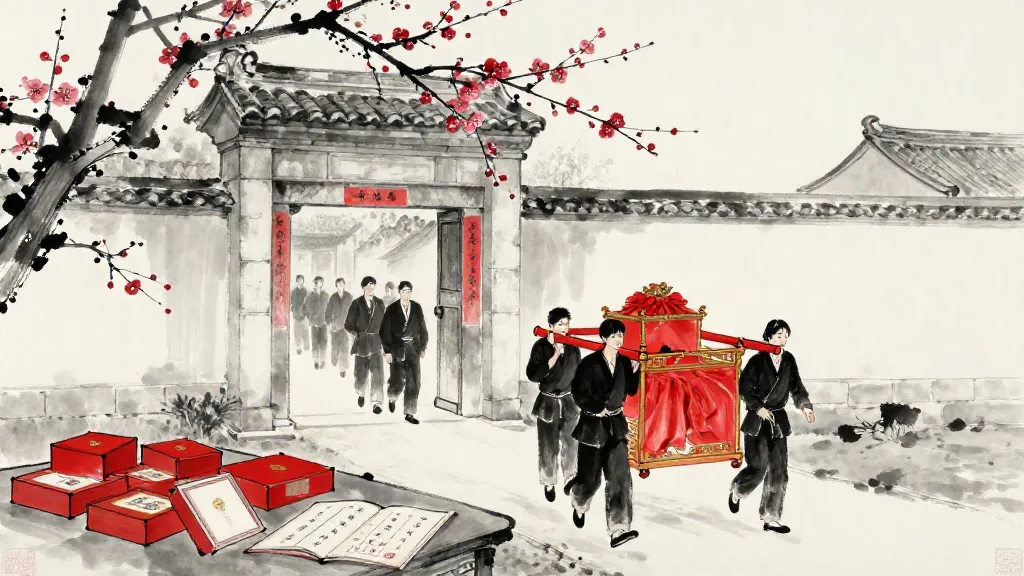
The Six Rites: What the Imperial Almanac Says About Marriage
Six stages of marriage, from the first gift to the wedding day. Each stage has its own list of suitable and forbidden stars. The system treats marriage not as a single event but as a negotiation between two families and the calendar.
Part 2 of The 67 Imperial Activities — what the Xieji Bianfang Shu actually says about each activity.
Picking the Date
You're getting married. Or more precisely: your family is arranging a marriage. You've got a prospective partner, the families have talked, things are moving forward. The question everyone's asking isn't "what color should the invitations be?"—it's "what day do we send the betrothal gifts?"
This is not a hypothetical from ancient history. Walk into any date-selection practitioner's office in Hong Kong, Taipei, or Singapore today, and the most common request is still: pick a wedding date. The practitioner opens the almanac. And if they're using a classical source—not a simplified app, not a crowd-sourced rating—they're looking at rules that trace back to the Xieji Bianfang Shu, compiled under Emperor Qianlong in 1739.
The marriage section of the Xieji Bianfang Shu covers four distinct activities across three entries: 結婚姻 (forming the marriage alliance), 納采問名 (betrothal gifts and exchanging birth data), and 嫁娶 (the wedding itself). Together they constitute the almanac's framework for the traditional Six Rites of Marriage—六禮—the sequence that governed Chinese matrimony for over two thousand years.
The Six Rites, Briefly
The Six Rites (六禮) are: 納采 (presenting betrothal gifts), 問名 (inquiring the bride's name and birth data for divination), 納吉 (announcing that the match is auspicious), 納徵 (delivering the formal engagement gifts), 請期 (requesting and setting the wedding date), and 親迎 (the groom personally receiving the bride). These six steps take what might otherwise be a private arrangement and turn it into a calendrically regulated process.
The Xieji Bianfang Shu doesn't list all six as separate activities. It compresses. 納采 and 問名 are combined into a single entry—納采問名—because the almanac considers them calendrically identical: same suitable stars, same taboo stars, same day-selection logic. The wedding ceremony itself is 嫁娶. And the overarching category of establishing the marriage agreement is 結婚姻. The remaining rites—納吉, 納徵, 請期—fall under the umbrella of 結婚姻 as sub-stages of the formal agreement process.
This compression is characteristic. The editors don't multiply categories when the underlying astronomical conditions are the same. They consolidate, note the equivalences, and move on.
Forming the Alliance: 結婚姻
結婚姻 is the broadest marriage activity. It covers the formal agreement between families—the point at which two households commit to a union. The suitable star list reads like a social harmony checklist:
結婚姻
宜天德、月德、天德合、月德合、天赦、天願、月恩、四相、時德、民日、三合、天喜、六合、五合
Suitable: Heavenly Virtue, Monthly Virtue, their combinations, Heavenly Pardon, Heavenly Wish, Monthly Grace, Four Phases, Seasonal Virtue, People's Day, Triple Harmony, Heavenly Joy, Six Harmonies, Five Harmonies.
Fourteen suitable conditions. Compare that to the construction cluster, where building residences got only six. Marriage gets more than twice as many qualifying days. The system is being generous here, and the reason is embedded in the star names themselves.
Look at what shows up: 民日 (People's Day), 三合 (Triple Harmony), 六合 (Six Harmonies), 五合 (Five Harmonies). These are all union stars—stars whose character is about bringing things together, combining, harmonizing. 天喜 (Heavenly Joy) is the celebration star. The almanac is matching the nature of the activity to the character of the astronomical configuration. Marriage is about joining. The suitable days are days whose essential quality is conjunction.
Betrothal and Name Exchange: 納采問名
納采問名 combines two steps: sending the initial betrothal gifts (納采) and formally requesting the bride's name and birth data (問名) so that compatibility divination can be performed. In practice, these two steps often happened on the same day or in quick succession, and the almanac treats them as one.
納采問名
宜天德、月德、天德合、月德合、天赦、天願、月恩、四相、時德、民日、三合、天喜
忌月建、月破、平日、收日、滿日、閉日、劫煞、災煞、月煞、月刑、月害、月厭、大時、天吏、四廢、四忌、四窮、五墓、五離
Twelve suitable stars. Nineteen taboo conditions. Plus 八專 as a special prohibition.
The suitable list drops 六合 and 五合 compared to 結婚姻. Those two harmony stars apply to the general marriage agreement but not to the specific step of exchanging gifts and birth data. The reduction is subtle but deliberate: 納采問名 is a preliminary step, not the union itself.
The taboo list is where it gets interesting. Nineteen conditions—and they include items that never appear in construction taboos. 四忌 (Four Taboos), 四窮 (Four Poverty), 五離 (Five Separations). That last one is the most telling: 五離, "Five Separations," is naturally forbidden for any activity whose purpose is to bring two things together. You don't begin a union on a separation day.
月害 (Monthly Harm) also shows up here but is absent from most construction taboos. 月害 specifically governs interpersonal conflict—it's about relationships going wrong. The almanac reserves it for activities that involve human bonds.
The 八專 Problem
Both 納采問名 and 嫁娶 flag 八專 (Eight Monopoly) as a special taboo. This is worth pausing on because 八專 is one of the more unusual prohibitions in the entire almanac system.
八專 days occur when the Heavenly Stem and Earthly Branch of a day share the same yin-yang polarity and the same five-phase element. The result is a day dominated by a single energy—no complementary balance. In the context of marriage, this is a problem. Marriage is fundamentally about the union of yin and yang, male and female, two different families becoming one. A day that is all-yang or all-yin lacks the complementary dynamic that marriage requires.
八專 doesn't appear in construction taboos. It doesn't appear in military taboos. It is specifically a marriage prohibition—because the imbalance it represents directly contradicts the nature of what marriage is supposed to achieve. The system doesn't just check a list of generically bad days. It checks whether the character of the day conflicts with the character of the activity.
The Wedding: 嫁娶
嫁娶—the actual wedding ceremony, the day the bride leaves her family and enters the groom's household—has the most specific star profile of all three marriage activities.
嫁娶
宜天德、月德、天德合、月德合、天赦、天願、三合、天喜、六合、不將
忌月破、平日、收日、閉日、劫煞、災煞、月煞、月刑、月害、月厭、厭對、大時、天吏、四廢、四忌、四窮、五墓、往亡、八專
Ten suitable stars. Nineteen taboo conditions. But look at what changed.
The suitable list drops 月恩 (Monthly Grace), 四相 (Four Phases), 時德 (Seasonal Virtue), and 民日 (People's Day), which were present for the betrothal stage. But it adds 不將 (Bu Jiang, literally "No Generals")—a star that appears nowhere else in the entire 67-activity system. 不將 is exclusively a wedding star. It indicates a day free from martial influence, favorable for conjugal harmony. On a 不將 day, the aggressive yang energy associated with military command is absent, creating conditions suited to the domestic union.
On the taboo side, 嫁娶 adds two items not found in 納采問名: 厭對 (Aversion Opposition) and 往亡 (Going to Extinction). 厭對 specifically represents opposition between partners—an anti-marriage star by definition. 往亡 is the "going toward death" star, inauspicious for anything meant to begin.
And notice what's missing from the taboo list: 月建 (Month Builder), 滿日 (Full Day), and 五離 (Five Separations) are taboo for 納采問名 but not for 嫁娶. The wedding ceremony has a slightly different risk profile than the betrothal. 月建 is about initiating something under the full weight of the month ruler—a concern for beginning a process, less so for completing one. The wedding is the culmination, not the start.
The System's Logic
Step back and compare all three marriage entries, and the pattern emerges.
The general agreement has the most suitable days. 結婚姻 gets fourteen suitable conditions. 納采問名 gets twelve. 嫁娶 gets ten. As the activity becomes more specific and consequential, the system becomes more selective. Committing in principle is easier to schedule than executing the ceremony.
Harmony stars dominate the suitable lists. 三合, 六合, 五合, 天喜—these are stars of conjunction, combination, joy. Construction suitable lists are led by virtue stars (天德, 月德). Marriage suitable lists are led by harmony stars. The system matches star character to activity character.
Relationship-specific taboos appear only here. 八專 (yin-yang imbalance), 厭對 (partner opposition), 五離 (separation), 月害 (interpersonal harm)—none of these show up in construction or military activities. The almanac maintains distinct taboo vocabularies for distinct risk domains. What can go wrong with a building is not what can go wrong with a marriage.
Unique stars exist for unique activities. 不將 appears only for 嫁娶. It was designed for weddings and nothing else. This is not a generic system applying generic rules. It is a system that has thought specifically about what makes a wedding day different from every other kind of day.
What People Get Wrong
The modern reading of almanac wedding dates usually goes like this: "People in ancient China picked lucky days for weddings because they were superstitious." This flattens something that is actually quite structured.
The Xieji Bianfang Shu doesn't identify "lucky days." It identifies days whose astronomical character corresponds to the requirements of a specific activity. A marriage needs harmony—so the system checks for harmony stars. A marriage needs balanced yin-yang—so the system excludes 八專 days. A wedding needs an absence of martial energy—so the system provides 不將.
Each rule is a correspondence claim: this configuration matches (or conflicts with) this activity. You can reject the correspondence framework entirely—plenty of people do—but you can't call it random. The internal consistency is precise enough that each marriage stage gets its own calibrated star profile, different from the others by exactly the features that distinguish those stages from each other.
What Six Lines Does With This
Six Lines implements these marriage activity rules as part of its daily almanac. When the app evaluates whether a day is suitable for marriage-related activities, it checks each stage independently: 結婚姻, 納采問名, and 嫁娶 can return different results for the same day because they have different star profiles. A day might be fine for sending betrothal gifts but not for the wedding ceremony itself.
This is the kind of granularity that most almanac apps flatten. They give you a single "marriage: good/bad" rating. The classical source distinguishes three levels. Six Lines preserves that distinction.
Next in this series: burial activities—where the taboo lists get even longer and the earth spirits return.
References
Primary Source
欽定協紀辨方書 (Qinding Xieji Bianfang Shu), juan 11: 用事 (Activities). Compiled under Emperor Qianlong, 1739. Siku Quanshu edition.
Marriage Activities Referenced
結婚姻 (Forming Marriage Alliances) · 納采問名 (Betrothal Gifts and Name Exchange) · 嫁娶 (Marriage Ceremony)
All extracted from juan 11, folios 13–14, pages 27–29 of the Siku Quanshu manuscript copy.
The Six Rites (六禮)
納采 (Betrothal Gifts) · 問名 (Name Exchange) · 納吉 (Announcing the Match) · 納徵 (Engagement Gifts) · 請期 (Setting the Date) · 親迎 (Receiving the Bride)
Codified in the Yili (儀禮) and referenced throughout imperial-period marriage customs.