Returning to Earth: What the Imperial Almanac Says About Burial
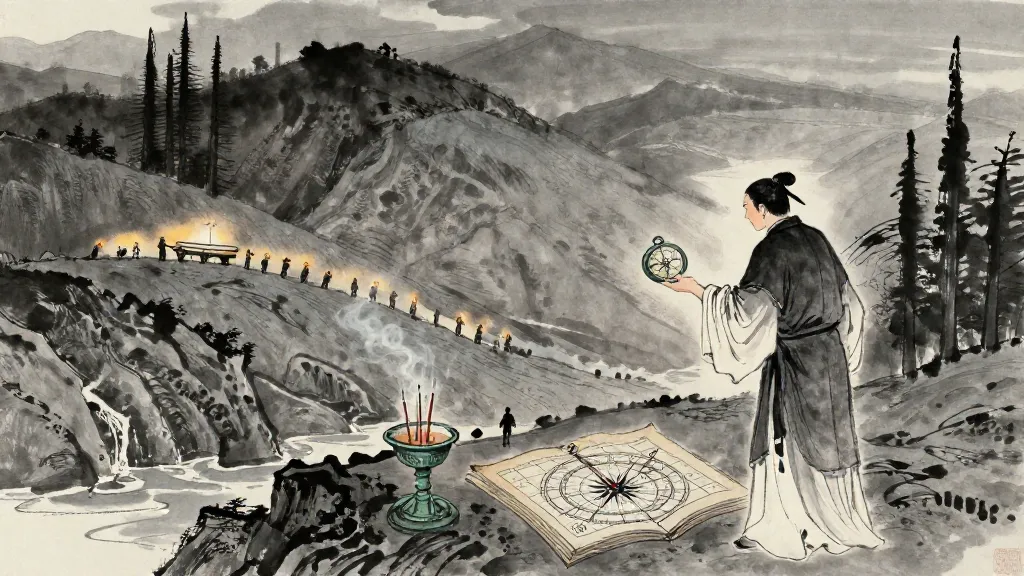
Three activities for the dead: breaking ground for a grave, interment, and exhumation for reburial. The almanac treats death with more scheduling precision than it gives to the living—because a burial done wrong doesn't just fail. It repeats.
Part 3 of The 67 Imperial Activities — what the Xieji Bianfang Shu actually says about each activity.
A Different Kind of Ground-Breaking
Here's a distinction most people miss. The Xieji Bianfang Shu (欽定協紀辨方書) lists 67 activities that require date selection. Two of them involve breaking ground: 興造動土 (breaking ground for construction) and 破土 (breaking ground for burial). Same physical act—shovel into soil—but the almanac treats them as fundamentally different operations. Different suitable stars. Different taboo lists. Different logic entirely.
The construction version, which we covered in Part 1 of this series, is about managing the earth's elemental forces. The burial version is about managing something else: the relationship between the living and the dead. And the almanac knows that these two anxieties are not the same anxiety.
The burial cluster in juan 11 contains three activities: 破土 (breaking ground for a grave), 安葬 (interment), and 啓攢 (exhumation and reburial). They appear at the very end of the volume, after all the construction, commercial, agricultural, and domestic activities. The dead come last. But they come with their own complete system.
破土: The Grave's First Cut
破土 means, literally, "breaking earth." But in the almanac's vocabulary, it refers exclusively to breaking ground for burial purposes—digging a grave, opening earth for a tomb. If you're digging a foundation for a house, that's 動土. If you're digging a grave, that's 破土. The distinction matters because the suitable and taboo conditions are completely different.
Here's what the text says:
破土
宜鳴吠 鳴吠對
忌月建、土府、月破、平日、收日、劫煞、災煞、月煞、月刑、月害、月厭、四廢、五墓、土符、地囊、復日、重日、土王用事後
Suitable: Barking, Barking Opposition. Taboo: Month Builder, Earth Treasury, Month Breaker, Balance Day, Receive Day, plus thirteen more conflict stars—including Return Day and Repeat Day.
Two suitable stars. Eighteen taboo conditions. Read that ratio again.
For construction ground-breaking, the almanac provides six virtue stars as suitable conditions—Heavenly Virtue, Monthly Virtue, and their combinations. For burial ground-breaking, it provides two stars you've probably never heard of: 鳴吠 (Barking) and 鳴吠對 (Barking Opposition). The name comes from an old divinatory tradition: a dog barking at a grave site was considered an auspicious omen, a sign that the earth spirits acknowledged the intrusion.
No virtue stars. No harmony stars. No grace stars. Just: the dog barked. That's your green light.
The minimalism here is deliberate. Construction is about building something for the living. The almanac can afford to be generous with auspicious conditions because the stakes, while real, are about prosperity and stability. Burial ground-breaking operates in a different register. You're opening the earth not to create but to receive. The suitable conditions shrink to nearly nothing because the almanac's logic says: there is almost no good time to do this. You do it when you must, on the least bad day available.
The Taboos That Follow the Dead
The taboo list for 破土 shares most of its entries with construction ground-breaking: 土府, 土符, 地囊, 土王用事後—the same earth-spirit taboos that appear across every activity involving digging. But two items are new and specific to burial: 復日 (Return Day) and 重日 (Repeat Day).
復日 is a day when the Heavenly Stem of the day matches or echoes the stem of a previous day in a specific cycle. 重日 is a day when the stem and branch repeat a doubling pattern. In most contexts, these are neutral or mildly unfavorable. In the context of burial, they are explicitly forbidden. The reason is grimly literal: "return" and "repeat" in the context of death means another death. The family buries one person and the calendar says: this could happen again.
This is not symbolic hand-waving. It's a taboo structure built on lexical correspondence—the name of the day carries semantic weight that interacts with the nature of the activity. You don't "return" when burying. You don't "repeat." The system takes words seriously.
Also note: 土王用事後. Not 土王用事 (Earth Phase in Effect), which is what construction activities avoid. The burial version adds 後 ("after")—meaning the taboo extends even after the Earth Phase period has technically ended. The earth stays sensitive longer when you're burying someone in it. The almanac gives the ground extra time to settle before you open it for the dead.
安葬: The Interment Itself
If 破土 is preparing the grave, 安葬 is the act of placing the body in it. And here the almanac shifts tone completely.
安葬
宜天德、月德、天德合、月德合、天赦、天願、六合、鳴吠
忌月建、月破、平日、收日、劫煞、災煞、月煞、月刑、月害、月厭、四廢、四忌、四窮、五墓、復日、重日
Suitable: Heavenly Virtue, Monthly Virtue, their combinations, Heavenly Pardon, Heavenly Wish, Six Harmonies, Barking. Taboo: sixteen conditions including Four Taboos and Four Poverty.
Eight suitable conditions. Sixteen taboos. The ratio has improved. Breaking ground gets two suitable stars; interment gets eight. The almanac is more generous to the act of laying someone to rest than to the act of opening the earth.
The virtue stars return: 天德, 月德, and their combinations. These are the same protective, auspicious stars that appear for construction, marriage, and most major life events. Their presence here means the almanac treats burial as a dignified act deserving of heaven's favor—not a polluting one. 六合 (Six Harmonies) also appears, a star associated with agreement and union. And 鳴吠 carries over from 破土, connecting the two stages.
But look at what changed in the taboos. The earth-specific taboos are gone: no 土府, no 土符, no 地囊, no 土王用事後. The grave is already open. The earth has already been disturbed. The interment itself is not an act of breaking ground—it's an act of closing it. So the earth-disturbance taboos don't apply.
Instead, 安葬 adds two taboos absent from 破土: 四忌 (Four Taboos) and 四窮 (Four Poverty). These are stars associated with obstruction and deprivation. In the context of burial, they suggest that interring someone under conditions of blockage or scarcity could affect the fortunes of the surviving family. The almanac is looking ahead: the dead are settled, but the living continue. The taboo list protects the family's future, not just the ceremony's propriety.
啓攢: Opening the Grave Again
啓攢 is the activity that surprises Western readers most. It means exhuming remains—opening a grave to collect bones for reburial at a different site. This was not uncommon in traditional China. Families relocated ancestral graves when geomantic conditions were unfavorable, when the family moved to a new region, or when political circumstances required it. The practice is still observed in parts of southern China, Taiwan, and Southeast Asian Chinese communities.
啓攢
宜鳴吠 鳴吠對
忌月建、月破、平日、收日、劫煞、災煞、月煞、月刑、月害、月厭、四廢、四忌、四窮、五墓、復日、重日
Two suitable stars—鳴吠 and 鳴吠對, same as 破土. And the taboo list is identical to 安葬's: sixteen conditions, including 復日, 重日, 四忌, and 四窮. The editors note in their commentary that the two activities share the same taboo structure, which makes sense: 啓攢 is burial in reverse. You're opening rather than closing, but the dead are still involved, and the same temporal sensitivities apply.
What's missing is revealing. 啓攢 has no earth-spirit taboos—no 土府, 土符, 地囊, or 土王用事後. This seems counterintuitive: you're literally opening the earth. But the almanac's logic is consistent. 破土 (initial ground-breaking) disturbs earth that was previously undisturbed. 啓攢 opens earth that has already been opened once, already accepted a burial, already been part of the human-earth transaction. The earth-spirit taboos apply to first contact, not to reopening.
The Dog That Barks at Graves
We should talk about 鳴吠. It appears as a suitable star for all three burial activities, and it doesn't appear anywhere else in the 67-activity system. It is exclusive to death.
The name means "barking" or "crying out." Its computational basis is a specific combination of Heavenly Stems and Earthly Branches in the day pillar. But the folk etymology—and the reason the name persists—is that dogs were believed to perceive the boundary between the living and the dead. A dog barking at a grave site signals that the spirits are present and acknowledging the activity. In a system that generally avoids supernatural language, 鳴吠 is as close as the Xieji Bianfang Shu gets to saying: something is watching.
鳴吠對 (Barking Opposition) is its complement—a day when the same configuration appears in opposition position. Both count as suitable. The almanac doesn't care whether the dog is barking at you or away from you. It cares that the dog is barking.
For 安葬, 鳴吠 shares the suitable list with seven other stars. For 破土 and 啓攢, it's alone. This creates an interesting asymmetry: the physical acts of opening and closing the earth have almost no auspicious support, while the ceremonial act of interment is generously provisioned with virtue stars. The almanac is harder on the labor and gentler on the ritual.
What the System Reveals
Three activities. Three different rule sets. But the underlying logic is remarkably consistent once you map it.
Earth taboos apply only to first disturbance. 破土 carries the full earth-spirit taboo set: 土府, 土符, 地囊, 土王用事後. 安葬 and 啓攢 do not. The almanac distinguishes between breaking new ground and working in ground that has already been opened. This is the same principle as construction: the first shovel is the dangerous moment.
Death-specific taboos center on repetition. 復日 and 重日 appear in all three burial activities but in no construction activity. The fear is specific: death should not recur. A burial performed on a "return" or "repeat" day risks another death in the family. The construction cluster has no equivalent concern—a wall built on a repeat day might need rebuilding, but nobody dies.
Interment is honored; ground-breaking is feared. 安葬 gets eight suitable stars including the full virtue set. 破土 gets two. The almanac treats the act of laying someone to rest as worthy of heaven's blessing. The act of opening the earth for that purpose is barely tolerated.
Burial ground-breaking and construction ground-breaking share almost nothing. 破土 (burial) and 興造動土 (construction) share some taboo stars—the earth-spirit set overlaps—but their suitable star lists have zero overlap. Construction uses virtue stars. Burial uses 鳴吠. The almanac is explicit: these are different operations performed on the same earth for different reasons, and the cosmos responds to the reason, not just the action.
The Weight of It
Modern readers tend to approach almanac rules as curiosities or superstitions. The burial cluster makes that harder. There's a gravity to these rules that the construction and marriage clusters don't carry. When the almanac says "don't bury on a Repeat Day because it means another death," it's speaking to a fear that hasn't changed in three centuries. Grief makes people careful. The almanac gives that care a structure.
The Xieji Bianfang Shu was compiled by court astronomers, not priests. Its system is computational, not devotional. But the burial rules reveal something the construction rules don't: the system was built by people who understood that some acts carry weight beyond their physical dimensions. Breaking ground for a house and breaking ground for a grave involve the same muscles and the same soil. The almanac insists they are not the same act. And it structures that insistence with the same precision it applies to everything else.
Six Lines implements these rules as part of its daily almanac calculations. When the app marks a day as suitable or unsuitable for burial activities, it's checking these specific star conditions against the day's astronomical data. The distinction between 破土 and 動土—burial ground-breaking versus construction ground-breaking—is preserved. Because the original text insisted on it, and the original text was right to insist.
Next in this series: the remaining imperial activities.
References
Primary Source
欽定協紀辨方書 (Qinding Xieji Bianfang Shu), juan 11: 用事 (Activities). Compiled under Emperor Qianlong, 1739. Siku Quanshu edition.
Burial Activities Referenced
破土 (Breaking Ground for Burial) · 安葬 (Interment) · 啓攢 (Exhumation for Reburial)
All extracted from juan 11, folios 25–26, pages 51–53 of the Siku Quanshu manuscript copy.