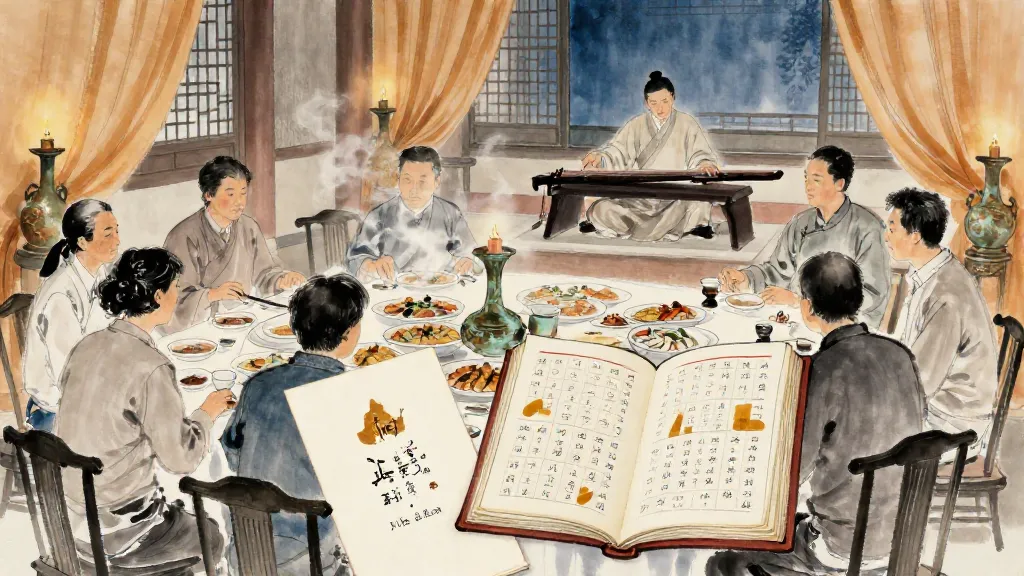
Gathering Well: What the Imperial Almanac Says About Banquets and Social Life
Of all 67 imperial activities, hosting a dinner party has the most auspicious days. The system isn't grudging about social gatherings—it actively encourages them. But don't throw your banquet on a Rooster Day.
Part 4 of The 67 Imperial Activities — what the Xieji Bianfang Shu actually says about each activity.
Picking a Date for Dinner
Here's something you probably haven't considered: of all the activities catalogued in the Qing imperial almanac—67 distinct categories spanning government decrees, military campaigns, marriages, funerals, and construction projects—the one with the most generous scheduling is throwing a dinner party.
Not "generous" in the vague sense. Generous in the countable, verifiable sense. The Xieji Bianfang Shu (欽定協紀辨方書), compiled under Emperor Qianlong in 1739, assigns 18 suitable star conditions to 宴會 (banquets)—more than any other activity in the entire system. Breaking ground for a building gets 6. Marriage gets 10. Deploying the army gets 7. But hosting a feast? Eighteen ways the calendar says yes.
The almanac wants you to gather. That's the headline. And once you start examining the specific stars it assigns to social activities, the logic behind that generosity becomes clear.
The Social Cluster
Four activities form the almanac's social cluster. They range from imperial ceremonies to everyday get-togethers, and the text links them through explicit cross-references.
宴會 (Banquets)—the imperial-level activity for hosting feasts and formal dinner gatherings. This is the big one, the entry with the largest suitable star list in the book. The text adds a cross-reference in two characters: 會親友同. Same rules as meeting relatives and friends.
會親友 (Meeting Relatives and Friends)—the commoner version of banquets. It appears in both the tongbook (通書) list of 60 activities and the commoner 27-activity list. Same star conditions as 宴會, meaning the almanac draws no scheduling distinction between an emperor's feast and a family gathering. The calendar treats both with equal favor.
慶賜賞賀 (Celebrations, Bestowing Gifts, Rewarding)—formal celebrations, official gift-giving, and merit recognition. This is the ceremony side of social life: the awards banquet, the commendation, the imperial bestowal of gifts. Its suitable star list is nearly as generous as banquets.
冠帶 (Capping Ceremony)—the coming-of-age ritual. In classical Chinese society, the capping ceremony marked a young person's transition to adulthood. It was a major social occasion, involving family, community, and formal investiture. And the almanac treats it very differently from the other three.
Eighteen Stars Say Yes
The banquet entry deserves to be quoted in full, because there's nothing else quite like it in the Xieji Bianfang Shu:
宴會 會親友同
宜天德、月德、天德合、月德合、天恩、天赦、天願、月恩、四相、時德、王日、民日、三合、福德、天喜、開日、六合、五合
忌月破、平日、收日、閉日、劫煞、災煞、月煞、月刑、月害、月厭、四廢、五離、酉日
Eighteen suitable conditions. Thirteen taboo conditions. The ratio alone—more suitable days than forbidden ones—is unusual. For most activities in the almanac, the taboo list is longer than the suitable list. Construction has 6 suitable and 18 taboo. Military deployment has 7 suitable and 26 taboo. But banquets invert the ratio. The system is structurally optimistic about gathering.
Look at the specific stars. The list includes every major category of auspicious condition in the almanac's vocabulary:
Virtue stars (天德, 月德, and their combinations): the foundational auspicious conditions that appear in almost every activity. These are the baseline.
Grace and pardon stars (天恩, 天赦, 天願, 月恩): the stars associated with forgiveness, generosity, and divine favor. Gatherings happen under a benevolent sky.
Timing and governance stars (四相, 時德, 王日): the stars that mark well-governed, seasonally appropriate moments. The almanac wants your dinner party to be timely.
Harmony stars (三合, 六合, 五合, 福德, 天喜): here is where banquets diverge from every other activity. Three separate harmony conditions appear: Triple Harmony (三合), Six Harmonies (六合), and Five Harmonies (五合). Plus Fortune Virtue (福德) and Heavenly Joy (天喜). Five stars dedicated to concordance, joy, and good fortune. No other activity in the almanac collects this many harmony-class stars.
And then there's 民日 (People's Day)—a star from the Jianchu twelve-day officer system that specifically marks days favorable for the common people. It appears in banquets but not in most government or military activities. The almanac is signaling: this is an activity that belongs to everyone.
開日 (Open Day) rounds out the list. In the Jianchu system, Open Day marks beginnings and fresh starts. Its presence here frames a gathering as an opening—of conversation, of relationship, of possibility.
The Rooster Day Problem
The taboo list for banquets is mostly standard—月破 (Month Breaker), various conflict stars, the usual suspects. But one entry is unique: 酉日 (Rooster Day).
酉日 refers to the Rooster day in the twelve Earthly Branches cycle. Every twelve-day period includes one Rooster day. And only for banquets is it explicitly forbidden.
This is genuinely strange. The Earthly Branch 酉 (You) is associated with the metal element, the west direction, and the hours of 5–7 PM—precisely the time when dinner banquets would typically begin. The character 酉 itself is etymologically related to wine vessels. You would think the Wine Day would be perfect for a feast.
But the almanac says no. The most plausible explanation involves the metal element's association with cutting and separation in five-phase theory. A gathering is fundamentally about union—and the taboo list already includes 五離 (Five Separations). The Rooster day, with its metal-phase cutting energy, may represent a more subtle form of the same risk: gathering under a separating influence.
Or it may be simpler than that. 酉 is the branch most closely associated with alcohol. And the text's editors may have had a very practical concern: don't schedule formal banquets on the day whose energy is most associated with drinking to excess. The almanac system includes both cosmological and practical reasoning, and sometimes the practical reading is the right one.
Celebrations and Gift-Giving
慶賜賞賀 (Celebrations, Bestowing Gifts, Rewarding) covers the formal, official side of social life: imperial celebrations, ceremonial gift-giving, merit awards. Its star profile overlaps heavily with banquets but includes two additions that banquets lack:
慶賜賞賀
宜天德、月德、天德合、月德合、天恩、天赦、天願、陽德、陰德、王日、開日
忌月破、平日、收日、閉日、劫煞、災煞、月煞、月刑、月害、月厭、四廢、五離
陽德 (Yang Virtue) and 陰德 (Yin Virtue) appear here but not in the banquet entry. These are the virtue stars associated with visible good deeds (陽德) and hidden good deeds (陰德). Their presence makes sense: formal celebrations and rewards are public acknowledgments of merit, and the almanac selects conditions that resonate with the act of recognizing virtue, both the seen and unseen kind.
The taboo list is identical to banquets minus 酉日. The Rooster Day taboo is specific to eating and drinking together, not to formal ceremony. The system distinguishes between a feast and an awards ceremony, even when both are social occasions.
The Capping Ceremony: A Different Logic
冠帶 (the capping ceremony) looks nothing like the other social activities. While banquets get 18 suitable stars, the capping ceremony gets exactly one:
冠帶
宜定日
忌月破、平日、收日、劫煞、災煞、月煞、月刑、月厭、大時、天吏、四廢、五墓、丑日
One suitable star. Thirteen taboos. The ratio is extreme—the opposite of the banquet pattern. And the single suitable star is 定日 (Settle Day) from the Jianchu system, the day whose character is stability, establishment, and settling into a defined role. For a coming-of-age ceremony that marks the moment a person assumes their adult identity, Settle Day is a precise match.
The capping ceremony also has its own unique day taboo: 丑日 (Ox Day), just as banquets have 酉日. The Ox branch is associated with earth and the northeast, with stubbornness and stagnation. A coming-of-age ceremony is about transformation and forward movement—the Ox day's energy pulls in the opposite direction.
But the deeper point is structural. The almanac treats the capping ceremony as a formal ritual, not a party. It belongs to the category of activities where one specific condition must be met, rather than the category where many conditions can qualify. The difference between 18 suitable stars and 1 suitable star is the difference between "gather whenever the sky is willing" and "this must happen on exactly the right day."
What the System Is Saying
When you line up the four social activities, a pattern emerges that illuminates how the entire almanac system thinks about human connection.
Informal gathering is maximally encouraged. Banquets and meeting friends get the longest suitable star list in the book. The almanac wants people to get together. It opens the calendar as wide as it can for eating, drinking, and conversation.
Formal celebration is nearly as generous. Awards ceremonies and gift-giving share most of the same favorable conditions, with the addition of virtue-recognition stars. The system approves of public acknowledgment.
Ritual transition is tightly constrained. The capping ceremony—despite being a social occasion—is treated as a formal ritual requiring a single precise day. The almanac distinguishes between gathering (flexible) and transformation (rigid).
Harmony stars dominate the social category. 三合, 六合, 五合, 福德, 天喜—five harmony-class stars appear in the banquet entry. The system reserves its vocabulary of concordance and joy specifically for activities where people come together. Marriage uses some of these same stars. Military activities use none of them.
There's something worth sitting with here. The most controlling, schedule-obsessed text in the Chinese calendrical tradition—a book that tells you exactly when to break ground, when to bury the dead, when to deploy armies—is most permissive about the simplest human activity: sitting down together for a meal. Eighteen stars say yes. The calendar bends to make room for it.
What Six Lines Does With This
Six Lines implements the Xieji Bianfang Shu's activity system as part of its daily almanac feature. When the app evaluates a day for banquets or social gatherings, it checks these 18 suitable conditions and 13 taboo conditions against the astronomical data for that date. The result is that most days qualify for gathering— which is exactly what the original text intended.
The social cluster is the fourth activity group in this series. Previous: burial activities. Next: the full series—covering all 67 activities from imperial decrees to household management.
References
Primary Source
欽定協紀辨方書 (Qinding Xieji Bianfang Shu), juan 11: 用事 (Activities). Compiled under Emperor Qianlong, 1739. Siku Quanshu edition.
Social Activities Referenced
宴會 (Banquets) · 會親友 (Meeting Relatives and Friends) · 慶賜賞賀 (Celebrations, Bestowing Gifts, Rewarding) · 冠帶 (Capping Ceremony)
All extracted from juan 11, folios 21–23 of the Siku Quanshu manuscript copy.