When to Get a Haircut: What the Imperial Almanac Says About Daily Life
The imperial court had an official position on when to get a haircut. Also when to bathe, when to get dressed up, when to cut cloth for new clothes, and when to set up your bed. Five activities that sound trivial—until you understand why they aren't.
Part 5 of The 67 Imperial Activities — what the Xieji Bianfang Shu actually says about each activity.
The Imperial Court Regulated Haircuts
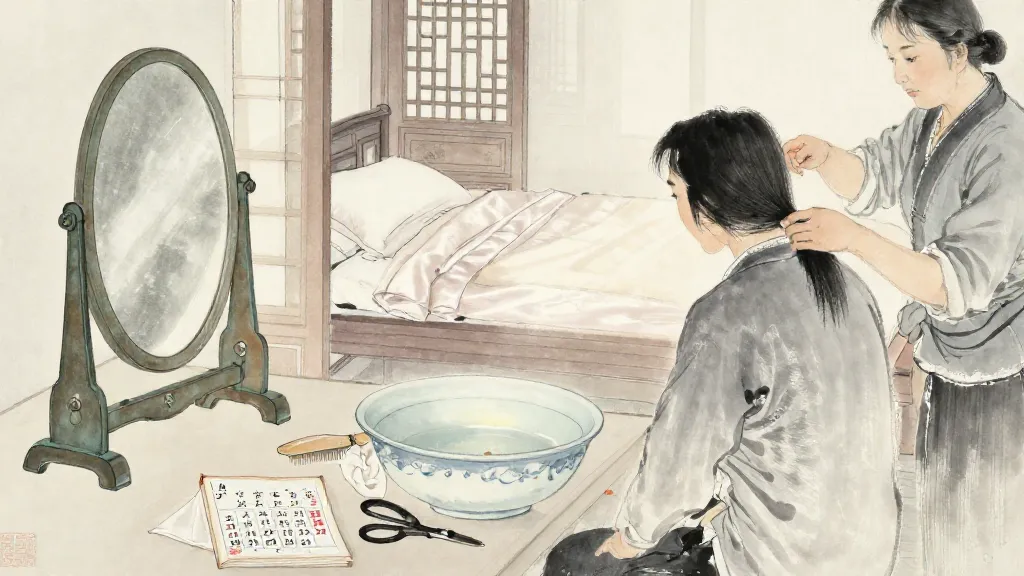
Here is something that sounds like a joke but is not: the Xieji Bianfang Shu (欽定協紀辨方書), compiled under Emperor Qianlong in 1739, contains an entry specifying which days are suitable for shaving your head. Not metaphorically. Not as part of some larger ritual. The entry is 整容剃頭—"grooming and shaving the head" —and it has its own list of approved astronomical conditions.
The modern reaction is predictable: this is absurd. Who needs celestial permission to visit a barber? But the modern reaction misses the point, and the point is worth understanding, because it reveals something about how the entire system thinks.
The Confucian classic Xiaojing (Classic of Filial Piety) contains a line that every educated person in imperial China would have known by heart:
身體髮膚,受之父母,不敢毀傷,孝之始也。
"Your body, hair, and skin are received from your parents. Not daring to damage them is the beginning of filial piety."
Hair was not a cosmetic matter. It was a filial matter. Cutting it was not grooming—it was an act that touched the boundary between self-care and self-violation. The almanac's date requirements for haircuts are not about vanity. They're about making sure that when you do something to your body that your ancestors gave you, you do it under the right conditions.
This is the logic that runs through all five activities in this article: bathing, grooming, tailoring, and bed installation. They're the domestic layer of the almanac's 67-activity system. They look trivial. They are not.
Grooming and Shaving (整容剃頭)
The entry for 整容剃頭 is one of the shortest in the entire text. Three suitable conditions, zero taboos:
整容剃頭
宜除日、解神、除神
Suitable: Removal Day, Dissolution Spirit, Removal Spirit.
Three conditions. No taboo list at all. Compare this to construction activities, which have 18 taboo conditions, or burial, which has dozens. The almanac is saying: grooming is low-risk. You need a few favorable conditions, but there's almost nothing that can make it go wrong.
The choice of suitable stars is interesting. All three belong to the "removal" family—除日 (Removal Day) is one of the twelve Jianchu day officers, and 解神 (Dissolution Spirit) and 除神 (Removal Spirit) are both spirits associated with clearing away, dissolving, and letting go. You're removing hair. The almanac picks days whose character matches the act. This is correspondence logic, the same principle that governs every activity in the system: the nature of the day should match the nature of the action.
Note that the text combines grooming (整容) and head-shaving (剃頭) into a single entry. They're treated as the same activity because the underlying logic is the same: you're altering your appearance by removing something. Whether it's a full shave or just tidying up, the same days apply.
Bathing (沐浴)
沐浴 doesn't mean what you think it means. Or rather, it means what you think it means plus something else. The literal meaning is "washing the hair and body," but in the almanac's context, bathing is not just hygiene—it's purification. Before important ceremonies, audiences with superiors, sacrificial rites, and court appearances, officials were expected to bathe and fast (齋戒沐浴). The bath was the first step in making yourself presentable to heaven.
沐浴
宜除日、解神、除神、亥日、子日
忌伏社日
Suitable: Removal Day, Dissolution Spirit, Removal Spirit, Pig Day (亥), Rat Day (子). Taboo: Hidden Altar Day (伏社日).
Five suitable conditions and one taboo. The suitable list builds on the grooming entry—it shares the same three removal-family stars—but adds two Earthly Branch days: 亥 (Pig) and 子 (Rat). In the five-phase system, both 亥 and 子 belong to the water element. Bathing is a water activity. The almanac assigns water days to water acts.
The single taboo, 伏社日 (Hidden Altar Day), refers to specific days tied to the She (社) altar—the earth deity rituals observed at the community level. These were days of communal ceremony when people were expected to be at the altar, not in the bath. The taboo is not mystical. It's a scheduling conflict: don't be washing yourself when you should be at the village shrine.
The ratio here is revealing. Five suitable, one taboo. Bathing is even more permissive than grooming, and grooming already had zero taboos. The system is generous with personal cleaning. It wants you to bathe.
Cutting Cloth and Tailoring (裁製)
裁製 (cutting and tailoring cloth) shifts into a different register entirely. Where grooming and bathing are minimal entries—a few suitable stars, almost no taboos—tailoring gets the full treatment:
裁製
裁衣同
宜天德、月德、天德合、月德合、天赦、天願、月恩、四相、時德、王日、三合、滿日、開日、復日
忌月破、平日、收日、劫煞、災煞、月煞、月刑、月厭、四廢
"Same as cutting clothes." Suitable: 14 conditions including Heavenly Virtue, Monthly Virtue, their combinations, Heavenly Pardon, Heavenly Wish, Monthly Grace, Four Phases, Seasonal Virtue, King Day, Triple Harmony, Full Day, Open Day, Recovery Day. Taboo: 9 conditions including Month Breaker, Balance Day, Receive Day, plus six conflict stars.
Fourteen suitable conditions. Nine taboo conditions. This is a serious entry—comparable in complexity to construction activities. Why would cutting cloth need this level of scheduling precision?
Because clothes were not casual purchases. In imperial China, garments were made from whole cloth, cut and sewn to fit. The moment you cut the fabric was irreversible—you could not uncut it. New clothes were made for specific occasions: weddings, court appearances, seasonal transitions, mourning periods. The first cut of the scissors was the commitment point. Get the day wrong and you've wasted expensive material—or worse, you've made garments under inauspicious conditions for an occasion that demands auspiciousness.
The text notes "裁衣同"—"same as cutting clothes." This means 裁製 (tailoring/cutting cloth) and 裁衣 (cutting clothes) follow identical rules. As with construction, the editors compress: when two activities share the same logic, they say "same" and move on.
The suitable list here is dominated by virtue stars—天德, 月德, and their combinations—which are the same stars that govern construction, marriage, and other high-stakes activities. 滿日 (Full Day) and 開日 (Open Day) are both auspicious day officers that signify abundance and new beginnings. The taboo list avoids days associated with destruction (月破), stagnation (平日), and conflict (the various 煞 stars). The system treats tailoring like a creative act that needs good cosmic conditions to succeed.
Installing the Bed (安床)
And then there is 安床—installing or positioning the bed. This is the entry that catches scholars off guard, because it has a taboo that appears nowhere else in the entire text:
安牀
宜危日
忌月破、平日、收日、閉日、劫煞、災煞、月煞、月刑、月厭、大時、天吏、四廢、五墓、申日
Suitable: Danger Day. Taboo: 14 conditions including Month Breaker, Balance Day, Receive Day, Close Day, plus nine conflict stars, Five Tombs—and Monkey Day (申日).
One suitable day. Fourteen taboo conditions. This is the most restrictive entry among the daily-life activities, more restrictive even than many construction activities. And at the end of the taboo list, sitting there quietly among the standard conflict stars, is 申日—Monkey Day.
申 is the ninth Earthly Branch, corresponding to the Monkey in the Chinese zodiac. It occupies the 3–5 PM time slot and belongs to the metal element. In the full 67-activity system, no other activity specifically taboos Monkey Day. It's unique to bed installation.
The reasoning, as far as traditional commentaries explain it, is associative: 申 is linked to restlessness and movement. The monkey doesn't sit still. A bed installed on Monkey Day inherits that quality—the sleeper won't rest well, will toss and turn, will be plagued by agitation. This is correspondence logic at its most granular: the character of the time infuses the character of the object placed within it.
The single suitable day, 危日 (Danger Day), seems counterintuitive until you understand the Jianchu system. The twelve day officers form a cycle: Build, Remove, Full, Balance, Settle, Execute, Destroy, Danger, Accomplish, Receive, Open, Close. 危日 (Danger) doesn't mean "dangerous" in the way we use the word—it means "precarious, elevated, on the edge." It's the moment of heightened awareness. For bed placement, the logic is: you want a day that keeps you alert to the arrangement, attentive to the positioning. Beds are where you are most vulnerable—you sleep in them. The almanac wants you to set them up on a day when your guard is up.
The Pattern Across Daily Life
Line up these five activities and a hierarchy emerges.
Grooming (整容剃頭): 3 suitable, 0 taboo. Minimal. The system trusts you to groom yourself without much cosmic risk.
Bathing (沐浴): 5 suitable, 1 taboo. Slightly more structured. Water days for water acts, and stay away from communal altar days.
Tailoring (裁製): 14 suitable, 9 taboo. Full treatment. Irreversible acts on expensive materials need careful scheduling.
Bed installation (安床): 1 suitable, 14 taboo. Maximum restriction. Where you sleep matters more than what you wear.
The gradient maps to a single variable: reversibility. Grooming grows back. Bathwater evaporates. Cut cloth stays cut. A bed, once placed, establishes the orientation of your most vulnerable hours. The more permanent the act, the more the almanac restricts it.
This is the same logic that governs construction (starting is harder to schedule than continuing), marriage (the first rite is more constrained than the last), and burial (interment is more restricted than exhumation). The system is consistently more cautious about beginnings and commitments than about processes and completions.
Nothing Is Too Small
The modern instinct is to classify these activities as beneath the almanac's notice—surely the emperor's astronomers had bigger concerns than haircuts and bed frames. But the Xieji Bianfang Shu operates on a different assumption: there is no threshold below which timing ceases to matter. The system covers imperial sacrifices and troop deployments in the same volumes that cover bathing and nail-trimming. The scale changes. The logic doesn't.
This is not inefficiency. It's completeness. The editors of the Xieji Bianfang Shu were building a scheduling system that could handle any human activity, from the grandest to the most domestic. If the system left gaps—if it said "haircuts don't need date selection"—then the folk almanacs would fill those gaps with contradictory, unverified rules. The court preempted that by covering everything.
And in covering everything, they revealed their real position: daily life is not separate from cosmic order. How you care for your body, how you dress, where you sleep—these are not trivial acts. They are the smallest units of a person's relationship with time. The almanac takes them seriously because the tradition that produced it does not recognize a boundary between significant and insignificant action. There is only action, and the question of when.
What Six Lines Does With This
Six Lines implements the Xieji Bianfang Shu's activity system as part of its daily almanac feature. When the app evaluates a day for grooming, bathing, tailoring, or bed installation, it checks exactly these star conditions against the astronomical data for that date. The Monkey Day taboo for bed installation is in there. The water-element days for bathing are in there. The original rules from the 1739 text, applied to today's calendar.
The daily-life cluster is the fifth activity group in this series. Previous: social activities. See the full series—covering all 67 activities from imperial decrees to household management.
References
Primary Source
欽定協紀辨方書 (Qinding Xieji Bianfang Shu), juan 11: 用事 (Activities). Compiled under Emperor Qianlong, 1739. Siku Quanshu edition.
Daily Life Activities Referenced
沐浴 (Bathing) · 整容剃頭 (Grooming/Shaving) · 裁製 (Tailoring/Cutting Cloth) · 安牀 (Installing the Bed)
Extracted from juan 11, folios 15–17, pages 31–35 of the Siku Quanshu manuscript copy.
Cultural Context
《孝經》(Xiaojing / Classic of Filial Piety): 身體髮膚受之父母 — the source of the cultural weight placed on hair and bodily integrity in Confucian tradition.