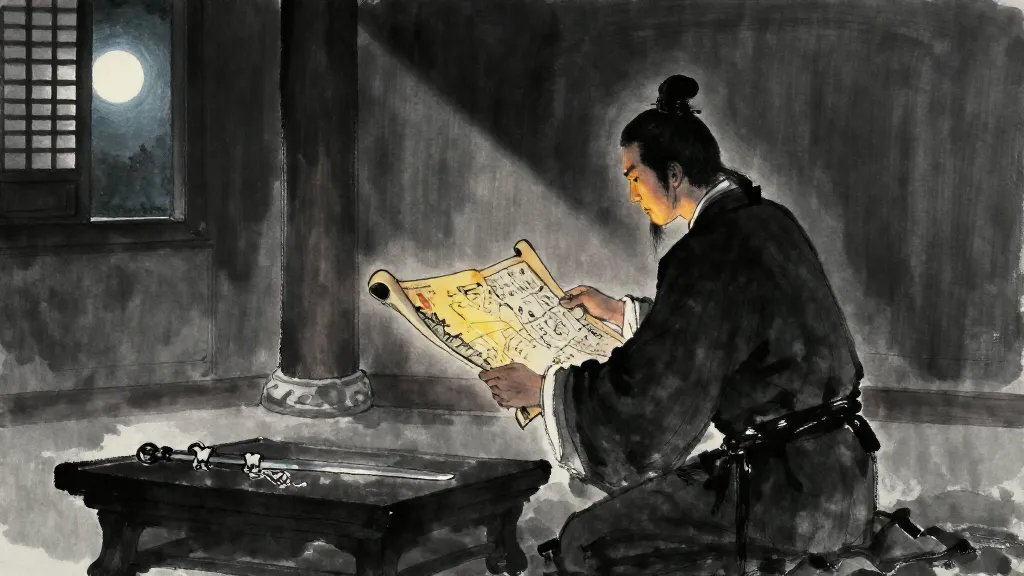
Assassins and Covert Operations in Ancient China
Sima Qian's Chapter 86 profiles five men who killed—or tried to kill—for personal loyalty rather than ideology. A dagger in a fish, a lacquered body, a map that hides a blade. The Biographies of the Assassins is the Shiji's darkest and most cinematic chapter.
Part of the Shiji Deep Dives — exploring individual chapters of the Records of the Grand Historian. See the Warring States world brought to life at Warring States Day.
The Logic of Assassination
In a world of seven warring kingdoms with no international law and no permanent alliances, assassination was not aberrant. It was a recognized tool of statecraft. A single killing could change the succession of a throne, shatter an alliance, or reverse the outcome of a war. The cost was one man's life. The potential return was a kingdom.
Sima Qian understood this calculus. In Chapter 86 of the Shiji—刺客列傳, Biographies of the Assassins—he profiles five men across three and a half centuries, from the seventh century BC to the eve of unification. The chapter is not a celebration of violence. It is a study of what drives men to trade their lives for a single act. In every case, the answer is the same: not ideology, not patriotism, not money, but personal loyalty to someone who recognized their worth.
The principle is stated most clearly by the third assassin, Yu Rang:
士為知己者死,女為說己者容。
“A man dies for the one who truly knows him, just as a woman adorns herself for the one who delights in her.”
This line became one of the most quoted sentences in Chinese literature. It is the chapter's moral key.
Cao Mo: The Dagger on the Altar (681 BC)
The chapter opens with the briefest and most efficient assassination. Cao Mo (曹沫) was a general of Lu who had lost to Qi three times. When Duke Huan of Qi—the most powerful lord in the realm—agreed to a covenant ceremony at Ke, Cao Mo attended as an escort. On the altar, in front of the assembled courts, he pulled a dagger and seized Duke Huan.
“Qi is strong and Lu is weak,” he said, “yet your great state has encroached upon Lu grievously.” Duke Huan promised to return all the territory taken from Lu. Cao Mo threw down the dagger, walked back to his place among the ministers, his expression unchanged and his speech composed. The entire act took minutes.
Duke Huan wanted to break the promise. His minister Guan Zhong stopped him: “To snatch a petty advantage for momentary satisfaction while abandoning your word before all the lords and losing the support of All-Under-Heaven—better to give it back.” The territory was returned. Cao Mo's gamble worked because he understood the political context: a hegemon's power rested on his reputation for trustworthiness. Coerced or not, a public promise could not be broken.
Zhuan Zhu: The Fish-Belly Sword (515 BC)
One hundred and sixty-seven years later, in the state of Wu, a prince named Guang wanted the throne. The legitimate king, Liao, sat firmly on it. Wu Zixu—the great avenger whose own story fills another Shiji chapter—recognized that Guang had ambitions and introduced him to a man named Zhuan Zhu (專諸).
Prince Guang treated Zhuan Zhu as an honored guest for nine years, waiting for the right moment. It came when King Liao sent his brothers and his best general away on campaign. Guang hosted a banquet for the king. Guards lined every corridor. Bodyguards with long halberds flanked every step. But the weapon was already inside—a dagger concealed in the belly of a roasted fish.
When the dish was served, Zhuan Zhu split the fish, seized the dagger, and killed King Liao instantly. The guards killed Zhuan Zhu in the next breath. Prince Guang released his hidden soldiers, slaughtered the king's loyalists, and took the throne as King Helu of Wu—one of the most formidable rulers of the Spring and Autumn period. He honored Zhuan Zhu's son as a senior minister.
The fish-belly sword (魚腸劍) became legendary. The assassination is a study in patience and timing: nine years of preparation for thirty seconds of action. At Warring States Day, the Wu kingdom's rise under Helu is one of the pivotal events that shaped the strategic landscape every subsequent kingdom inherited.
Yu Rang: The Lacquered Body (c. 450 BC)
Yu Rang (豫讓) is the chapter's moral center. He had served two clans without distinction. Then he served Zhi Bo, who treated him with extraordinary honor. When Zhao Xiangzi conspired with Han and Wei to destroy Zhi Bo—going so far as to lacquer his skull into a drinking cup—Yu Rang swore vengeance.
His first attempt was crude: he disguised himself as a convict laborer, plastered the privy walls, and waited with a hidden dagger. Zhao Xiangzi felt a premonition, searched the workers, and found him. Yu Rang admitted everything. Instead of killing him, Zhao Xiangzi released him, calling him “a man of honor” and “one of the worthiest in All-Under-Heaven.”
Yu Rang's second attempt was something else entirely. He lacquered his body to raise sores, swallowed charcoal to destroy his voice, and transformed himself so completely that his own wife did not recognize him. A friend wept and begged him to take the easier path: pledge service to Zhao Xiangzi, gain his trust, then kill him. Yu Rang refused:
既已委質臣事人,而求殺之,是懷二心以事其君也。
“If I pledged myself as his subject and then sought to kill him, that would be serving my lord with a divided heart.”
He hid beneath a bridge Zhao Xiangzi would cross. The lord's horse shied. Zhao Xiangzi knew at once: “This must be Yu Rang.” Confronted again, Yu Rang delivered the line that defines the chapter. Zhao Xiangzi asked why he sought revenge for Zhi Bo but not for the Fan and Zhonghang clans he had previously served. Yu Rang answered:
范、中行氏皆眾人遇我,我故眾人報之。至於智伯,國士遇我,我故國士報之。
“The Fan and Zhonghang clans treated me as an ordinary man—so I repaid them as an ordinary man. Zhi Bo treated me as the finest man in the state—so I repay him as the finest man in the state.”
Zhao Xiangzi wept. He could not release Yu Rang a second time but granted him a final request: to strike the lord's robe in symbolic vengeance. Yu Rang drew his sword, leaped three times, and slashed the robe. “Now I can go below and face Zhi Bo,” he said, and fell upon his sword. Every man of resolve in Zhao wept on the day of his death.
Nie Zheng: The Self-Destroyed Face (c. 397 BC)
Nie Zheng (聶政) was a butcher hiding in Qi with his mother and sister after killing a man in his hometown. A nobleman named Yan Zhongzi, who needed an assassin to kill the Han minister Xia Lei, came to him repeatedly, offered gold for his mother's welfare, and waited. Nie Zheng refused everything. His mother was alive. While she lived, his life was not his own to spend.
When his mother died and the mourning was complete, Nie Zheng traveled west alone. He refused all offers of carriages and men: “Many men cannot be used. With many men, something will go wrong. If something goes wrong, word will leak.” He walked into the minister's office carrying only a sword, charged up the steps past armed guards, and killed Xia Lei. Then he cut down dozens of guards. And then he did something extraordinary: he flayed his own face, gouged out his eyes, and sliced open his belly. He died unrecognizable.
He had mutilated himself to protect his patron. If his identity were discovered, the trail would lead back to Yan Zhongzi. Han posted his body in the marketplace with a thousand-gold bounty for anyone who could name him. No one came forward.
Then his elder sister Nie Rong (聶榮) heard the news. She traveled to Han, knowing what it meant. She threw herself on the body and wept: “This is Nie Zheng, of the Deep Well district in Zhi.” The crowd said: “Don't you know there's a bounty? How dare you identify him?” She answered: “He mutilated his face only because I was still alive, to cut off the trail that might lead to me. How can I fear death and erase the name of my worthy brother?” She cried out to heaven three times and died beside him.
Sima Qian concludes that if Nie Zheng had known his sister would not let his name be erased, he might not have dared accept the mission at all. The logic of personal loyalty extends beyond the assassin to everyone bound to him.
Jing Ke: The Map and the Dagger (227 BC)
The final and most famous assassination attempt in the chapter is Jing Ke's mission to kill the King of Qin—the man who would become the First Emperor of China. This is the longest narrative in the chapter, and Sima Qian treats it with the gravity of an epic.
Jing Ke (荊軻) was a drifter who loved reading, wine, and swordsmanship. He wandered through the states, befriending worthy men in every court. In Yan, he spent his days drinking in the marketplace with a dog butcher and a musician named Gao Jianli, who played the zhu. “When the wine had taken hold, Gao Jianli would play and Jing Ke would sing, right there in the market—delighting in each other, and then weeping together, as though no one else existed.”
Crown Prince Dan of Yan needed him for a desperate mission. Qin was devouring the states one by one. Zhao had fallen. Qin's armies stood on Yan's border. The crown prince's plan was to send an assassin to seize the King of Qin and force him to return the conquered territories—or, failing that, to kill him and throw Qin into chaos.
The preparation required extraordinary sacrifices. Tian Guang, the recluse who recommended Jing Ke, killed himself to prove he would not betray the secret. Fan Yuqi, a Qin general hiding in Yan, cut his own throat to provide the bait: his head, which the King of Qin had priced at a thousand catties of gold, packed in a box alongside a map of Yan's richest territory. A poison-tempered dagger was concealed inside the rolled map.
The farewell at the Yi River is one of the most celebrated scenes in Chinese literature. The crown prince and all who knew the plan wore white—the color of mourning. Gao Jianli played the zhu. Jing Ke sang:
風蕭蕭兮易水寒,壯士一去兮不復還。
“The wind sighs, sighs—the Yi River is cold. The warrior departs—and will not return.”
He mounted his chariot and never looked back.
At the Qin court, everything went according to plan until it didn't. The King of Qin unrolled the map. The dagger appeared —圖窮匕見, “the map unrolls and the dagger is revealed,” another idiom that entered permanent usage. Jing Ke grabbed the king's sleeve and stabbed. The sleeve tore. The king ran around a pillar. His sword was too long to draw from its scabbard. Under Qin law, no minister in the hall carried a weapon. The guards below could not ascend without a summons. For a surreal interval, the most powerful man in China ran for his life around a pillar while an assassin chased him and the entire court stood frozen.
A physician threw his medicine bag. Someone shouted “Sling the sword to your back!” The king drew the blade and struck. Jing Ke, his thigh severed, hurled the dagger. It missed, hitting a bronze pillar. Wounded eight times, he leaned against the pillar, sat with his legs spread in deliberate contempt, and said: “The reason I failed is that I wanted to seize you alive and force a treaty, to repay the Crown Prince.”
The guards killed him. The King of Qin “was unsettled for a long time afterward.” He sent armies to destroy Yan. Crown Prince Dan was beheaded by his own father in a vain attempt to appease Qin. It did not work. Five years later, Yan ceased to exist.
But the story had one more act. Gao Jianli, the musician, went into hiding, changed his name, and worked as a laborer. He could not stop commenting on other people's music. Eventually recognized and brought before the First Emperor, he was blinded but permitted to play. He filled his zhu with lead, and when he was admitted close enough, swung it at the emperor. He missed. He was executed. The emperor never again allowed anyone from the former states near his person.
What the Assassins Share
Sima Qian's concluding comment is notable for its restraint. He corrects popular legends, cites his actual sources, and then delivers a simple verdict: “From Cao Mo to Jing Ke, these five men—some succeeded in their purpose and some did not. But their intentions were clear and plain. They did not betray their own convictions, and their names have been handed down to posterity.”
What unites them is not skill—Jing Ke, the most famous, was arguably the least competent swordsman of the five. What unites them is the principle of reciprocal recognition. Each man killed (or tried to kill) because someone had seen him, valued him, and treated him as something more than ordinary. The debt could only be repaid with a life. Yu Rang said it most precisely: “He treated me as the finest man in the state, so I repay him as the finest man in the state.”
In the Warring States Day simulation, assassination is one of the covert actions available to AI agents. The strategic calculus is exactly as Sima Qian describes—cheap in resources, catastrophic in consequences if it succeeds, devastating to diplomatic reputation if it fails. The AI kingdoms must weigh the same risks that Crown Prince Dan weighed when he sent Jing Ke across the Yi River. Most of the time, they decide it isn't worth it. Sometimes they do it anyway. The results are unpredictable—which is, of course, the point.
Sima Qian's final couplet lands hard:
暴秦奪魄,懦夫增氣。
“Fearsome Qin was shaken to its core, and even cowards found their courage.”
The assassins failed to stop Qin. But they proved that even the most overwhelming power has a vulnerability: one person, in the right place, at the right moment, willing to trade everything for a single act.
References
Primary Source
史記·刺客列傳 (Records of the Grand Historian, Biographies of the Assassins). Sima Qian's profiles of five assassins, Chapter 86 of the Shiji. Chinese Text Project
Full translated text with commentary available in the Warring States Day Shiji archive.