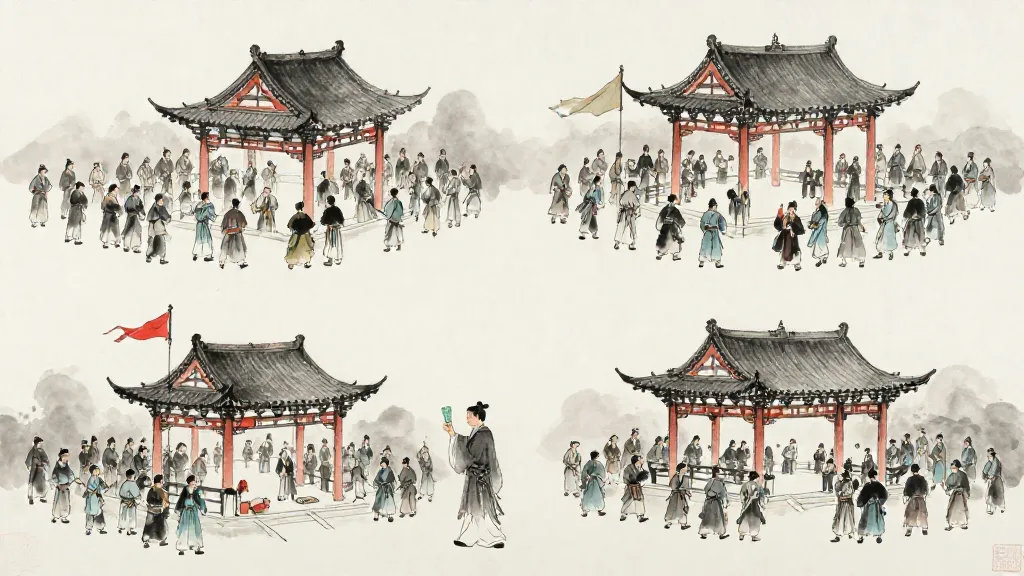
The Four Lords of the Warring States
Four aristocrats maintained thousands of retainers, shaped the geopolitics of an era, and gave Chinese culture some of its most enduring idioms. Sima Qian's portraits of Lords Mengchang, Pingyuan, Xinling, and Chunshen are studies in what patronage buys—and what it costs.
Part of the Shiji Deep Dives — exploring individual chapters of the Records of the Grand Historian. See the Warring States world brought to life at Warring States Day.
The Retainer Economy
The late Warring States period—roughly 300 to 230 BC—was defined by a peculiar institution. Powerful aristocrats maintained private networks of retainers (食客, literally “eating guests”) numbering in the thousands. These retainers were not servants. They were advisors, spies, diplomats, warriors, and specialists of every description, housed and fed at the patron's expense in exchange for their loyalty and their skills. The patron provided wealth and status; the retainers provided intelligence, military capability, and political leverage.
Four men perfected this system, and Sima Qian devoted consecutive chapters of the Shiji (Chapters 75 through 78) to their biographies. They were Lord Mengchang of Qi (孟嘗君), Lord Pingyuan of Zhao (平原君), Lord Xinling of Wei (信陵君), and Lord Chunshen of Chu (春申君). Between them, they maintained well over ten thousand retainers and dominated the diplomacy of an era. Each produced stories that became permanent fixtures of the Chinese literary tradition.
At Warring States Day, the kingdoms these lords served—Qi, Zhao, Wei, and Chu—are played by AI agents who must decide how to allocate resources between military force and diplomatic networks. The patron-client dynamics Sima Qian describes turn out to be among the hardest strategic problems in the simulation.
Lord Mengchang: The Cock-Crow and the Dog-Thief
Lord Mengchang (田文, Tian Wen) of Qi should not have existed. Born on the fifth day of the fifth month—an inauspicious date believed to produce children who would harm their parents—his father ordered him killed at birth. His mother raised him in secret. When the boy was old enough to argue, he confronted his father with a question that became famous: “Is a person's fate determined by Heaven, or by the doorframe?” If by Heaven, there was nothing to fear. If by the doorframe, simply raise it.
That combative intelligence defined his career. Lord Mengchang gathered over three thousand retainers at his fief of Xue and treated them all equally—noble or criminal, skilled or apparently useless. He stationed a clerk behind a screen during every conversation to record what was discussed and track each guest's family connections. When a retainer departed, gifts were already on the way to his relatives. The operation was systematic.
The most famous episode tested this system to its limit. Lord Mengchang traveled to Qin, was appointed chancellor, then was imprisoned when the King of Qin changed his mind. Escape required passing through Hangu Pass, which only opened at cock-crow. His retainers included two men whom the others despised: one who could imitate a rooster, and one who could sneak into buildings like a dog. The dog-thief stole back a fox-fur coat from the Qin palace storeroom to bribe the king's consort. The cock-crower set off every rooster at the pass in the dead of night. Lord Mengchang escaped.
The phrase 雞鳴狗盜—“cock-crow and dog-thief”— became one of the most recognized idioms in Chinese, meaning people with disreputable skills that prove useful in a crisis. But the episode also became ammunition for critics who argued that Lord Mengchang's willingness to harbor criminals and tricksters actually prevented truly worthy men from serving him. Sima Qian leaves the question open.
Feng Huan: Buying Goodwill
The deepest portrait in Lord Mengchang's biography belongs not to the lord himself but to his retainer Feng Huan (馮驩)—a man who arrived in straw sandals, with nothing but a cord-wrapped sword, and proceeded to make escalating demands. He strummed his sword and sang that he had no fish, so he was moved to better quarters. He sang that he had no carriage, and received one. He sang that he had no way to support his family. Lord Mengchang was displeased. For a full year after that, Feng Huan contributed nothing.
Then Lord Mengchang needed someone to collect debts from the people of his fief at Xue. Feng Huan volunteered. He traveled to Xue, assembled all the debtors, threw a lavish feast—and burned every debt tally belonging to anyone too poor to pay. He told the stunned crowd: “With a lord like this, how could you bear to fail him?” Everyone bowed.
Lord Mengchang was furious. Feng Huan explained: hounding people who can never repay earns you a reputation for greed. Forgiving debts earns you a population that would die for you. He called it 市義— “buying goodwill”—and argued it was a better return on investment than interest payments. When Lord Mengchang was later dismissed from office and all his other retainers fled, the people of Xue lined the roads to welcome him. The investment paid off.
Feng Huan then executed a masterpiece of double-dealing: he traveled to Qin and told King Zhao that the dismissed Lord Mengchang, bitter and resentful, would bring all of Qi's secrets to Qin if recruited. He then raced back to Qi and told King Min that Qin was about to hire Lord Mengchang—better restore him quickly. Both courts acted exactly as Feng Huan predicted. Lord Mengchang was restored to the chancellorship with additional territory. The Qin envoys turned around and went home.
Lord Pingyuan: Mao Sui Recommends Himself
Lord Pingyuan (趙勝, Zhao Sheng) of Zhao was a prince of the royal house who served as chancellor through the most dangerous years of Zhao's existence. His biography opens with an episode about honor and its costs. A lame man who lived below Lord Pingyuan's mansion was mocked by one of the lord's concubines. The lame man demanded her head. Lord Pingyuan laughed and refused. Over the next year, more than half his retainers quietly left. When he asked why, one of them explained: they believed he valued beauty over principle. Lord Pingyuan beheaded the concubine, went to the lame man's door, and apologized. The retainers returned.
The honor economy of the Warring States was brutal. A patron's reputation was his capital, and any crack in it caused an immediate run on the bank.
Lord Pingyuan's defining moment came in 258 BC, when Qin besieged Zhao's capital Handan after the catastrophe at Changping. He needed to forge an alliance with Chu and selected nineteen retainers for the diplomatic mission, but could not find a twentieth. A retainer named Mao Sui (毛遂) stepped forward and volunteered. Lord Pingyuan said: “A man of talent is like an awl in a sack—its point shows through at once. You have been here three years and no one has heard of you.” Mao Sui replied: “I am asking today to be placed in the sack. Had I been placed in the sack earlier, the entire awl-head would have burst through.”
The idiom 毛遂自薦—“Mao Sui recommends himself”— is still used daily in Chinese. At the Chu court, when the King of Chu hesitated, Mao Sui gripped his sword, strode up the steps, and told the king that within ten paces, the king could not rely on Chu's millions. He shamed the king into the alliance by cataloging Chu's defeats at Qin's hands and calling Bai Qi a “worthless whelp.” Lord Pingyuan returned to Zhao and said he would never presume to judge men again. “Mao Sui's three inches of tongue proved mightier than a million troops.”
Lord Xinling: Stealing the Tiger Tally
Lord Xinling (魏無忌, Wei Wuji) of Wei was, in Sima Qian's judgment, the noblest of the four. His intelligence network was so effective that he knew the King of Zhao was merely hunting before Wei's own frontier beacons could confirm it. His reputation deterred the other states from attacking Wei for over a decade. And his humility was legendary: he personally drove his chariot to welcome a seventy-year-old gatekeeper named Hou Ying, leaving the seat of honor empty, then sat patiently while Hou Ying deliberately humiliated him by chatting with a butcher friend in the public market. The prince's expression never changed. The market crowd thought the old man was being rude. In fact, Hou Ying was testing whether the prince's courtesy was genuine.
That gatekeeper would save the state of Zhao.
When Qin besieged Handan in 258 BC, the King of Wei sent an army but then halted it, afraid of Qin's retaliation. Lord Xinling begged his brother the king to act. The king refused. Lord Xinling prepared to ride with his retainers straight into the Qin army and die. Hou Ying, the gatekeeper, stopped him with a plan: steal the tiger tally—the bronze half-tiger that authorized command of the army—from the king's bedchamber through the king's favorite consort, Lady Ru, whose father's murder Lord Xinling had once avenged. Lady Ru owed him a debt of blood. She stole the tally.
Lord Xinling rode to the army camp with the tally and the butcher Zhu Hai (the friend Hou Ying had chatted with in the market). When General Jin Bi questioned the orders, Zhu Hai killed him with an iron mace. Lord Xinling took command and broke the siege of Handan. The idiom 竊符救趙—“stealing the tally to save Zhao”—commemorates an act that was simultaneously treason against one's own king and the salvation of an ally. It is a story about what happens when loyalty to a principle conflicts with loyalty to a sovereign.
Hou Ying did not go with the prince. He had said he was too old. When Lord Xinling reached the army camp, Hou Ying faced north— the direction of his lord—and cut his own throat. He had given everything he had.
Lord Chunshen: The Diplomat Who Risked Everything
Lord Chunshen (黃歇, Huang Xie) of Chu was the last of the four and the most diplomatically gifted. His career began with a memorial to the King of Qin that is one of the longest and most sophisticated diplomatic arguments preserved in the Shiji. In it, he argued that Qin should ally with Chu rather than destroy it, because the destruction of Chu would disproportionately benefit Han, Wei, and Qi—strengthening Qin's rivals while exhausting Qin's armies. The King of Qin agreed.
Huang Xie's bravest act was personal. When the Chu crown prince was held hostage in Qin and the King of Chu lay dying, Huang Xie engineered an escape: the crown prince disguised himself as a chariot-driver and slipped out through the pass, while Huang Xie stayed behind to face the consequences. He went before the King of Qin and said, simply: “The Chu crown prince has returned. He is already far away. I deserve death.” The king was furious but was talked out of executing him. The crown prince took the throne, appointed Huang Xie chancellor, and gave him a fief that included the ruins of the old Wu capital—the region around modern Suzhou.
Lord Chunshen governed Chu for twenty-five years, led the army that helped relieve the siege of Handan, conquered Lu, and appointed the philosopher Xunzi as a local magistrate. At the peak of his power, his retainers wore pearl-studded shoes—a display so extravagant that a visiting Zhao envoy, who had come to impress Chu, was mortified by the comparison.
What the Four Lords Tell Us
Read together, these four biographies form a treatise on the mechanics of power in a world without centralized authority. The Warring States had no international law, no binding treaties, no permanent alliances. Power was personal. It flowed through networks of obligation, reputation, and reciprocity. The retainer system was the institutional expression of this reality: you survived by accumulating loyal men, and you accumulated loyal men by being demonstrably generous, principled, and willing to subordinate your private interests to your retainers' honor.
Each lord illustrates a different facet. Lord Mengchang shows that even useless-looking retainers have their moment. Lord Pingyuan shows that reputation must be maintained at any cost. Lord Xinling shows that the deepest loyalty sometimes requires betraying your own king. Lord Chunshen shows that a diplomat's willingness to die can be his most effective argument.
The Qin state that eventually conquered all of them had a different theory of power: institutions over individuals, law over loyalty, central authority over patronage networks. In the Warring States Day simulation, this tension between network-based and institution-based strategies plays out in every game. The AI agent playing Qin must decide whether to invest in the Shang Yang model of impersonal institutional strength, while the agents playing Qi, Zhao, Wei, and Chu face the Four Lords' dilemma: how much of your treasury do you spend on retainers, and when do you cut your losses?
None of the Four Lords outlived the system they built. Lord Mengchang's fief was destroyed after his death. Lord Pingyuan died before Zhao fell. Lord Xinling was driven to drink by his brother's suspicion and died broken. Lord Chunshen was assassinated by a retainer's plot—killed by the very system he had mastered. Sima Qian does not moralize. He simply lays out the evidence and lets the reader decide whether the retainer economy was a source of strength or a symptom of decline.
References
Primary Sources
史記·孟嘗君列傳 (Records of the Grand Historian, Biography of Lord Mengchang), Chapter 75. Chinese Text Project
史記·平原君虞卿列傳 (Biography of Lord Pingyuan), Chapter 76. Chinese Text Project
史記·魏公子列傳 (Biography of the Prince of Wei), Chapter 77. Chinese Text Project
史記·春申君列傳 (Biography of Lord Chunshen), Chapter 78. Chinese Text Project
Full translated texts with commentary available in the Warring States Day Shiji archive.