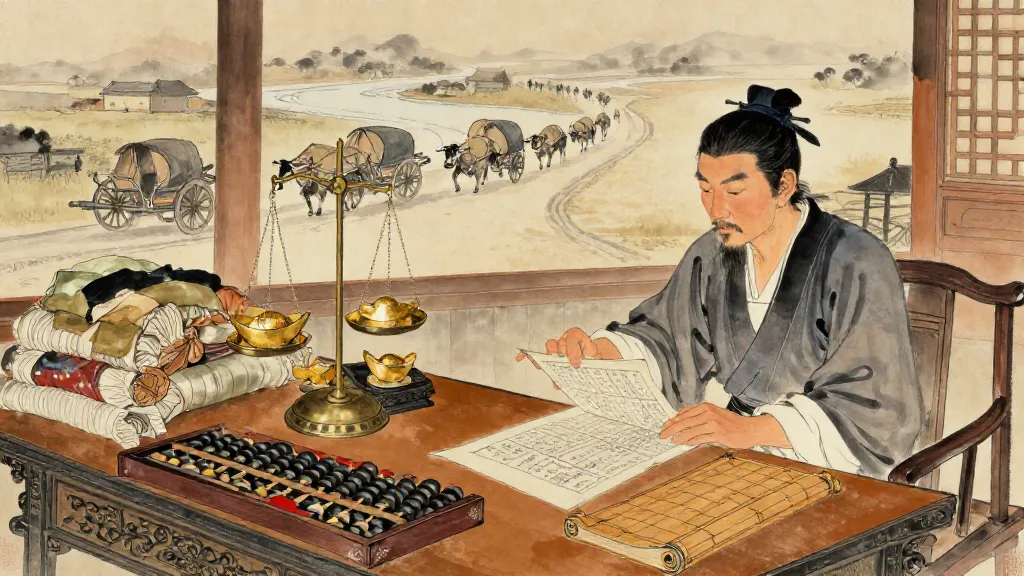
The Economics of Empire: Sima Qian's Treatise on Wealth
Twenty-one centuries before Adam Smith, China's greatest historian wrote a chapter arguing that the desire for wealth is natural, markets are self-organizing, and the best rulers get out of the way. Shiji Chapter 129 remains one of the most radical texts in ancient economics.
Part of the Shiji Deep Dives — exploring individual chapters of the Records of the Grand Historian. See the Warring States world brought to life at Warring States Day.
The Chapter That Shouldn't Exist
The Shiji—Records of the Grand Historian—is 130 chapters long. It contains the annals of emperors, the genealogies of feudal houses, treatises on ritual and astronomy, and seventy biographies of generals, ministers, philosophers, and diplomats. The last biography, Chapter 129, is titled 貨殖列傳—Biographies of the Money-Makers. It profiles merchants, speculators, and industrialists.
In the intellectual world of the second century BC, this was an act of provocation. Confucian orthodoxy placed merchants at the bottom of the four occupations: scholars, farmers, artisans, then traders. The Han dynasty had laws forbidding merchants from wearing silk or riding in carriages. Sima Qian, the Grand Historian, gave these despised figures the same biographical treatment he gave prime ministers and conquerors. And then he opened the chapter by arguing that they deserved it.
Against the Daoist Fantasy
The chapter begins with a quotation from the Dao De Jing—the famous passage about neighboring states so content that their people grow old and die without ever visiting one another. Sima Qian quotes it only to dismiss it. “If one were to make this the guiding policy in the present age,” he writes, “it would mean stopping the people's ears and covering their eyes—and it would be almost impossible to put into practice.”
What follows is a taxonomy of human desire that would not sound out of place in a modern economics textbook. People want fine sounds and beautiful sights. They want rich food. They want comfort. They want status. These drives have “soaked into the people for a long time.” You cannot preach them away. The question is not whether people will pursue their interests, but how a government should respond.
Sima Qian's answer is a ranked list that reads like a libertarian manifesto:
故善者因之,其次利道之,其次教誨之,其次整齊之,最下者與之爭。
“The best rulers go along with human nature; the next best guide it toward profit; the next best instruct it; the next best regulate it; and the worst rulers contend with it.”
The best government, in other words, does not try to redirect human desire. It allows the market to operate.
The Invisible Hand, Twenty-One Centuries Early
Sima Qian then describes how the economy of China organizes itself without central planning. The west produces timber and jade. The east produces fish and salt. The south produces tropical goods. The north produces livestock. Farmers grow the food, foresters extract resources, artisans make finished goods, and merchants circulate them. No one commands this system. It runs on its own:
各勸其業,樂其事,若水之趨下,日夜無休時,不召而自來,不求而民出之。
“Each person is encouraged in his trade and delights in his work, like water flowing downhill, ceaselessly day and night, coming without being summoned, produced by the people without being demanded.”
The comparison to water flowing downhill is more than a metaphor. It is a claim about the natural order—that markets, like hydrology, operate according to principles that exist independently of human legislation. Sima Qian then asks: “Is this not the verification of the Way and the proof of what is natural?” He is using Daoist language—the Way, the natural—to make an anti-Daoist argument. The Way is not withdrawal and simplicity. The Way is commerce.
Ji Ran's Counter-Cyclical Theory
The chapter's first merchant profile is not a merchant at all but a strategist: Ji Ran (計然), the economic advisor who saved the state of Yue. When King Goujian was trapped on Mount Kuaiji, humbled by Wu, he turned to Ji Ran for a recovery plan. Ji Ran gave him not a military strategy but an economic one.
The core of Ji Ran's system is a theory of cycles. Harvests follow a twelve-year pattern governed by the five elements: six years of abundance, six of scarcity, with a major famine every twelve years. The wise investor does not follow the cycle—he invests against it:
旱則資舟,水則資車。
“In drought, invest in boats; in flood, invest in carts.”
This is counter-cyclical investment stated as concisely as it has ever been stated. Buy what is cheap now because conditions will reverse. Ji Ran's price theory is equally modern: keep grain prices between thirty and eighty cash. Below thirty, the farmer suffers and stops planting. Above ninety, the merchant suffers and goods stop circulating. The state's job is to stabilize the band, not to set the price.
Goujian followed the advice for ten years. Yue grew rich. With the surplus, he lavished rewards on his soldiers, who “charged into arrows and stones as though they were parched men reaching for water.” He destroyed Wu and became one of the Five Hegemons. The economic strategy produced the military outcome.
If you want to see what happens when seven kingdoms pursue these strategies against each other—with AI agents making the decisions—that is exactly what Warring States Day simulates.
Fan Li: The Man Who Quit Politics and Got Rich
Fan Li (范蠡) is one of the most remarkable figures in Chinese history. He was the strategist who engineered Yue's victory over Wu—the architect of Goujian's revenge. At the moment of his greatest triumph, he looked at his king and made a calculation that had nothing to do with economics: “Of Ji Ran's seven strategies, Yue used five and achieved its aim. I have already applied them to the state; now I wish to apply them to my household.”
He took a small boat and vanished across the rivers and lakes. He changed his name. He moved to Tao (modern Dingtao, Shandong)—a crossroads where all the trade routes converged—and reinvented himself as a merchant. Under the name Lord Zhu, he applied the same principles of timing and strategic positioning that had saved a kingdom. In nineteen years, he accumulated a thousand pieces of gold three separate times. Twice he gave it all away to his poor friends and relatives.
Sima Qian's comment on this is pointed: “This is what is called a rich man who delights in practicing virtue.” The Confucian claim was that virtue and wealth were opposed. Fan Li embodied both. He became the patron saint of Chinese business—a figure whose portrait still hangs in shops across East Asia.
Bai Gui's Buy-Low-Sell-High System
If Ji Ran was the theorist and Fan Li the proof of concept, Bai Gui (白圭) was the systematizer. Sima Qian identifies him as the founder of commercial theory, and his profile reads like a hedge fund manager's playbook.
Bai Gui's principle was contrarian trading, stated in four characters that became proverbial:
人棄我取,人取我與。
“What others discard, I take; what others take, I give.”
When the harvest was good and grain was cheap, he bought grain and sold silk. When silkworm season arrived and silk flooded the market, he bought silk and sold food. He tracked Jupiter's twelve-year cycle to predict harvests. He ate frugally, dressed plainly, and shared the labor of his own servants. But when the moment came to act, he “struck like a beast of prey or a raptor swooping down.”
What makes Bai Gui's profile extraordinary is his self-assessment. He compared his own work to the stratagems of the great ministers Yi Yin and Lu Shang, the generalship of Sunzi and Wuzi, and the legal reforms of Shang Yang. Business, in his view, required the same qualities as statecraft and warfare: intelligence to adapt, courage to decide, benevolence to know when to give, and firmness to hold one's position. Without all four, he said, he would refuse to teach.
The Geography of Wealth
The middle section of Chapter 129 is something no other ancient historian attempted: a systematic economic geography of the entire Chinese world. Region by region, Sima Qian catalogs the products, customs, commercial character, and trading advantages of every major area. Guanzhong (the Wei River valley around Chang'an) holds one-third of the territory but six-tenths of the wealth. Linzi, the capital of Qi, is a metropolis of broadminded merchants and individual assassins. The people of Lu are frugal Confucians who, when times get hard, pursue profit more avidly than anyone. Panyu (Guangzhou) is the southern terminus for pearls, rhinoceros horn, and tropical luxury goods.
This is not antiquarian curiosity. It is intelligence—the kind of information that a merchant, a general, or an emperor would need to understand how the empire actually worked. Sima Qian is mapping the arteries of commerce the way his astronomical chapters mapped the movements of the stars.
All-Under-Heaven Bustles
The chapter's most famous line is a couplet that Chinese schoolchildren still memorize:
天下熙熙,皆為利來;天下壤壤,皆為利往。
“All-Under-Heaven bustles—all come for profit. All-Under-Heaven hustles—all go for profit.”
This is Sima Qian at his most subversive. He is not describing merchants. He is describing everyone—kings, lords, generals, scholars, hermits, courtesans, gamblers, tomb-robbers, and physicians. The chapter's final section catalogs a dizzying array of people who became fabulously wealthy through every conceivable trade: iron smelting, horse breeding, fish farming, moneylending during civil wars, and even knife-grinding. The tripe-seller rode with linked carriages. The horse-doctor struck bronze bells at his feasts. The grease-seller made a thousand pieces of gold.
Sima Qian's conclusion is devastating in its simplicity:
富無經業,則貨無常主。
“There is no fixed trade for wealth, and goods have no permanent owner.”
Wealth is not inherited through bloodlines or assigned by Heaven. It flows to whoever can read the market. The capable draw it “like spokes to a hub.” The incapable watch it crumble “like tiles.” This was a frontal challenge to the aristocratic order—and it appeared in the most authoritative history ever written in China.
Why This Chapter Is Radical
To understand what Sima Qian was doing, you need to know what happened to him. In 99 BC, he defended a disgraced general, Li Ling, before Emperor Wu. The emperor had him castrated—the most humiliating punishment a man could receive. Sima Qian chose to survive rather than commit suicide, solely to finish the Shiji. Every word he wrote after that was composed by a man who had been destroyed by imperial power and who understood, with absolute clarity, that the state's claims to moral authority were hollow.
Chapter 129 is the quiet culmination of that understanding. The Confucian state said that virtue flows downward from the ruler and that merchants are parasites. Sima Qian said that wealth is natural, that markets organize themselves, and that the despised merchant class was building the actual infrastructure of civilization while the court debated ritual. He gave the knife-grinder and the tripe-seller the same historiographical dignity as the Son of Heaven.
It is, by any measure, one of the most extraordinary chapters in the history of historical writing.
The Warring States Economy, Simulated
The economic dynamics Sima Qian describes—counter-cyclical trading, regional specialization, the weaponization of commerce—are exactly the dynamics at play in Warring States Day, where seven AI-driven kingdoms compete for supremacy in a Diplomacy-style simulation. Each kingdom must manage resources, form alliances, and decide whether to invest in agriculture or armaments. The strategies Ji Ran and Bai Gui articulated twenty-three centuries ago turn out to be surprisingly effective when AI agents rediscover them independently.
References
Primary Source
史記·貨殖列傳 (Records of the Grand Historian, Biographies of the Money-Makers). Sima Qian's economic treatise, Chapter 129 of the Shiji. Chinese Text Project
Full translated text with commentary available in the Warring States Day Shiji archive.