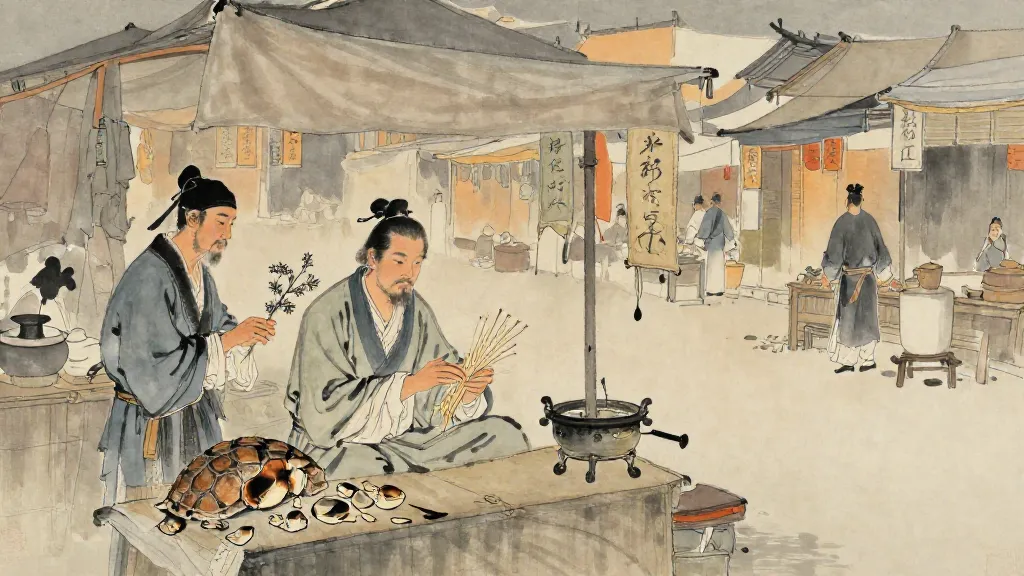
How Sima Qian Described Fortune-Telling
Two chapters of the Shiji profile the diviners of Han China—market-stall fortune-tellers, turtle-shell readers, and milfoil-stalk casters. The debate they record about whether divination is superstition or pattern recognition was already two thousand years old.
From The Court Historian's Art — a series on how astronomy, record-keeping, and divination became one tradition.
The Fortune-Teller in the Market
Sometime around 140 BC, two senior officials of the Han court—Song Zhong (宋忠), a Palace Grandee, and Jia Yi (賈誼), a Court Academician—decided to visit the fortune-tellers' stalls in the eastern market of Chang'an. They had been discussing the teachings of the sages, and Jia Yi proposed a test. He had already observed the great ministers and officials at court, he said, and found them wanting. Perhaps wisdom had migrated elsewhere: “吾聞古之聖人,不居朝廷,必在卜醫之中”—“I have heard that the sages of antiquity, when not at court, were to be found among the diviners and physicians.”
What they found at the market stall was a man named Sima Jizhu (司馬季主), a scholar from Chu who made his living casting fortunes. He was sitting with three or four disciples, discoursing on the Way of heaven and earth, the movements of the sun and moon, and the foundations of yin-yang and auspicious and inauspicious forces. Sima Qian records that the two officials bowed and took their seats. Sima Jizhu then spoke “several thousand words, none of which went against reason” (語數千言,莫不順理).
This scene opens chapter 127 of the Shiji (史記), the 日者列傳 (Biographies of the Day-Readers). It is a short chapter—barely two thousand characters—but it contains one of the most pointed debates in all of Chinese classical literature about the social status and intellectual legitimacy of divination.
The Accusation
The two officials were impressed by Sima Jizhu's learning but baffled by his circumstances. Why would a man of such obvious talent occupy so lowly a position? Their question was blunt: “吾望先生之狀,聽先生之辭,小子竊觀於世,未嘗見也。今何居之卑,何行之汙?”—“Looking at your bearing and listening to your words, we have never encountered the like in the world. Why then do you dwell so low, and why is your profession so base?”
Their reasoning was the standard elite view. Divination was a trade of charlatans who flattered their clients with inflated predictions of wealth and rank, invented disasters to frighten them, invoked ghosts and spirits to drain their money, and took excessive fees for their trouble. “夫卜筮者,世俗之所賤簡也”—“Diviners are what common society holds cheap and dismisses.”
The Counterattack
Sima Jizhu's response is devastating. He laughed—the text says he “clutched his belly with laughter” (捧腹大笑)—and then systematically dismantled the officials' assumption that government service was inherently noble and market divination inherently base.
The people you call virtuous, he told them, are nothing to admire. They crawl before power and speak in servile tones. They form cliques, trade favors, claim credit for work they did not do, inflate empty reports to their superiors, and feast while their families starve. His indictment builds to a striking analogy: these officials are “夫為盜不操矛弧者也”—“thieves who simply don't carry spears and bows.”
Against this, Sima Jizhu placed the diviner's practice. The diviner sits properly dressed, speaks with ritual propriety, charges only a modest fee, and through his work heals the sick, saves the dying, and helps families with marriages and childbirth. He invoked Laozi: “上德不德,是以有德”—“The highest virtue does not claim virtue; therefore it has virtue.” The diviner's rewards are great and his fees small. Is that not what Laozi meant?
He then turned to the divination tradition itself, tracing it back to its deepest roots: “自伏羲作八卦,周文王演三百八十四爻而天下治”—“Since Fuxi created the eight trigrams and King Wen of Zhou elaborated the 384 lines, the world has been well governed.” King Goujian of Yue had used the eight trigrams to defeat his enemies and achieve hegemony. “由是言之,卜筮有何負哉”—“Considering all this, how has divination ever failed anyone?”
The Effect
The result of this exchange is one of the most vivid passages in the Shiji. The two officials were struck dumb: “忽而自失,芒乎無色,悵然噤口不能言。於是攝衣而起,再拜而辭。行洋洋也,出門僅能自上車,伏軾低頭,卒不能出氣。”—“Suddenly lost, ashen-faced, their mouths shut and unable to speak. They gathered their robes, rose, bowed twice, and departed. They walked unsteadily, barely managed to climb into their carriage at the gate, leaned against the crossbar with heads bowed, and could not even exhale.”
Three days later, they met again and confessed to each other what Sima Jizhu had made them realize: “道高益安,勢高益危”—“The higher one's Way, the more secure one becomes; the higher one's position, the more precarious.” The fortune-teller in the market was safe precisely because he lacked worldly power.
Sima Qian then adds a coda of cold irony. Song Zhong was later sent as an envoy to the Xiongnu, failed in his mission, and was punished. Jia Yi became tutor to the King of Liang, whose death from a horse fall left Jia Yi so grief-stricken that he refused food and died. “此務華絕根者也”—“These were men who pursued the flower and severed the root.”
The Material Culture of Turtle and Milfoil
Chapter 128, the 龜策列傳 (Biography of Turtle and Milfoil Divination), is a different kind of document entirely. Where chapter 127 is a philosophical dialogue, chapter 128 is closer to a technical manual—an account of the physical instruments and ritual procedures behind ancient Chinese divination.
Sima Qian opens with a sweeping claim: “自古聖王將建國受命,興動事業,何嘗不寶卜筮以助善”—“Since antiquity, whenever sage kings founded states and received Heaven's Mandate, whenever they undertook great enterprises, they always treasured divination by turtle and milfoil to assist the good.” He traces the practice through the Xia, Shang, and Zhou dynasties, noting that each relied on auspicious signs to legitimize their rise to power. Even the barbarian peoples of the frontiers, he observes, though they lacked the court hierarchies of China, had their own methods of divination—some using metal and stone, others grass and wood.
The chapter then turns to specifics. Turtles for divination had to be at least a foot and two inches (尺二寸) in length. They were harvested from Lujiang commandery, where twenty shells were sent annually to the Grand Diviner's office (太卜官). A turtle had to live a thousand years to reach the proper size. There were eight named categories of sacred turtles—the North Star Turtle, the Southern Asterism Turtle, the Five Planets Turtle, the Eight Winds Turtle, and others—each bearing distinctive markings on its belly.
Milfoil Stalks and the Roots of the I Ching Method
The milfoil (蓍, shi) sections are especially significant for understanding the I Ching tradition. Sima Qian describes the ideal milfoil plant: a cluster of one hundred stalks growing from a single root, guarded by a sacred turtle beneath and covered by blue clouds above. This was the ancient standard. By the Han dynasty, the text acknowledges, such perfect specimens were impossible to find. The practical threshold had dropped to eighty stalks at least eight feet long, or—for common people who simply wanted to cast hexagrams—sixty stalks of six feet would suffice.
This passage matters because it documents the physical basis of what would become the yarrow-stalk method of I Ching consultation. The procedure—dividing a bundle of fifty stalks through a sequence of sortings to produce a hexagram line by line—evolved from exactly the milfoil-stalk practices Sima Qian describes here. When the three-coin method later replaced the stalk method (because it was faster and didn't require a supply of yarrow), the mathematical structure shifted slightly, but the principle remained: generating hexagram lines through a process with controlled randomness.
Six Lines implements the three-coin method. But the coins are a simplification of the stalks, and the stalks are what Sima Qian saw in the market stalls and the Grand Diviner's office. The lineage is direct.
The Parable of the Captured Turtle
The longest section of chapter 128 is a remarkable extended narrative about King Yuan of Song (宋元王) and a sacred turtle. A divine turtle, serving as an envoy from the Yangtze River to the Yellow River, was caught in a fisherman's net. That night, the turtle appeared in King Yuan's dream, describing itself as a tall man in dark embroidered robes riding a covered carriage, trapped and unable to continue its journey.
The king consulted his advisor Weiping (衛平), who used a divination board (式) to identify the creature: “玄服而乘輜車,其名為龜”—“Dark robes and a covered carriage—its name is Turtle.” When the turtle was brought to court, it stretched its neck forward three steps (interpreted as giving thanks), then pulled back (interpreted as wanting to leave).
What follows is a philosophical debate between the king and his advisor. Weiping argued the turtle was a treasure that could win wars and secure the state: “先得此龜者為天子”—“Whoever first obtains this turtle becomes Son of Heaven.” The king refused. Keeping the turtle by force would make him no better than a fisherman, he said. “暴得者必暴亡,彊取者必後無功”—“What is violently seized is violently lost; what is taken by force brings no lasting achievement.” He compared himself to Jie and Zhou—the archetypal tyrants—and ordered the turtle released.
In the end, Weiping persuaded him to keep it. The turtle was sacrificed according to ritual, its shell divined upon, and the results proved unfailingly accurate. “宋國最彊,龜之力也”—“Song became the strongest state—by the power of the turtle.”
But Sima Qian immediately undercuts the triumph with a reflection that reads like a Daoist koan: the turtle could appear in a king's dream but could not free itself from a fisherman's net. It could make ten predictions that were all correct, but could not avoid the knife that cut its shell. “聖能先知亟見,而不能令衛平無言”—“It had divine foreknowledge, yet could not make Weiping stop talking.”
Superstition or Pattern Recognition?
Read together, chapters 127 and 128 reveal something striking: the debate about whether divination is legitimate was not invented by modern skeptics. It was already fully articulated in 100 BC. Song Zhong and Jia Yi represented the rationalist critique—divination is fraud practiced on the gullible. Sima Jizhu represented the practitioner's defense—divination is a disciplined art rooted in the same cosmic patterns the sages observed.
Sima Qian himself refuses to resolve the tension. He records Sima Jizhu's eloquent defense without commentary, then shows the officials who dismissed divination coming to ruin. He describes the sacred turtle's power, then notes its helplessness. He documents the Grand Diviner's office under Emperor Wu, where rewards for accurate divination ran into the millions—and then records that the same system was used for political purges, with families destroyed on the basis of divination accusations.
This ambivalence is methodological, not accidental. Sima Qian was a historian whose job title (太史令) literally encompassed both record-keeping and divination. He was not a credulous believer, but neither was he a dismissive skeptic. His approach was to present the evidence—the arguments, the practices, the outcomes—and let the reader decide.
Five Schools of Fortune-Telling
A postscript to chapter 127, attributed to the later editor Chu Shaosun (褚先生), preserves a fascinating detail about divination under Emperor Wu. When the emperor asked a gathering of diviners whether a particular day was suitable for a wedding, the different schools gave contradictory answers. The Five Elements school (五行家) said yes. The Kanyu geomancers (堪輿家) said no. The Jianchu calendar school (建除家) said unlucky. The Congchen star school (叢辰家) said greatly inauspicious. The calendar specialists (歷家) said slightly inauspicious. The Heaven-and-Man school (天人家) said slightly auspicious. And the Taiyi school (太一家) said greatly auspicious.
The emperor's ruling: avoid the death taboos, but follow the Five Elements school as primary. This is exactly the kind of problem the Xieji Bianfang Shu would attempt to resolve eighteen centuries later—the proliferation of competing almanac systems giving contradictory guidance for the same day. The problem Sima Qian documented in 100 BC was the same problem Emperor Qianlong tried to fix in 1739.
Why This Matters for Six Lines
Six Lines is a divination app built on classical Chinese sources. The three-coin method it implements descends directly from the milfoil-stalk procedures documented in chapter 128. The Yilin verses it displays for each hexagram transformation come from a tradition that treated divination as a serious intellectual discipline—the tradition Sima Jizhu defended in the Chang'an market.
The almanac layer of Six Lines—the daily suitability ratings—addresses exactly the problem the Han emperor faced: multiple schools, contradictory recommendations, no single authority. The Xieji Bianfang Shu that Six Lines follows was the Qing dynasty's attempt to impose order on that chaos, using the Five Elements framework Emperor Wu had already designated as primary.
And Sima Qian's refusal to declare divination either real or fraudulent remains the honest position. The I Ching does not require belief in the supernatural. It requires engagement with a system of pattern recognition that has been refined over three millennia. Sima Jizhu's argument was not that the gods speak through the stalks. His argument was that the practice is disciplined, the tradition is ancient, and the results—for the people who use them—are worth more than the modest fee charged. The diviner helps the sick, assists the dying, guides the uncertain. That is the tradition Six Lines inherits.
References
Primary Sources
史記·日者列傳 (Records of the Grand Historian, Biographies of the Day-Readers). Sima Qian, chapter 127. Chinese Text Project
史記·龜策列傳 (Records of the Grand Historian, Biography of Turtle and Milfoil Divination). Sima Qian, chapter 128. Chinese Text Project
Chinese source text from 中華古詩文古書籍網 (arteducation.com.tw), cross-referenced with the 中華書局點校本 edition.
Context
The Shiji (史記) is a 130-chapter history compiled by Sima Qian (司馬遷, c. 145–86 BC) during the Western Han dynasty. Chapters 127–128 fall in the 列傳 (Biographies) section. Some material in both chapters is attributed to the later editor Chu Shaosun (褚少孫), who supplemented the Shiji after Sima Qian's death.