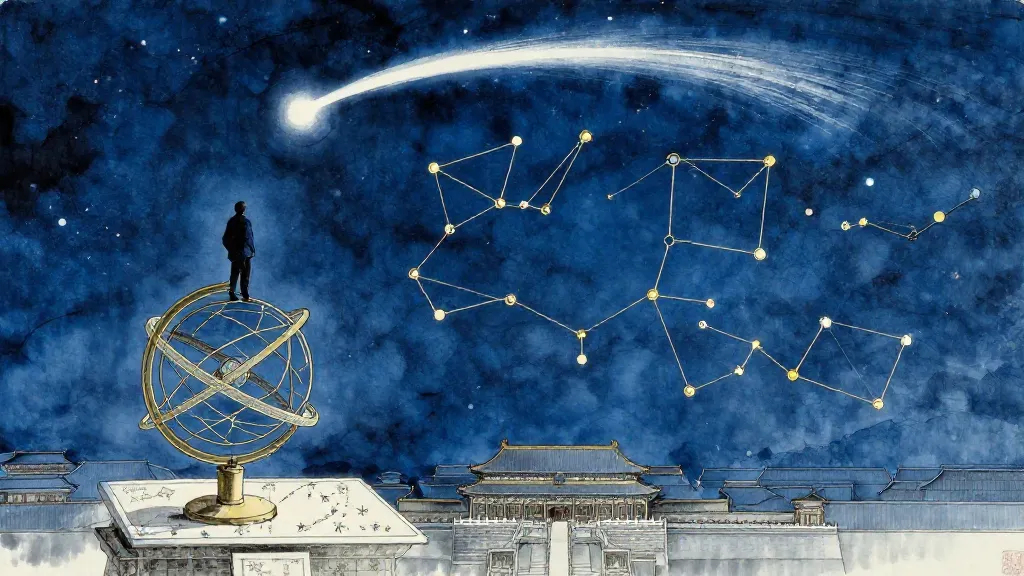
The Astronomer's Chapter on the Heavens
In Chapter 27 of the Records of the Grand Historian, Sima Qian maps the entire sky as a bureaucracy—complete with palaces, ministers, and prison yards. Every star has a political meaning. Every comet is a memo from heaven.
Part 1 of Shiji Deep Dives—a series on individual chapters of the Records of the Grand Historian. See also The Court Historian's Art for the broader tradition connecting astronomy, record-keeping, and divination.
A Star Catalog That Reads Like an Org Chart
The 天官書 (Tiānguān Shū, Treatise on the Celestial Offices) is the twenty-seventh chapter of the Shiji and one of the most remarkable documents in the history of astronomy. It is not, however, what a modern astronomer would recognize as a star catalog. There are no coordinates, no magnitudes, no spectral classifications. What Sima Qian produced instead is a political map of the sky—a systematic account of every major constellation and celestial phenomenon, organized not by position or brightness but by bureaucratic function.
The chapter's title tells you everything. 天官 means "celestial offices" or "heavenly officials." The sky is not a void filled with burning gas. It is a court, staffed by ministers, generals, and functionaries, presided over by the Pole Star as the emperor's throne. Every constellation is a department. Every anomaly is a dispatch. The Grand Historian's job was to read these dispatches and advise the throne accordingly.
The Purple Palace at the Center
Sima Qian begins where any proper court survey would begin: at the center. The opening line of the 天官書 establishes the cosmic throne:
中宮天極星,其一明者,太一常居也;旁三星三公,或曰子屬。後句四星,末大星正妃,餘三星後宮之屬也。環之匡衛十二星,籓臣。皆曰紫宮。
The Central Palace is the Celestial Pole Star. Its brightest star is the permanent seat of Taiyi [the Supreme Unity]. The three stars beside it are the Three Excellencies, or sometimes called the Heir's retinue. The four curved stars behind, the last large star being the Principal Consort, the other three belonging to the Rear Palace. The twelve stars encircling and guarding them are vassal ministers. All of this is called the Purple Palace.
The structure is unmistakable. The Pole Star is the emperor. The nearby stars are his highest ministers (三公, the Three Excellencies), his consort, and his harem. The surrounding twelve stars are vassal lords forming a protective ring. The entire circumpolar region is named 紫宮, the Purple Palace—the celestial counterpart of the Forbidden City that would be built fifteen centuries later and bear the same name (紫禁城).
This is not metaphor. In the cosmology Sima Qian inherited and codified, the correspondence between celestial and terrestrial governance was structural. The sky was a court. The question was not whether the stars had political meaning, but whether the observer was skilled enough to read it.
The Four Palaces and the Big Dipper
After establishing the center, Sima Qian surveys the sky in four quadrants, each governed by a mythological creature and associated with a cardinal direction, a season, and a set of constellations. The East is the Azure Dragon (東宮蒼龍), associated with spring. The South is the Vermillion Bird (南宮硃鳥), associated with summer. The West is the White Tiger (西宮鹹池), associated with autumn. The North is the Dark Warrior (北宮玄武), associated with winter.
Each palace is a department of heaven, and within each department the constellations have specific jurisdictions. 房 (Fang, the Room) and 心 (Xin, the Heart) are the throne room of the Eastern Palace—心 is literally called 明堂, the "Hall of Light," the same term used for the emperor's ritual hall on earth. The Southern Palace's key constellation is 太微 (Taiwei), described as "the court of the Three Luminaries" (三光之廷), complete with gates, flanking doors, and designated seats for the Five Emperors.
Connecting all of this is the Big Dipper (北斗七星), which Sima Qian calls the "Emperor's Chariot" (帝車). The Dipper does not merely point north. It governs:
分陰陽,建四時,均五行,移節度,定諸紀,皆系於斗。
Dividing yin and yang, establishing the four seasons, regulating the Five Phases, shifting the节 and度 [seasonal markers], fixing all chronological systems—all are bound to the Dipper.
The Dipper is the celestial timekeeper. As its handle rotates through the year, pointing to different directions at dusk, midnight, and dawn, it establishes the calendar. This passage is one of the clearest ancient statements linking astronomical observation to calendrical authority—the same authority that the Taichu reform would formalize a generation later.
The Five Planets as Five Phases
The heart of the 天官書—its longest and most technically dense section—is the treatment of the five visible planets. Each planet is mapped to one of the Five Phases (五行), a cardinal direction, a season, a pair of Heavenly Stems, and a category of political disorder that triggers its appearance as a punitive omen.
Jupiter (歲星) is Wood, east, spring, days 甲 and 乙. "When righteousness is lost, punishment comes forth through Jupiter" (義失者,罰出歲星). Saturn (填星) is Earth, center, late summer, days 戊 and 己. Venus (太白) is Metal, west, autumn, days 庚 and 辛: "It governs killing. When killing goes wrong, punishment comes forth through Venus" (主殺。殺失者,罰出太白). Mars (熒惑) is Fire, south, summer, days 丙 and 丁. Mercury (辰星) is Water, north, winter, days 壬 and 癸.
This is not casual symbolism. Sima Qian devotes page after page to the observational rules for each planet: how many degrees it moves per day, how long it remains visible, when it goes retrograde, and what each behavior means for the state. Mars retrograding through a constellation for three months brings calamity in five; holding for nine months means the loss of more than half a kingdom's territory. Venus appearing in daylight—"contending for brightness" (爭明) with the Sun—means a revolution: "strong states weaken, small states grow powerful, and female rulers flourish" (彊國弱,小國彊,女主昌).
The most consequential omen is convergence. When all five planets gather in a single lunar mansion:
五星皆從而聚於一舍,其下之國可以義致天下。
When all five planets follow and gather in a single lodge, the state below it may claim all under heaven through righteousness.
Sima Qian then provides his historical proof: "At the rise of Han, the five planets gathered in the Eastern Well" (漢之興,五星聚於東井). The founding of the dynasty was written in the sky before it happened on earth. This is the logic of the 天官書—not that heavenly signs cause events, but that heaven and the human world are synchronized systems, and a competent observer can read one to anticipate the other.
Comets, Meteors, and the Grammar of Crisis
Beyond the regular planets, Sima Qian catalogs a menagerie of transient phenomena, each with specific political semantics. Comets (彗星) signal military campaigns. The "Banner of Chiyou" (蚩尤之旗)—a comet with a curved tail shaped like a flag—appears when "the king shall campaign in all four directions" (見則王者征伐四方). The "Heavenly Dog" (天狗), a large meteor that strikes the ground "like a dog," leaving a scorched crater "several qing in area," signals the destruction of armies within a thousand li.
There are also the "guest stars"—novae and supernovae, though Sima Qian did not distinguish them from other transients. The "Auspicious Star" (景星) appears only over states that have the Way (有道之國). The "Candle Star" (燭星) resembles Venus but does not move; wherever it shines, that city falls into chaos. Even sounds count: "Heavenly Drums" (天鼓), a sound "like thunder but not thunder," originating in the sky but felt on the ground, means war will erupt at the location below.
What emerges is a complete grammar of celestial crisis. Every type of anomaly has a defined meaning, a geographic application, and a temporal window. The system is not arbitrary—it is rule-bound, teachable, and testable against historical records. This is exactly what Sima Qian does in the chapter's closing sections, matching omens from the Spring and Autumn period and the Qin-Han transition to the events that followed them.
Cloud Qi and the Eight Winds
The final third of the 天官書 shifts from stars to atmosphere. Sima Qian describes how to read cloud formations (望雲氣) at different distances—looking up for events within 300–400 li, looking at the horizon for a thousand li, climbing high for three thousand li. Military clouds have specific shapes: cavalry qi is "low and spread out" (卑而布), infantry qi "clumps together" (摶), and a formation that rises high in front and drops low behind means the army is in flight.
He then describes a New Year's Day forecasting protocol. On the morning of the first day of the first month, the observer notes which of the eight cardinal and intercardinal directions the wind comes from. South wind means great drought. Northeast wind means an excellent harvest. East wind means great floods. The chapter even maps the hours of the day to specific crops: dawn to the first meal corresponds to wheat; the first meal to midday, to millet; and so on through hemp at sunset.
This is where the 天官書 reveals its deepest connection to the tradition Six Lines inherits. The eight winds correspond to the eight trigrams. The five planets correspond to the five phases. The twenty-eight lunar mansions divide the sky into the same coordinate system that the hexagram-calendar uses to map the sixty-four hexagrams onto the solar year. Sima Qian is not inventing these correspondences. He is documenting the system of correlative cosmology that was already operational in his time—and that would continue to develop through Meng Xi, Jing Fang, and ultimately into the imperial almanac tradition.
The Grand Historian's Conclusion
Sima Qian ends the chapter with a personal reflection that doubles as a methodological statement. He traces the lineage of sky-readers from the mythological astronomers Chong and Li through the Shang dynasty diviner Wu Xian, the Zhou historian Shi Yi, and down to the Warring States astronomers Gan De and Shi Shen—the same figures whose star catalogs form the technical backbone of the chapter. Then he states his operating principle:
太上脩德,其次脩政,其次脩救,其次脩禳,正下無之。
The highest response is to cultivate virtue. The next is to correct governance. The next is to organize relief. The next is to perform exorcism. The very lowest is to do nothing at all.
This hierarchy is essential. The point of reading celestial omens is not fatalism. It is not that a comet will destroy an army regardless of human action. The point is that heaven signals imbalances, and the competent ruler responds—ideally through moral cultivation, and failing that, through progressively more desperate measures. The sky gives warnings. The question is whether anyone is qualified to read them and whether the ruler is willing to act.
And then the final line of the Grand Historian's own analysis—a sentence that summarizes not just this chapter but his entire conception of what the 天官 system is:
日變脩德,月變省刑,星變結和。
When the sun changes, cultivate virtue. When the moon changes, examine punishments. When the stars change, seek harmony.
Three celestial categories, three governmental responses. The system is compact, actionable, and entirely political. This is not mysticism. It is statecraft conducted through astronomical observation.
"Historian" Is the Wrong Translation
The 天官書 is the single best proof that the title 太史 ("Grand Historian") is mistranslated in every Western-language source. As discussed in The Grand Historian's Other Job, the 太史 was simultaneously historian, astronomer, astrologer, and calendar-master. The 天官書 is the proof that these were not separate sidelines. This is the core of the job: systematic observation of the sky, interpretation of anomalies, and advice to the throne based on celestial signs.
The chapter catalogs 91 constellations containing over 500 individual stars, all organized by political function. It provides observational rules for the five planets spanning their complete synodic cycles. It records historical correlations between celestial events and political outcomes across four centuries. And it does all of this not as a theoretical exercise but as an operational manual for the office Sima Qian himself held.
When he writes 余觀史記—"I have examined the historical records"—he is not speaking as a detached scholar. He is the incumbent Grand Historian reviewing his department's archives, checking whether the observational protocols handed down from Gan De and Shi Shen still hold against two centuries of accumulated data. The 天官書 is a departmental report filed by the department head.
From Star Catalog to Hexagram Calendar
Why does a chapter on ancient Chinese astronomy matter for an I Ching app? Because the system Sima Qian documents is the system that the hexagram-calendar tradition was built on top of.
The 天官書 establishes the coordinate grid: twenty-eight lunar mansions dividing the ecliptic, five planets cycling through them in predictable periods, four directional palaces corresponding to four seasons. Within a generation of Sima Qian, Meng Xi and Jing Fang would take exactly this grid and overlay the sixty-four hexagrams onto it, creating the 卦氣 (hexagram-qi) system that assigns each hexagram to a specific period of the solar year.
The five-planet/five-phase correspondence that Sima Qian articulates in such detail—Jupiter-Wood-Spring, Mars-Fire-Summer, Saturn-Earth-Late Summer, Venus-Metal-Autumn, Mercury-Water-Winter—is the same correspondence that structures the Heavenly Stems and Earthly Branches used in Chinese calendar computation to this day. The eight winds of the 天官書 map to the eight trigrams. The twelve "vassal stars" encircling the Pole correspond to the twelve Earthly Branches that govern the months and the double-hours.
The 天官書 is not the origin of these correspondences—they predate Sima Qian. But it is the earliest surviving systematic documentation of them, written by the one official whose job required mastery of all the threads simultaneously. When Six Lines computes a day's hexagram from the solar term, the Earthly Branch, and the Five Phase associations, it is working within the same framework that Sima Qian codified in this chapter twenty-one centuries ago.
The tradition has sources. The sources have authors. And the authors had a title—天官, Celestial Officer—that described exactly what they did: they read the sky, and they told the state what it meant.
References
Primary Sources
史記·天官書 (Records of the Grand Historian, Treatise on the Celestial Offices). Sima Qian's star catalog and celestial omen manual. Chinese Text Project
史記·曆書 (Records of the Grand Historian, Treatise on the Calendar). Sima Qian's companion chapter on calendrical methods. Chinese Text Project
史記·太史公自序 (Records of the Grand Historian, Grand Historian's Self-Narration). Sima Qian's account of his own role and methods. Chinese Text Project
Secondary Scholarship
Pankenier, David W. Astrology and Cosmology in Early China: Conforming Earth to Heaven. Cambridge University Press, 2013. The definitive study of Chinese astral-political cosmology from the Shang through the Han.
Sun, Xiaochun and Jacob Kistemaker. The Chinese Sky During the Han: Constellating Stars and Society. Brill, 1997. Technical reconstruction of Han-dynasty star catalogs including the 天官書 constellation system.
Cullen, Christopher. Astronomy and Mathematics in Ancient China: The Zhou Bi Suan Jing. Cambridge University Press, 1996. Context for the mathematical astronomy underlying Sima Qian's observational framework.