The Grand Historian's Other Job: Divination at the Imperial Court
The 太史 wasn't just a record-keeper. He was astronomer, diviner, and calendar-master in one—and the fact that we now treat these as separate disciplines says more about us than about him.
Part 3 of The Court Historian's Art — a series on how astronomy, record-keeping, and divination became one tradition.
A Title That Doesn't Translate
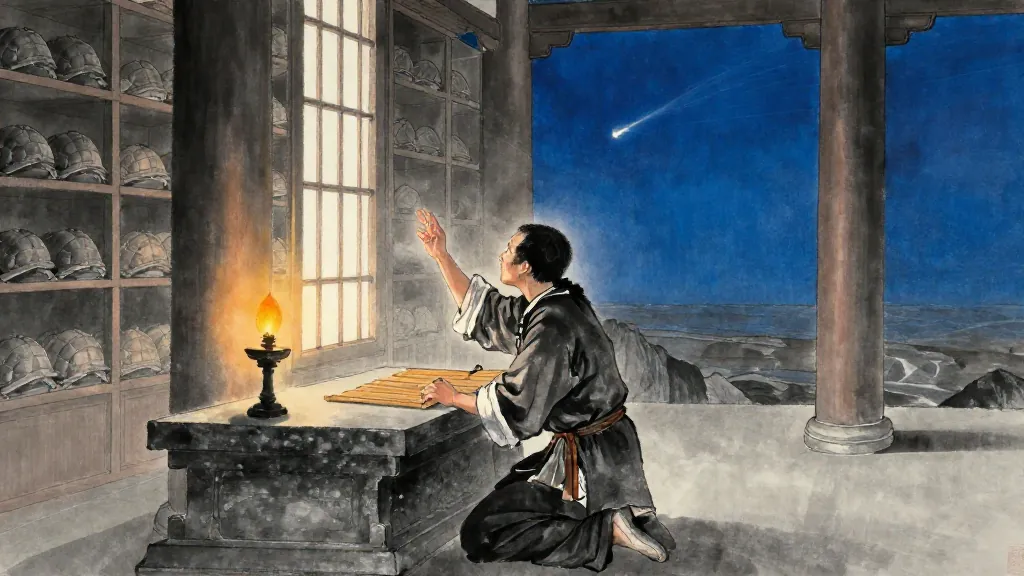
Start with the title itself: 太史, Tàishǐ. Every English translation gets it wrong. "Grand Historian" is the standard rendering, and it's misleading in a specific way—it makes you think the job was about writing history. It wasn't. Or rather, writing history was one function of a role that also encompassed astronomical observation, calendar management, omen interpretation, and advising the ruler on auspicious timing for state rituals. The 太史 didn't do these things in addition to his "real" job. These things were the job. All of them. Simultaneously.
And while we're questioning inherited translations: the words we use to discuss this tradition don't even sound like what the people in the tradition actually said. “I-Ching” is modern Mandarin filtered through a 19th-century British romanization. When the text was being compiled, 易經 was pronounced something closer to *lek-kēŋ—with a hard -k stop on the first character and a velar k- on the second. Cantonese yik-ging, Japanese Eki-kyō, and Korean Yeok-gyeong all preserve these sounds. Mandarin lost them through centuries of contact with the languages of the northern steppe. ( More on how the sounds were lost—and where they survived.)
The Rites of Zhou (周禮), which codifies the bureaucratic structure of the idealized Zhou court, places the 太史 within the Spring Office (春官宗伯)—the division responsible for ritual and religious affairs. The text specifies his duties: he manages the six types of canonical texts, he oversees the calendar, he records auspicious and inauspicious days, he orders the arrangement of court rituals by season. He is, in modern terms, simultaneously the national librarian, the director of the astronomical bureau, the keeper of the official chronicle, and the state's chief consultant on ritual timing.
Here's what people miss. This isn't administrative confusion—some ancient bureaucratic accident where unrelated duties got bundled into one office. The duties are unified because the cosmology is unified. If you believe—as Han dynasty thinkers did—that heaven (天) and human affairs (人事) are connected through observable patterns (象), then the person who reads celestial patterns and the person who records human patterns and the person who advises on when to act are obviously the same person. Splitting them apart would be like hiring one person to read sheet music, another to hear it, and a third to play the instrument.
The Zuo Zhuan: Historians Who Divine
If you want to see this unified role in action, the Zuo Zhuan (左傳)—the great narrative commentary on the Spring and Autumn Annals—is where you go. It's a text from roughly the 4th century BC that covers events from 722 to 468 BC, and it's full of court historians doing things that modern scholars would distribute across at least three departments.
In the ninth year of Duke Xi (僖公九年, 651 BC), the historian Xin Liao (辛廖) performs a divination using the Changes for the ruler of Jin, interpreting the hexagram he obtains to advise on political strategy. In the twenty-second year of Duke Xiang (襄公二十二年, 551 BC), the court historian records a solar eclipse, interprets its significance for state affairs, and notes which rituals should be performed in response—all in the same passage, as a single continuous act of professional competence.
This is not a historian who happens to dabble in divination on weekends. The Zuo Zhuan treats omen interpretation as a core function of the historian's office. When a comet appears, the historian explains what it means. When the ruler is deciding whether to launch a military campaign, the historian performs a divination and records both the question and the result. When the outcome later confirms or refutes the prediction, the historian records that too. Observation, interpretation, and documentation form a single workflow.
And notice—the Zuo Zhuan doesn't present this as remarkable. There's no moment where the text says "and then, unusually, the historian also performed a divination." It's simply what historians do. The role is taken for granted in exactly the way that we take it for granted that a modern journalist both investigates stories and writes them up. You wouldn't note it as surprising because the two activities aren't separable.
Sima Qian's Treatise on the Celestial Offices
The strongest evidence for the unified discipline comes from its most famous practitioner. Sima Qian (司馬遷), the Grand Historian whose role in the Taichu calendar reform we covered in Article 1, didn't just write dynastic history. The Shiji (史記, Records of the Grand Historian) contains 130 chapters, and one of them is the Treatise on the Celestial Offices (天官書)—a systematic survey of the stars and planets, their movements, and their correspondences with human affairs.
Think about what that means structurally. The same work that contains biographies of emperors and generals and philosophers also contains a comprehensive star catalog. Sima Qian didn't put the 天官書 in a separate book. He didn't treat it as a hobby project, an appendix, or a digression. It sits alongside his treatises on ritual, music, the calendar, and economics as one of the eight shū (書, treatises) that together describe the systems governing civilization.
The 天官書 is organized by celestial region. It maps the sky into five palaces (五宮), associates specific star groups with specific government offices and territorial regions, and describes what it means when planets enter certain constellations or when unusual phenomena appear. The language is observational—Sima Qian records what was seen and what followed—but the framework assumes that celestial events and terrestrial events are part of a single pattern system.
This is not astrology in the modern Western sense—not a system of personality typing based on birth charts. It's closer to what you'd get if the head of a national weather bureau were also required to maintain the historical record of how weather events correlated with political outcomes, and to advise the government accordingly. Empirical observation, pattern recognition, institutional memory, and practical counsel—all integrated.
The Cosmological Framework: Heaven and Human Affairs
To understand why this integration made sense, you need the cosmological premise that underlay it. In Han dynasty thought—crystallized by thinkers like Dong Zhongshu (董仲舒) but drawing on older traditions—heaven and humanity are not separate domains that occasionally interact. They are two expressions of a single system, connected through gǎnyìng (感應), a term usually translated as "sympathetic resonance" or "stimulus and response."
The mechanism works through patterns (象, xiàng). Celestial phenomena display patterns. Human affairs display patterns. When the patterns align, things go well. When they diverge—when the calendar drifts, when eclipses go unpredicted, when the ruler acts against seasonal propriety—the misalignment manifests as disorder. The Book of Han's Treatise on Literature (漢書·藝文志) classifies knowledge accordingly: the six arts (六藝), including the Changes, are grouped together not because they share a subject matter but because they share a method—the reading and application of patterns.
Within this framework, the 太史's unified role makes perfect sense. Observing celestial patterns (astronomy), recording the patterns of human events (history), maintaining the system that synchronizes the two (the calendar), and consulting the canonical pattern-recognition instruments when specific decisions require guidance (divination)— these are four aspects of one discipline. The discipline is pattern literacy. The 太史 is its chief practitioner.
The I-Ching as Professional Instrument
This brings us to the Book of Changes (易經) itself, and to a recalibration of how you should think about it. In the hands of a court historian, the I-Ching was not a fortune-telling device. It was a pattern-recognition instrument—a structured method for analyzing situations in terms of interacting forces (yin and yang, the eight trigrams, the sixty-four hexagrams) and deriving counsel from the analysis.
The hexagram system encodes a complete typology of situations. Each hexagram represents a specific configuration of stacked broken and unbroken lines—a specific combination of upper and lower trigrams—and each configuration has associated texts describing its dynamics, its dangers, and its opportunities. When a court historian cast a hexagram, he was using a formal system to map the current situation onto this typology, then reading the associated texts for applicable insight.
The Book of Han's Treatise on Literature makes the classification explicit. It places the Changes first among the six classical arts (六藝略), calling it the wellspring of pattern-knowledge. This is not a marginal text relegated to a "superstition" category. It's the foundational text of the entire classical curriculum, positioned as the root from which the other arts branch.
And the historians used it as such. The Liu Yao method that later systematized I-Ching consultation into a rigorous analytical technique didn't emerge from nowhere. It grew from centuries of court historians applying the Changes to real decisions and refining their methods based on observed results. The tradition was empirical in its own way—not controlled experiments, but institutional memory accumulated over generations of practice by trained professionals.
The Discipline Fractures
So what happened? If the unified discipline made such good sense within its cosmological framework, why did it split apart?
The short answer is that the cosmology changed. As Chinese thought evolved through the medieval and early modern periods, the tight coupling between heaven and human affairs loosened. Astronomy became increasingly technical and mathematical—focused on prediction accuracy rather than omen interpretation. History became a literary and moral enterprise, concerned with narrative and judgment. Divination persisted but was gradually excluded from the highest levels of official culture, pushed toward the margins even as it remained enormously popular.
The bureaucracy split accordingly. By the Tang dynasty, the astronomical bureau (太史局, later 司天監) and the historical office (史館) were separate institutions with separate staffs. The unified title persisted in memory—everyone knew that Sima Qian had been 太史令, that the role had once encompassed everything—but the living practice had fragmented into specializations.
This is the trajectory that modern Western scholarship inherited and accelerated. When 19th and 20th-century sinologists encountered the Chinese tradition, they mapped it onto their own disciplinary categories: astronomy here, history there, divination over in the "religion and superstition" bin. The result was a set of translations and interpretive frameworks that made it nearly impossible to see the original unity. "Grand Historian" sounds like a historian. It doesn't sound like an astronomer- diviner-calendar-master who also happened to write things down.
The Thread Forward
But the tradition didn't vanish—it just went underground, or rather, it persisted in systems that retained the integration even after the institutions had split. The Taichu calendar reform was a product of this unified discipline: a historian petitioned for it, an astronomer designed it, and the resulting calendar became the framework onto which hexagram theorists mapped the Changes. The hexagram-calendar systems that Meng Xi and Jing Fang developed in the decades after the reform—systems that assigned hexagrams to specific days and solar terms—were only possible because someone still understood that calendrical time and divinatory pattern-reading were aspects of the same project.
That thread runs all the way forward to the Qing dynasty, to the Xieji Bianfang Shu (協紀辨方書) of 1739, which synthesizes calendrical calculation, astronomical observation, and day-selection methodology into a single imperial reference. The compilers of that text were working within the 太史 tradition even if the title had long since been retired. The discipline survived its own institutional decomposition.
Why This Matters Now
Six Lines exists in the space that the 太史 once occupied—not because an app can replace an imperial office, but because the app works with the same materials the 太史 worked with: hexagrams, calendrical cycles, the coordination of time and pattern. When you consult a hexagram through Six Lines, you're using a system that was designed by and for people who read the sky, kept the calendar, recorded the annals, and consulted the Changes as part of a single integrated practice.
The tradition has sources. The sources have names. And the names belonged to people whose job title—太史—contained an entire cosmology in two characters.
References
Primary Sources
史記·天官書 (Records of the Grand Historian, Treatise on the Celestial Offices). Sima Qian's systematic survey of celestial phenomena and their correspondences with human affairs. Chinese Text Project
左傳 (Zuo Zhuan). Narrative commentary on the Spring and Autumn Annals, containing extensive examples of court historians performing divination, interpreting omens, and advising rulers. Chinese Text Project
周禮·春官 (Rites of Zhou, Spring Officials). Official description of the 太史 role and its responsibilities within the Zhou court bureaucracy. Chinese Text Project
漢書·藝文志 (Book of Han, Treatise on Literature). Classifies the I-Ching among the six classical arts and provides the Han dynasty framework for organizing knowledge. Chinese Text Project
Secondary Scholarship
Loewe, Michael. Divination, Mythology and Monarchy in Han China. Cambridge University Press, 1994. Study of divination's institutional role in Han court politics and governance.
Raphals, Lisa. Divination and Prediction in Early China and Ancient Greece. Cambridge University Press, 2013. Comparative analysis of divinatory practices and their relationship to political and intellectual authority.