What Does “I-Ching” Actually Sound Like?
The two most common romanizations—“I-Ching” and “Yi Jing”—both reflect modern Mandarin. Neither one sounds like what the people who wrote the text actually said.
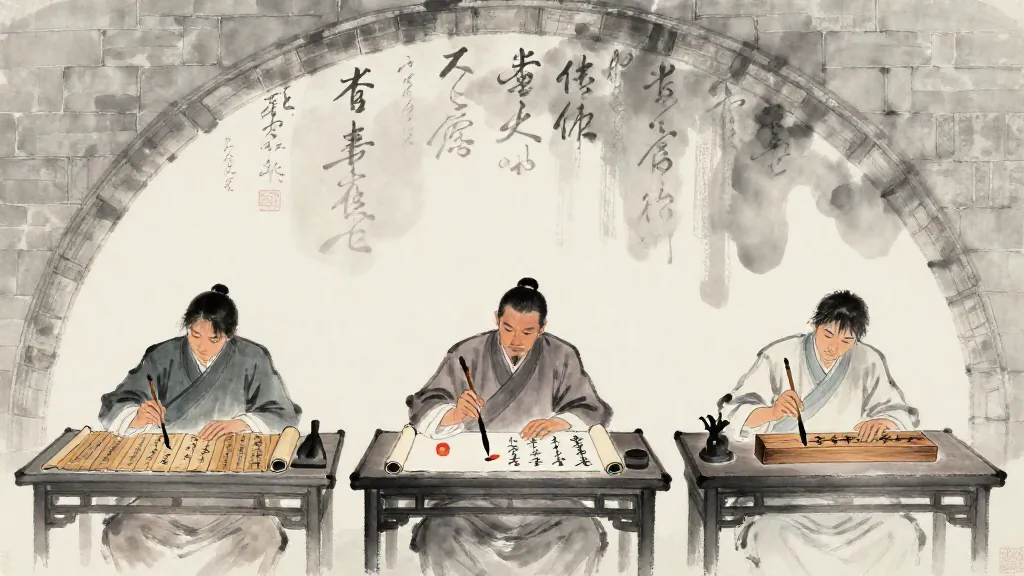
The Sounds We Lost
When the core text of the 易經 was being compiled—roughly 800 to 200 BC, during the Western Zhou and Warring States periods—the two characters were pronounced something like *lek k-lˤeŋ. That's the reconstruction from William Baxter and Laurent Sagart, the current standard in historical Chinese linguistics (Baxter & Sagart, Old Chinese: A New Reconstruction, Oxford, 2014). Zhengzhang Shangfang's independent reconstruction gives a similar result: *leɡs keːŋ.
Say those sounds out loud. They don't sound like “ee-ching.” They don't sound like “yee-jing” either. The first character, 易, started with an *l- and ended with a hard -k stop. The second, 經, had a velar k- initial—a hard “k” sound at the front of the syllable. Modern Mandarin has lost both features.
Why Mandarin Sounds Different
Here's the part most people don't know. Mandarin isn't just “Chinese.” It's specifically northern Chinese, and northern Chinese pronunciation was reshaped by centuries of contact with the languages of the steppe—Jurchen, Mongol, Manchu. The linguist Mantaro Hashimoto called this process the “Altaicization of Northern Chinese” (Hashimoto, “The Altaicization of Northern Chinese,” in Contributions to Sino-Tibetan Studies, 1986).
The pattern is systematic. Northern Chinese varieties, near the toneless Altaic languages, lost tonal complexity. They dropped the final stop consonants—the -p, -t, and -k endings that Old and Middle Chinese used extensively. This category of syllables, called the entering tone (入聲, rùshēng), simply vanished from Mandarin. Meanwhile, southern Chinese varieties—Cantonese, Hokkien, Hakka—were geographically insulated from steppe contact and preserved these archaic features.
The result: Cantonese yik-ging (易經) preserves both the final -k stop on 易 and the velar k/g- initial on 經. Mandarin yì-jīng has lost both. The southern pronunciation is closer to what the Zhou dynasty court would have heard.
The Evidence Hiding in Korean and Japanese
If you want proof that these sounds were real, you don't need to reconstruct anything. You just need to listen to how Korean and Japanese borrowed Chinese words.
When Chinese characters entered Korea and Japan—primarily during the Tang and Song dynasties—they carried the pronunciation of that era with them. Those pronunciations then froze in place, even as Chinese continued to evolve. The Sino-Korean and Sino-Japanese readings are linguistic fossils: snapshots of how Chinese sounded a thousand years ago.
易經 in Japanese is Eki-kyō (えききょう). That “eki” preserves the final -k that Mandarin dropped. The “kyō” preserves the velar k- initial that Mandarin palatalized to j-. In Korean, it's Yeok-gyeong (역경). Same pattern: the -k ending on 역 and the g- initial on 경.
The numbers make this even more striking:
| # | Mandarin | Cantonese | Korean | Japanese | What Mandarin lost |
|---|---|---|---|---|---|
| 1 (一) | yī | yāt | il (일) | ichi | Final -t |
| 6 (六) | liù | lohk | yuk (육) | roku | Final -k |
| 7 (七) | qī | chāt | chil (칠) | shichi | Final -t |
| 8 (八) | bā | baat | pal (팔) | hachi | Final -t |
| 10 (十) | shí | sahp | ship (십) | juu | Final -p |
Every column except Mandarin preserves final consonants that Middle Chinese had. Korean and Japanese don't “sound like Cantonese”—they all independently preserve features of the same older Chinese that Mandarin lost. Cantonese is simply the living dialect closest to what the loanwords froze in place (Norman, Chinese, Cambridge, 1988).
The Romanization Zoo
Given all of this, it's not surprising that the English-speaking world can't agree on how to spell the name. The major systems:
- I-Ching — Wade-Giles romanization (1859). Created by Thomas Wade, refined by Herbert Giles. The standard in English for over a century. Reflects Mandarin pronunciation.
- Yi Jing / Yìjīng — Hanyu Pinyin (1958). The People's Republic's official romanization system. Now the academic standard. Also reflects Mandarin.
- Yi-King — EFEO (École française d'Extrême-Orient) romanization. Used by early French Jesuits and sinologists who worked with speakers of southern Chinese dialects. The irony: their transcription is closer to the ancient pronunciation than either Wade-Giles or Pinyin.
There's also the Yale system (Yì Jīng, same as Pinyin for Mandarin), Gwoyeu Romatzyh (Yih Jing, using spelling to encode tones), and various missionary romanizations that never achieved standardization. Each system made different trade-offs between phonetic accuracy, learnability, and political context.
The 1913 Pronunciation War
There's a popular story that Cantonese lost its bid to become China's national language by a single vote. It's a good story. It's also not what happened.
What actually happened is messier and more interesting. In 1913, the newly founded Republic of China convened the Commission on the Unification of Pronunciation (讀音統一會) in Beijing. Forty-four delegates arrived from twenty-six provinces. The task: decide on a standard national pronunciation for approximately 6,500 characters.
The conference ran for months. The northern Mandarin faction, led by Wang Zhao (王照), had the numbers—more provinces spoke Mandarin variants. But the southern delegates fought fiercely for their features: the entering tone, the distinctions between -n and -ng endings, the sounds their dialects preserved from Middle Chinese.
The breaking point came when Wang Rongbao (王榮寶), a leader of the southern faction, used a Shanghai colloquialism that Wang Zhao misheard as a Mandarin curse. Wang Zhao attacked him physically and chased him out of the assembly hall. Wang Rongbao never returned (Ramsey, The Languages of China, Princeton, 1987; Kaske, The Politics of Language in Chinese Education, 1895–1919, 2008).
With the southern opposition weakened, the commission produced a compromise: the 老國音 (“old national pronunciation”), a hybrid that included some entering-tone distinctions. But the compromise satisfied no one. By 1932, it was quietly replaced by the 新國音 (“new national pronunciation”)—essentially Beijing Mandarin. The entering tone was formally dropped. The sounds that Cantonese, Hokkien, Korean, and Japanese preserved were declared officially irrelevant to the national standard.
Why Six Lines Uses “I-Ching”
We standardize on “I-Ching” because that's the romanization most English speakers know. It's the search term people type. It's the word on the spines of the translations they grew up with.
The romanization is the door, not the room. If you've read this far, you now know that the text was called something closer to *lek-kēŋ when its lines were first written down—and that the sounds survive in Cantonese yik-ging, Japanese Eki-kyō, and Korean Yeok-gyeong. The tradition is older than any one way of writing it in the Latin alphabet.
We meet readers where they are. The scholarship happens inside.
References
Historical Phonology
Baxter, William H. & Sagart, Laurent. Old Chinese: A New Reconstruction. Oxford University Press, 2014. Baxter-Sagart reconstruction data
Zhengzhang Shangfang (鄭張尚芳). 上古音系 (The Phonological System of Old Chinese). Shanghai Educational Publishing House, 2003.
Norman, Jerry. Chinese. Cambridge University Press, 1988. Standard reference on Chinese dialect geography and historical phonology.
Coblin, W. South. “A Brief History of Mandarin.” Journal of the American Oriental Society 120.4 (2000): 537–552.
Language Contact & Standardization
Hashimoto, Mantaro J. “The Altaicization of Northern Chinese.” In Contributions to Sino-Tibetan Studies, ed. John McCoy & Timothy Light, 76–97. Leiden: Brill, 1986.
Ramsey, S. Robert. The Languages of China. Princeton University Press, 1987.
Kaske, Elisabeth. The Politics of Language in Chinese Education, 1895–1919. Leiden: Brill, 2008.
Chen, Ping. Modern Chinese: History and Sociolinguistics. Cambridge University Press, 1999.
Sino-Xenic Readings
Miyake, Marc Hideo. Old Japanese: A Phonetic Reconstruction. RoutledgeCurzon, 2003.
“How Chinese, Japanese and Korean Numbers Sound the Same.” 中文秘诀. Comparative analysis of number pronunciations across Mandarin, Cantonese, Shanghainese, Japanese, and Korean.
Six Lines uses classical source texts for its almanac, hexagram calendar, and consultation system—the same tradition these sounds carried for two millennia. The romanization is I-Ching. The scholarship goes deeper.