The Taichu Reform: When China Rebuilt Its Calendar
In 104 BC, a historian, an astronomer from Sichuan, and a calendar expert won a competition to redesign how China measured time. The conventions they established still govern the Chinese calendar today.
Part 2 of The Court Historian's Art — a series on how astronomy, record-keeping, and divination became one tradition.
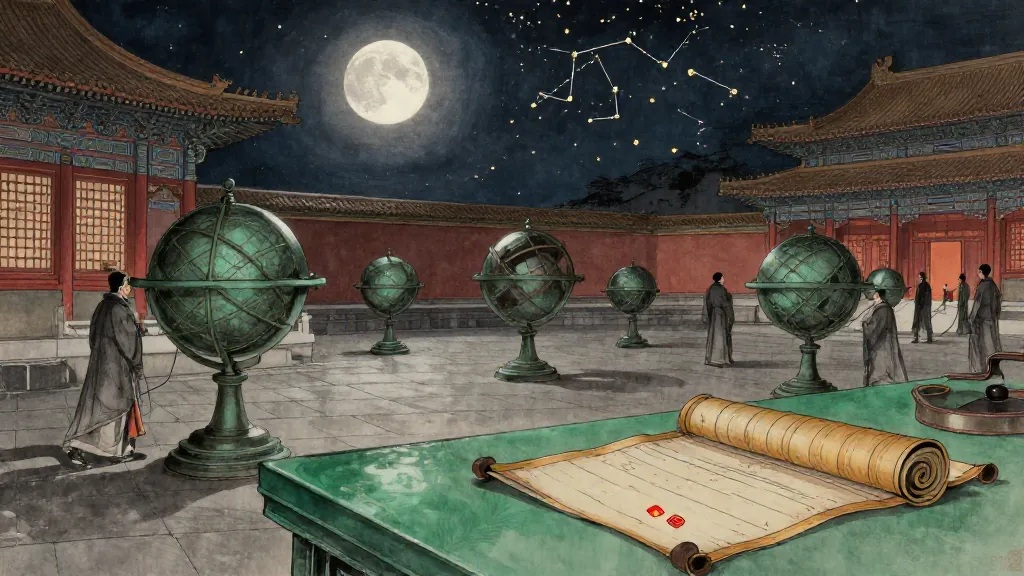
The Problem with the Old Calendar
By the early decades of the Western Han dynasty, the calendar was wrong—and everyone who mattered knew it. The system in use was the Zhuanxu calendar (顓頊曆), inherited from the Qin, which started the year in the tenth month and had accumulated enough drift that its predictions of solstices and eclipses were visibly off. For an empire that grounded its political legitimacy in the Mandate of Heaven (天命), a broken calendar wasn't a technical inconvenience. It was a constitutional crisis.
Here's what you need to understand about the Chinese calendar in this period: it wasn't a passive timekeeping device. The calendar was an instrument of state. The emperor's authority to issue the calendar—the zhèngshuò (正朔)—was an assertion that his dynasty had correctly read the heavens and could therefore guide human affairs. A calendar that missed the winter solstice by two days was a calendar that said, in effect, the emperor had lost touch with heaven.
The People Who Fixed It
In 104 BC, Emperor Wu of Han (漢武帝) ordered a formal calendar reform. Twenty competing proposals were submitted. The one that won came from an unlikely team: Luoxia Hong (落下閎), an astronomer from Sichuan with no court pedigree, and Deng Ping (鄧平), a specialist in calendrical computation. The petition that set the process in motion had been filed by three officials: Gongsun Qing (公孫卿), Hu Sui (壺遂), and Sima Qian (司馬遷).
That last name deserves a pause. Sima Qian is the most famous historian in Chinese civilization—the author of the Shiji (史記, Records of the Grand Historian), a 130-chapter work that established the model for all subsequent Chinese dynastic histories. But his official title was 太史令, Grand Historian, and that title didn't mean what "historian" means today. The Grand Historian managed the court's astronomical observations, maintained the calendar, recorded omens, and advised on auspicious timing for state rituals. History, astronomy, and divination were not separate departments. They were one job.
This is the thread that matters. The person who shaped how China recorded its past was the same person responsible for reading the heavens and keeping time. Sima Qian didn't see a contradiction between these roles. In the cosmology of the period, observing celestial patterns and observing human patterns were expressions of the same discipline. The calendar was where these observations became operational.
Three Changes That Still Hold
The resulting calendar—named Taichu (太初, "Grand Inception")—is the oldest Chinese calendar whose parameters are fully recorded. It introduced three structural conventions that remain in force over two thousand years later.
1. The Year Starts in the First Month (正月 = 寅月)
The Qin calendar, and the early Han calendar that copied it, began the year in the tenth month—the month corresponding to the Earthly Branch 亥 (Hài). This was the Qin dynasty's choice, tied to their association with the element Water. The Taichu reform restored the older convention attributed to the Xia dynasty: the first month (正月, Zhēngyuè) corresponds to 寅 (Yín), the third Earthly Branch.
This sounds like a technicality. It isn't. Every Chinese calendar system since the Taichu reform—including the one your phone uses when it shows you the lunar date—assumes that month one maps to 寅. The iOS Calendar(identifier: .chinese) API assumes it. The formula for mapping lunar months to Earthly Branches—(month + 1) % 12—depends on it. When you look at a Chinese almanac and the first month is labeled 寅, you are looking at a convention that Luoxia Hong and Deng Ping established in 104 BC.
2. The Twenty-Four Solar Terms Become Official (二十四節氣)
Solar terms existed before the Taichu reform. Farmers observed seasonal markers—the arrival of particular rains, the blooming of specific flowers, the behavior of animals at predictable intervals. But the Taichu calendar was the first to formally integrate all twenty-four solar terms into the official calendar system, spacing them at 15° intervals along the ecliptic and dividing them into pairs: 節氣 (jiéqì, pre-climate markers) and 中氣 (zhōngqì, mid-climate markers).
This formalization had consequences that extended far beyond agriculture. Once the solar terms were standardized and anchored to precise astronomical positions, they became available as a coordinate system for other kinds of reckoning. The hexagram qi cycle (卦氣六日七分), developed by Meng Xi and Jing Fang in the decades following the reform, maps the sixty-four hexagrams onto the solar year using the solstices and equinoxes as anchor points. That system was only possible because the Taichu reform had given the solar terms precise, standardized positions. The calendar created the coordinate system; the hexagram theorists then plotted their patterns onto it.
3. The Intercalary Month Rule (無中氣置閏法)
A lunisolar calendar has a fundamental tension: lunar months don't divide evenly into solar years. The Chinese calendar resolves this by inserting an intercalary (leap) month roughly every three years. Before the Taichu reform, the extra month was simply appended at the year's end—a blunt solution that created growing misalignment between months and seasons.
The Taichu reform replaced this with an elegant rule: any lunar month that does not contain a zhōngqì (major solar term) is designated as an intercalary month. Since 中氣 markers are spaced roughly 30.4 days apart and lunar months average 29.5 days, there will occasionally be a lunar month that falls entirely between two major solar terms. That month becomes the leap month, inheriting the number of the preceding month with the prefix 閏 (rùn, "intercalary").
This rule has governed Chinese calendar intercalation for over two thousand years. When iOS reports isLeapMonth = true for a date in the Chinese calendar, it is applying the same logic that Luoxia Hong formalized in 104 BC.
What the Reform Made Possible
Here's what people miss about the Taichu reform: its significance was not primarily astronomical. The calendar's original tropical year estimate—365 + 385/1539 days, computed using the 八十一分法 (81-division method)—was good but not exceptional. Later calendars improved on it. What the reform actually accomplished was standardization. It established the conventions that allowed everything else to be built.
Within a generation of the reform, Meng Xi (孟喜) and his student Jing Fang (京房) developed the hexagram qi system—a method of mapping the I-Ching's sixty hexagrams (excluding the four cardinal hexagrams 坎離震兌, which anchor the solstices and equinoxes) onto the solar year, with each hexagram governing roughly six days. This system depends entirely on the Taichu reform's formalized solar terms. Without a standardized winter solstice, there is no anchor for the hexagram cycle. Without standardized solar terms, there is no coordinate grid to map the hexagrams onto.
The Xieji Bianfang Shu (協紀辨方書), the 1739 imperial almanac that Six Lines follows, operates entirely within the Taichu reform's framework. Eighteen centuries separated the two projects, but the Qing dynasty compilers were still working within the conventions Luoxia Hong established: the same month-numbering, the same solar term system, the same intercalary month logic.
The Convention Persists; the Precision Doesn't
A necessary distinction. The Taichu calendar's original astronomical constants have long been superseded. Chinese astronomers revised their calculations repeatedly over the following centuries—the Sifen calendar, the Daming calendar, the Shoushi calendar, each improving on the precision of its predecessor. Modern computation has replaced all of them. The solar term dates your almanac app shows you are calculated using contemporary astronomical algorithms, not the 81-division method.
But the conventions persist. Month 1 is still 寅. The twenty-four solar terms are still the structural backbone of the calendar. The no-zhōngqì intercalary rule still determines which month is the leap month. The conventions outlasted the precision because they solved a different problem: not "where exactly is the sun?" but "how do we organize time so that everyone agrees on what month it is?"
Sima Qian understood this. The calendar reform he petitioned for was not fundamentally about better astronomy. It was about restoring the state's relationship with the heavens—which is to say, about restoring the credibility of the institutions that claimed to read and interpret celestial patterns. The Grand Historian's job was to make the heavens legible. The Taichu reform was his most lasting success.
Why This Matters for Six Lines
Six Lines implements the Chinese almanac. That means it inherits the Taichu reform's conventions as axioms: the month-branch mapping, the twenty-four solar terms, the intercalary month rule, the winter solstice as cycle anchor. These aren't arbitrary choices. They are the conventions that a Sichuan astronomer and an imperial historian established twenty-one centuries ago, and that every subsequent Chinese calendar system has adopted.
The lineage is traceable. The tradition has sources. And the sources lead back to a moment when reading the heavens and recording human affairs were the same discipline, practiced by the same person, in service of the same question: how should we organize our relationship with time?
References
Primary Sources
漢書·律曆志 (Book of Han, Treatise on Harmonics and Calendar). Original record of the Taichu reform. Chinese Text Project
史記·曆書 (Records of the Grand Historian, Treatise on the Calendar). Sima Qian's own account of the calendar's deficiencies and the reform petition. Chinese Text Project
漢上易傳·卷十三. Classical source for the hexagram qi (卦氣) and 六日七分 system referenced in connection with the reform's solar term standardization. Chinese Text Project
Secondary Scholarship
"Luoxia Hong." MacTutor History of Mathematics Archive, University of St Andrews. Biography of the Taichu calendar's principal astronomer. mathshistory.st-andrews.ac.uk
"Luoxia Hong." Biographical Encyclopedia of Astronomers, SpringerLink. Academic reference on Luoxia Hong's contributions. SpringerLink
"Calendar, Chronology and Astronomy." ChinaKnowledge.de. Comprehensive overview of Chinese calendar reforms including the Taichu. chinaknowledge.de
Liu, Yitong. "Computation of the Ancient Six Calendars." Technical analysis of pre-Taichu and Taichu calendar computation. ytliu0.github.io
Liu, Yitong. "24 Solar Terms (二十四節氣)." Detailed solar term calculation history. ytliu0.github.io