Don't Offend the Grand Duke: The Tai Sui System Explained
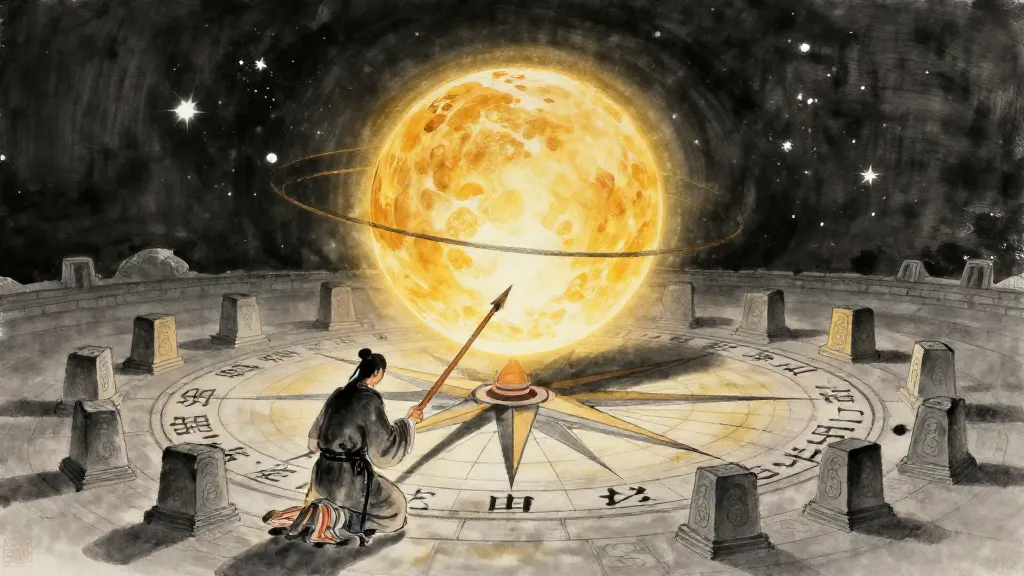
Everyone knows the saying “don't break ground above Tai Sui's head.” Almost nobody can tell you what Tai Sui actually is. The answer is Jupiter. The twelve-year cycle IS Jupiter's orbital period, mapped onto the Earthly Branches and turned into a directional taboo system. Here's how it works.
Part 1 of Spirit Stars Explained — the 116 spirit stars behind the Chinese almanac, from the Xieji Bianfang Shu.
The Planet in the Proverb
“太歲頭上動土”—“breaking ground above Tai Sui's head”—is one of the most common proverbs in Chinese. People use it the way English speakers say “don't poke the bear.” It means: don't provoke something vastly more powerful than you. And for most people, that's where the understanding ends. Tai Sui is some kind of god. Don't mess with it. Move on.
Here's what people miss: Tai Sui is a planet, not a god.
Or more precisely: Tai Sui started as a planet. Jupiter takes approximately 11.86 years to orbit the sun—close enough to 12 that ancient Chinese astronomers rounded it to a clean dozen and mapped each year of the cycle onto one of the twelve Earthly Branches. In a Zi (子) year, Jupiter occupies the Zi station. In a Chou (丑) year, the Chou station. And so on, around the twelve-station compass, one step per year.
The Xieji Bianfang Shu, the imperial almanac compiled under Emperor Qianlong in 1739, puts it plainly. The Shen Shu Jing (神樞經) passage it quotes says: Tai Sui is “the image of the human sovereign” (人君之象), “leading all spirits” (率領諸神), “governing the correct directional positions” (統正方位). It starts from the Upper Epoch at Zi and advances one position per year, completing a full circuit in twelve.
But there's a subtlety. Cao Zhengui, one of the commentators cited in the text, wrote flatly: “Tai Sui IS Jupiter” (太歲者歲星也). The Qianlong editors disagreed. Their editorial note draws a careful distinction: Jupiter is the “star of the year” (歲之星), Tai Sui is the “spirit of the year” (歲之神). You can use one to represent the other—but equating them is wrong (太歲即歲星則不可).
Why? Because Jupiter moves right (westward) through the sky, while Tai Sui moves left (eastward) on earth. Jupiter is visible; Tai Sui is invisible. Jupiter slightly exceeds one station per year, and every 144 years it “skips” a station (跳辰)—a known astronomical correction. The calendrical Tai Sui cycle has no such skip. It's a clean twelve-year rotation, idealized and simplified.
So Tai Sui is Jupiter's shadow. A conceptual counterpart moving in the opposite direction on earth, stripped of astronomical messiness and turned into a governance metaphor. The emperor of the spirit world, making his rounds.
What Tai Sui Actually Prohibits
The Shen Shu Jing lays out the prohibitions: “Whether the state is conducting tours, military campaigns, palace construction, or territorial expansion—one must not face toward [Tai Sui]” (不可向之). For commoners doing renovation or building walls, “one must absolutely avoid it” (並須迴避). The Huang Di Jing (黃帝經) adds: “The position of Tai Sui absolutely must not be violated” (必不可犯).
But here's the editorial twist that most almanac popularizers miss. The Qianlong editors note that Tai Sui's direction is fundamentally “upper auspicious” (上吉之方). It represents the sovereign. The direction isn't cursed—it's sacred. Common people (下民) don't dare use it, the same way you don't sit in the emperor's chair. The taboo is about hierarchy, not malevolence.
This matters for understanding what Tai Sui worship has become versus what the classical system actually says. In the classical system, Tai Sui is powerful and must be respected—not because it's evil, but because it's sovereign.
Year Breaker: The Opposite Direction
If Tai Sui occupies one compass station, the station directly opposite it is called 歲破 (Sui Po, “Year Breaker”). And this one IS straightforwardly bad.
The logic is simple: opposition. The twelve Earthly Branches form six pairs of opposites (六衝): Zi–Wu, Chou–Wei, Yin–Shen, Mao–You, Chen–Xu, Si–Hai. In a Zi year, Tai Sui is at Zi, so the Year Breaker is at Wu. In a Mao year, Year Breaker is at You. Always the direct opposition.
The Guang Sheng Calendar (廣聖曆) says of the Year Breaker's direction: “One must not build, move, marry, or travel far. Violators suffer loss of wealth and harm to the household head” (損財物及害家長). The Qianlong editors rate it as “the most inauspicious spirit” (最凶之神).
But even the Year Breaker has an exception. Military campaigns facing the Year Breaker are auspicious (戰伐向之吉). The editors' explanation is precise: “Facing the Year Breaker means you are sitting at Tai Sui” (向歲破即坐太歲). Your army has the Grand Duke at its back; the enemy occupies the broken direction. The auspiciousness comes from using Tai Sui's power, not from the Year Breaker itself. “This is still using Tai Sui, not using the Year Breaker” (仍是用太歲非用歲破也).
The Year Breaker has a second name: 大耗 (Da Hao, “Great Depletion”). Same position, different analytical function. Sui Po is the general directional taboo. Da Hao is the specific taboo for wealth and storage—don't store goods, don't warehouse grain, don't receive financial instruments in that direction. The editors explain why two names exist for one position: Tai Sui is “supreme without equal” (至尊無對). The position opposite a supreme being isn't occupied by another spirit—it's simply empty. The “breaking” is an effect of Tai Sui's power, not an independent force.
The Three Sha: Directional Kill Zones
The Three Sha (三煞) are the most practically consequential directional taboos in the entire almanac system. They're not three separate spirits so much as three positions within a single forbidden zone. Their names: 劫煞 (Robbery Sha), 災煞 (Disaster Sha), and 歲煞 (Year Sha).
To understand where they come from, you need the Three Combinations (三合) system. The twelve Earthly Branches group into four trios based on elemental affinity:
申子辰 → Water bureau (水局), flourishes in the North
寅午戌 → Fire bureau (火局), flourishes in the South
亥卯未 → Wood bureau (木局), flourishes in the East
巳酉丑 → Metal bureau (金局), flourishes in the West
Now here's the rule: the Three Sha occupy the direction opposite the bureau's flourishing position. Water flourishes in the North, so its Three Sha are in the South (巳午未). Fire flourishes in the South, so its Three Sha are in the North (亥子丑). Wood flourishes in the East, so its Three Sha are in the West (申酉戌). Metal flourishes in the West, so its Three Sha are in the East (寅卯辰).
The text from the Kao Yuan (考原) commentary explains the three individual sha as positions within the twelve-phase life cycle of the bureau's element: 劫煞 corresponds to the “extinction” (絕) position, 災煞 to the “embryo” (胎) position, and 歲煞 to the “nurturing” (養) position. These are the three stages between death and rebirth in the five-phase life cycle—the zone where the old element has died but the new one hasn't yet been born. The yin qi is at its most toxic here.
For a practical example: 2026 is a Wu (午) year, which belongs to the Fire bureau (寅午戌). Fire flourishes in the South. The Three Sha are in the North—亥 (Robbery Sha), 子 (Disaster Sha), 丑 (Year Sha). If you're doing construction, renovation, or moving in 2026, the classical system says: don't face north. Don't sit with the south at your back facing the northern directions. The Guang Sheng Calendar is explicit: “The land of the Year Sha must not be dug, built upon, or moved to. Violators harm children, descendants, and livestock” (不可穿鑿修營移徙犯之者傷子孫六畜).
There's a famous saying about the Three Sha: “suitable to face, not suitable to sit” (宜向不宜坐). You can face the sha direction if Tai Sui is at your back. You cannot sit with your back to Tai Sui, facing away from him, toward the sha. The directional logic, again, derives from the sovereign metaphor: you face the enemy with the king's authority behind you.
Year Punishment: The Penalty Direction
歲刑 (Year Punishment) operates on a different principle from the opposition-based Year Breaker. Instead of sitting across from Tai Sui, it follows the Earthly Branch punishment relationships (地支相刑)—a set of pairings where certain branches “punish” each other.
The punishment pairings don't follow a simple opposition pattern. Zi punishes Mao. Mao punishes Zi. Yin punishes Si. Si punishes Shen. Shen punishes Yin. It's a triangular system derived from five-phase interaction logic, and the Xieji Bianfang Shu cites the Yi Shi Feng Jiao (翼氏風角) for the cosmological explanation: “Metal is hard, Fire is strong, each guards its direction; Wood's leaves fall and return to roots; Water flows toward the end.”
The Guang Sheng Calendar says of the punishment direction: “One must not attack cities or join battle there, nor break ground or begin construction. Violation brings many disputes” (多鬪爭). Punishment is less catastrophic than the Year Breaker or the Three Sha—it produces conflict and litigation rather than destruction and death. But it's still firmly on the “avoid” list.
Tai Sui's Court: The Retinue Spirits
One of the most revealing passages in volume 3 describes how the spirits surrounding Tai Sui are arranged like an imperial court. Four spirits occupy the inter-cardinal corners (四維):
奏書 (Zou Shu, Memorial Presenter) — rear corner, closest to Tai Sui. The scribe who sits beside the sovereign. Auspicious.
博士 (Bo Shi, Scholar-Official) — front corner, opposite Zou Shu. The civil minister. Auspicious.
力士 (Li Shi, Strongman) — front corner. The imperial guard. Inauspicious direction.
蠶室 (Can Shi, Silkworm Chamber) — rear corner, opposite Li Shi. The inner palace, the empress's domain. Inauspicious direction.
Two positions ahead of Tai Sui sits 喪門 (Mourning Gate)—the front gate of the sovereign's chariot. Two positions behind sits 太陰 (Tai Yin, Great Yin)—the empress herself, always following two steps behind her lord. The Shiji records that the merchant Bai Gui used Tai Yin's position to predict harvest cycles and time his commodity trades. Astronomy became cosmology became agricultural economics.
The entire system is a political metaphor mapped onto a compass. The sovereign at center, ministers at the corners, the empress trailing behind, guards at the perimeter, and the most dangerous zone directly opposite the throne. Every spirit's position derives from its role in the cosmic court.
The Astronomical Layer and the Folk Layer
What makes the Tai Sui system intellectually interesting is that you can see three distinct layers of reasoning stacked on top of each other.
Layer 1: Astronomy. Jupiter's twelve-year orbital period. This is observable, measurable, and was known to Chinese astronomers at least since the Zhou dynasty. The Feng Xiang Shi (馮相氏) official described in the Zhou Li was responsible for tracking the twelve-year cycle. Zheng Xuan's commentary confirms: “sui refers to Tai Sui.”
Layer 2: Cosmological modeling. The twelve-station compass. The Three Combinations. The twelve-phase life cycle (長生 through 養). The opposition and punishment relationships. This is systematic, internally consistent, and follows the same five-phase logic that governs the entire almanac. You don't need to believe in it to see that it works as a model.
Layer 3: Folk practice. “Don't offend Tai Sui.” Temple rituals. Annual Tai Sui appeasement ceremonies. The proverb that opened this article. This layer strips away the astronomy and the modeling and replaces them with a simpler narrative: Tai Sui is a god. Don't anger him.
The Qianlong editors were working to preserve Layers 1 and 2 while pushing back against Layer 3. Their editorial preface to the entire Xieji Bianfang Shu explicitly targets “all the practitioners' unfounded, cumbersome, and contradictory theories” and resolves them by reference to “the four seasons, the five phases, generation and conquest, flourishing and decline.” The system they preserved is not superstition. It is cosmological modeling applied to scheduling.
Whether the model is correct is a separate question from whether it is coherent. The Tai Sui system is coherent. Every spirit's position can be derived from the year's Earthly Branch through a fixed set of rules. Every taboo follows from a defined relationship—opposition, punishment, Three Combination clash. There is no randomness. There is no ad hoc invention. It is a system.
What Six Lines Does With This
Six Lines implements the Tai Sui system as part of its daily almanac calculations. When the app flags a directional taboo for the year, it's computing the Tai Sui position from the year's Earthly Branch, then deriving the Year Breaker, the Three Sha, and the punishment direction using the rules described in volume 3 of the Xieji Bianfang Shu. Not a simplified “good direction / bad direction” score. The actual classical rules.
The next article in this series covers the monthly spirit stars (月神)—a faster-cycling version of the same system, where the same principles of opposition, combination, and five-phase logic play out on a thirty-day scale instead of a twelve-year one.
References
Primary Source
欽定協紀辨方書 (Qinding Xieji Bianfang Shu), juan 3: 義例一 (Principles, Part 1). Compiled under Emperor Qianlong, 1739. Siku Quanshu edition.
Spirit Stars Referenced
太歲 (Tai Sui / Grand Duke) · 歲破 / 大耗 (Year Breaker / Great Depletion) · 歲煞 (Year Sha) · 劫煞 (Robbery Sha) · 災煞 (Disaster Sha) · 歲刑 (Year Punishment) · 奏書 (Memorial Presenter) · 博士 (Scholar-Official) · 力士 (Strongman) · 蠶室 (Silkworm Chamber) · 喪門 (Mourning Gate) · 太陰 (Great Yin)
Classical Sources Cited in Volume 3
神樞經 · 黃帝經 · 廣聖曆 · 周禮 · 考原 · 曹震圭 · 李鼎祚 · 翼氏風角 · 曾門經 · 明時總要
Tai Sui entry: pages 27–32. Year Breaker / Great Depletion: pages 33–35. Three Sha (劫煞, 災煞, 歲煞): pages 87–93. Year Punishment: pages 105–110. Siku Quanshu manuscript copy.