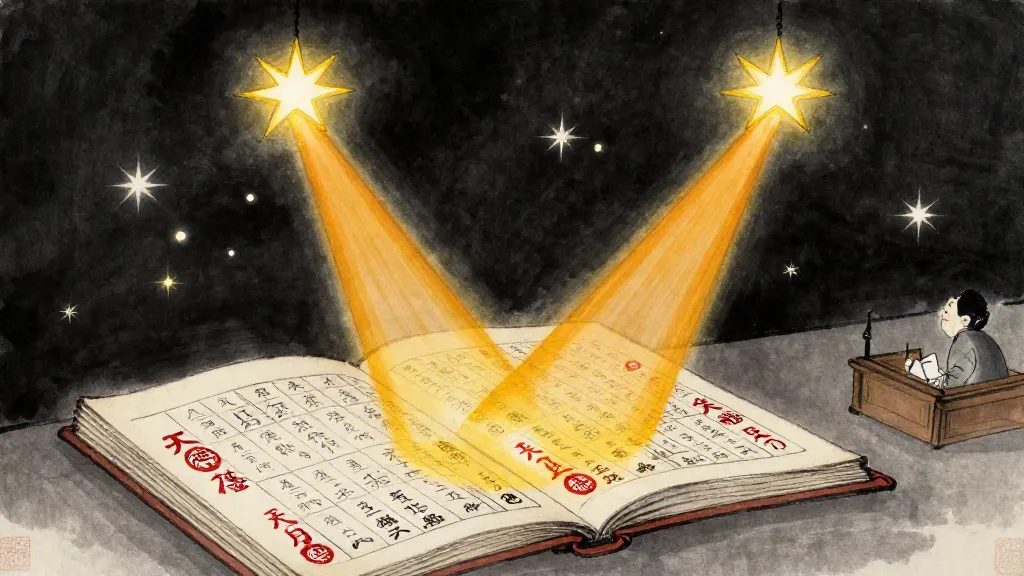
The Virtue Stars: Why Some Days Are Good for Everything
If you've read anything about the imperial almanac's activity lists, you've seen 天德 and 月德 in every single “suitable days” column. They're the universal pass. This article explains what they are, how they're calculated, and why they can override most taboo stars.
Part 2 of Spirit Stars Explained — how the 116 spirit stars of the imperial almanac actually work.
The Stars That Show Up Everywhere
Open the Xieji Bianfang Shu's activity lists—any of them—and start looking at the “suitable” column. Building a house? 天德、月德、天德合、 月德合. Raising a roof beam? Same four, plus a few extras. Repairing storehouses? Same four again. Getting married? Still there. Burying the dead? There too.
Of all 67 imperial activities catalogued in the text, virtually every one that lists specific suitable stars includes these four names: 天德 (Heavenly Virtue), 月德 (Monthly Virtue), 天德合 (Heavenly Virtue Harmony), and 月德合 (Monthly Virtue Harmony). Add the yearly equivalents—歲德 (Yearly Virtue) and 歲德合 (Yearly Virtue Harmony)—and you have the six Virtue Stars: the backbone of the system's concept of a “good day.”
Here's what people miss: the Virtue Stars are not just “good.” They're trumps. The Xieji Bianfang Shu rates them 上吉—“supreme auspicious”—and assigns them the notation 有宜無忌, which means “has suitability, no prohibitions.” A Virtue Star day can override many taboo conditions that would otherwise disqualify it. Understanding the Virtue Stars is understanding roughly half of how date selection actually works.
天德 and 月德: The Monthly Virtues
The two most commonly encountered Virtue Stars are 天德 (Heavenly Virtue) and 月德 (Monthly Virtue). Both rotate on a monthly cycle—meaning their position changes with each lunar month. But they rotate differently, and the difference reveals a fundamental principle of the system.
月德 (Monthly Virtue) is the simpler of the two. It cycles through four Heavenly Stems based on the season's dominant element:
寅午戌月,月德在丙
申子辰月,月德在壬
亥卯未月,月德在甲
巳酉丑月,月德在庚Months containing Fire-frame branches (寅午戌): Monthly Virtue at 丙 (Fire stem).
Water-frame months (申子辰): at 壬 (Water stem).
Wood-frame months (亥卯未): at 甲 (Wood stem).
Metal-frame months (巳酉丑): at 庚 (Metal stem).
The pattern: each three-month group shares a Earthly Branch “frame” (三合 / Triple Harmony), and 月德 falls on the yang Heavenly Stem whose element matches the frame's element. Fire-frame months get the Fire stem 丙. Water-frame months get the Water stem 壬. It is a clean, four-value rotation. If you know the month's branch, you know the Monthly Virtue in one lookup.
天德 (Heavenly Virtue) is more complex. It cycles through all twelve months individually, hitting a mix of Heavenly Stems and Earthly Branches:
正月丁、二月申、三月壬、四月辛
五月亥、六月甲、七月癸、八月寅
九月丙、十月乙、十一月巳、十二月庚Month 1: 丁. Month 2: 申. Month 3: 壬. Month 4: 辛. Month 5: 亥. Month 6: 甲. Month 7: 癸. Month 8: 寅. Month 9: 丙. Month 10: 乙. Month 11: 巳. Month 12: 庚.
Notice: Heavenly Virtue uses both Stems and Branches—丁 (a Stem) in month 1, 申 (a Branch) in month 2. This makes it harder to memorize than Monthly Virtue but gives it a wider range. Where 月德 cycles through only four values, 天德 visits twelve distinct positions across the full stem-branch space.
The underlying logic, as explained in the text's editorial commentary, involves the interplay of yin and yang within each month's elemental configuration. The details are intricate, but the practical effect is straightforward: every month has exactly one 天德 position and one 月德 position. Any day whose Heavenly Stem or Earthly Branch matches the month's 天德 or 月德 is a Virtue day.
天德合 and 月德合: The Combining Partners
Each Virtue Star has a “combining partner” (合) derived from the standard Heavenly Stem five-combination system (天干五合). The five combinations are:
甲己合、乙庚合、丙辛合、丁壬合、戊癸合
甲 combines with 己. 乙 combines with 庚. 丙 combines with 辛. 丁 combines with 壬. 戊 combines with 癸.
So if the month's 天德 is at 丁, then 天德合 is at 壬 (because 丁壬合). If 月德 is at 丙, then 月德合 is at 辛 (because 丙辛合). When 天德 lands on an Earthly Branch instead of a Stem—like 申 in month 2—the combination is derived from the Branch's six-harmony (六合) partner rather than the stem combination.
The combining partners carry nearly the same weight as the primary Virtue Stars. The Xieji Bianfang Shu consistently lists 天德合 and 月德合 in the suitable column right alongside 天德 and 月德. But the editorial commentary adds a nuance: there is a 剛柔之別—a distinction between “hard” and “soft.”
歲德無問陰年陽年皆剛辰也。歲德合無問陰年陽年皆柔辰也。外事以剛,內事以柔,古之志也。
“Yearly Virtue is always a hard/yang day regardless of the year type. Yearly Virtue Harmony is always a soft/yin day. External affairs favor hard days; internal affairs favor soft days—this is from the ancient records.”
This is a refinement most practitioners overlook. The primary Virtue Stars (天德, 月德, 歲德) are yang in character—better for public, external actions like construction, official appointments, and military affairs. Their combining partners (天德合, 月德合, 歲德合) are yin in character—better for domestic, internal actions like marriage, personal rituals, and family matters. The text notes that traditional date-selection practitioners (選擇家) “have not explicitly discussed this distinction,” but adds that “users can understand and apply it by inference” (用者可以意通也).
歲德 and 歲德合: The Yearly Virtues
The yearly Virtue Stars operate on a different timescale. Where 天德 and 月德 change every month, 歲德 (Yearly Virtue) and 歲德合 (Yearly Virtue Harmony) remain fixed for the entire year, determined by the year's Heavenly Stem.
The rule is elegant. Volume 5 of the Xieji Bianfang Shu, citing the Kaoyuan (考原), states:
五陽干當位自得,五陰干則取其合。蓋陽以自得為德,而陰以從陽為德也。
“The five yang stems take virtue at their own position (self-virtue). The five yin stems take virtue from their combination partner. Yang achieves virtue through self-possession; yin achieves virtue through following yang.”
In practice:
甲年:歲德在甲(self) 歲德合在己
乙年:歲德在庚(partner) 歲德合在乙
丙年:歲德在丙(self) 歲德合在辛
丁年:歲德在壬(partner) 歲德合在丁
戊年:歲德在戊(self) 歲德合在癸Yang stem years (甲丙戊庚壬): Yearly Virtue is the stem itself. Yin stem years (乙丁己辛癸): Yearly Virtue is the yang stem that controls it in the five-phase cycle.
The philosophical underpinning is drawn directly from the Yijing. The text cites Hexagram 2 (坤 Kun, The Receptive): “In the southwest one gains companions; in the northeast one loses companions.” The interpretation: yin's virtue lies in following yang. The yang stem stands on its own merit. The yin stem achieves virtue by aligning with the yang stem that governs it. This is not mysticism—it is a cosmological model of how yin and yang elements relate, applied to calendar mathematics.
The Zengmen Jing (曾門經) frames it in political metaphor: “Yang represents the Way of the ruler; yin represents the Way of the minister. The ruler's virtue resides in himself; the minister's virtue follows the ruler” (陽者君道也,陰者臣道也,君德自處,臣德從君也). The Yearly Virtue system maps the ruler-minister relationship onto the ten Heavenly Stems, and from that mapping, derives a specific stem that governs each year's “virtue direction.”
The Override Power
Here is where the Virtue Stars become genuinely important for practice. The Xieji Bianfang Shu contains explicit interaction rules—stated in the text, not inferred by later commentators—about how Virtue Stars interact with taboo stars (煞). The general principle: Virtue Stars can “resolve” (解) most taboo conditions.
This is not a blanket override. The text is specific about which taboos can be resolved and which cannot. The earth-specific taboos (土府, 土符, 地囊, 土王用事) that appear in every construction activity's forbidden list, for instance, are harder to override. But for many of the monthly taboo stars—月刑, 月厭, 大時, 天吏—a Virtue Star day neutralizes the conflict.
The practical effect is enormous. Without the Virtue Stars, the almanac's taboo system would be so restrictive that very few days in any given month would be usable for anything. The Virtue Stars function as the system's pressure valve: they create windows of opportunity inside what would otherwise be a wall of restrictions. This is why they appear in every activity's suitable list. They are not decoration. They are structural.
Two More Relatives: 歲幹德 and 歲枝德
Volume 5 of the Xieji Bianfang Shu also documents two additional yearly virtue calculations that are not listed in the standard almanac rotation but which the editors argue should be preserved.
歲幹合 (Yearly Stem Harmony) is, as the editors themselves acknowledge, functionally identical to the combination of 歲德 and 歲德合. For yin-stem years, the result equals 歲德. For yang-stem years, it equals 歲德合. The editors note this redundancy but argue the category should be retained because “yin and yang share the same function but differ in nature” (同職不同性)—the underlying principle is distinct even if the numerical result is the same.
歲枝德 (Yearly Branch Virtue) is more interesting. It occupies the Earthly Branch position five places ahead of Tai Sui (太歲), derived from the stem-combination at that position. The Shenshu Jing (神樞經) says it “rescues from calamity and aids the weak” (主救厄而濟弱). But here's the complication: the same branch position is simultaneously occupied by 死符 (Death Talisman) and 小耗 (Minor Depletion)—two inauspicious spirits.
The editors resolve this apparent contradiction with a principle that reveals the system's true sophistication: “Auspicious and inauspicious do not conflict at the same position” (美惡不嫌同位). Whether the position is auspicious or inauspicious depends on what activity you're undertaking. Building a private residence? The 小耗 influence applies—avoid it. Repairing a public bridge or embankment? The 歲枝德 influence applies—proceed. The same calendrical position can be good for one thing and bad for another. Context determines meaning.
The System's Logic
Step back, and the architecture becomes visible. The Virtue Stars are not a random collection of “lucky day” markers. They form a layered system:
Layer 1: Yearly. 歲德 and 歲德合, fixed for the entire year, determined by the year's Heavenly Stem. They set the baseline.
Layer 2: Monthly. 天德 and 月德, rotating each month, determined by the month's Earthly Branch. They provide the month-level overlay.
Layer 3: Combination. 天德合 and 月德合, the yin-natured partners of the monthly virtues. They double the available good days and provide yin-character alternatives for domestic affairs.
Layer 4: Interaction. The override rules that allow Virtue Stars to neutralize specific taboo conditions. This is the layer that makes the calendar practically usable.
Each layer is derived from a different computational rule—five-phase correspondence, stem combination, branch harmony, seasonal framing—but they all point in the same direction: identifying the days when the calendrical conditions are most favorable. The Virtue Stars are the system's way of saying “yes.”
And this is why, when you open any activity's suitable-stars list in the Xieji Bianfang Shu, the first four names are always the same. 天德, 月德, 天德合, 月德合. The universal pass. The system's permission slip. Now you know what they actually are.
References
Primary Source
欽定協紀辨方書 (Qinding Xieji Bianfang Shu), juan 4–5: 義例 (Exemplary Principles, volumes on monthly and yearly spirits). Also juan 11: 用事 (Activities) for the appearance of Virtue Stars in activity-specific suitable lists. Compiled under Emperor Qianlong, 1739. Siku Quanshu edition.
Classical Sources Cited in the Text
曾門經 (Zengmen Jing) · 廣聖曆 (Guangsheng Li) · 考原 (Kaoyuan) · 金匱經 (Jingui Jing) · 神樞經 (Shenshu Jing) · 李鼎祚 (Li Dingzuo) · 曹震圭 (Cao Zhengui)
Virtue Stars Referenced
天德 (Heavenly Virtue) · 月德 (Monthly Virtue) · 天德合 (Heavenly Virtue Harmony) · 月德合 (Monthly Virtue Harmony) · 歲德 (Yearly Virtue) · 歲德合 (Yearly Virtue Harmony) · 歲幹合 (Yearly Stem Harmony) · 歲枝德 (Yearly Branch Virtue)