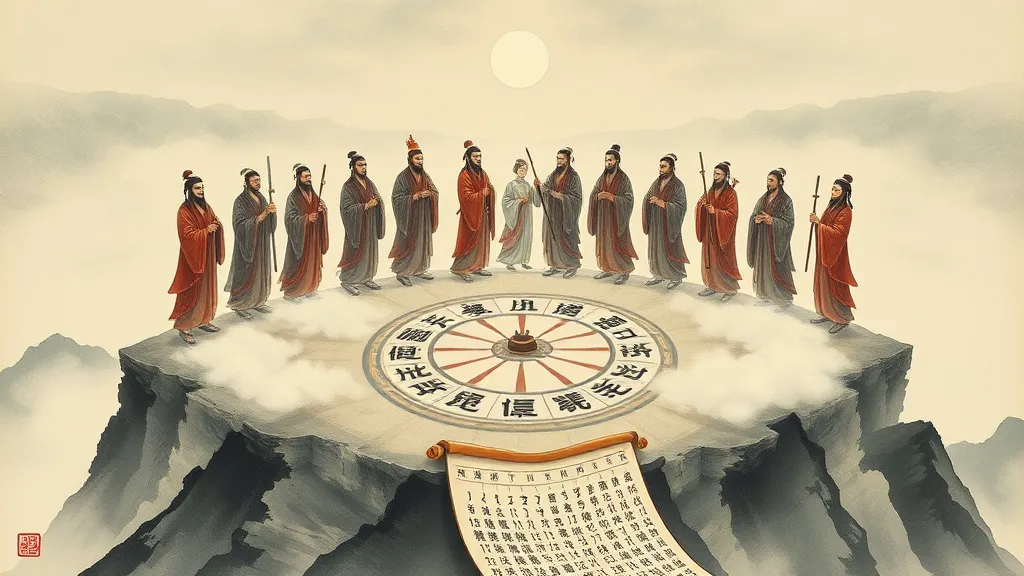
The Twelve Day Officers: How the Almanac Assigns a Character to Each Day
You've seen “Open Day” and “Close Day” in every almanac activity list. Now here's the system behind them. Each day gets one of twelve officers—and each officer has a personality. The system is called Jianchu (建除), it dates to at least the Warring States period, and it gives every day in the lunar month a one-word character assessment.
Part 4 of Spirit Stars Explained — the 116 spirit stars behind the Chinese almanac, from the Xieji Bianfang Shu.
The Twelve-Word Sentence
建除滿平定執破危成收開閉. Twelve characters. One month. Every day of the lunar month gets assigned one of these twelve “officers” (神) in sequence, cycling from the first to the twelfth and starting over. The cycle resets at each solar term boundary—when a new month begins, the count restarts from 建 (Establish).
The rule is simple: 建 always falls on the day whose Earthly Branch matches the month's branch. In the first month (寅 month), 建 falls on 寅 days. In the second month (卯 month), 建 falls on 卯 days. Then 除 follows on the next branch, 滿 on the one after that, and so on through all twelve. The Huainanzi, written in the second century BCE, gives the complete example: “In the first month, 建 is at Yin, 除 at Mao, 滿 at Chen, 平 at Si, 定 at Wu, 執 at Wei, 破 at Shen, 危 at You, 成 at Xu, 收 at Hai, 開 at Zi, 閉 at Chou.”
The system follows the Big Dipper's handle (斗杓). Where the handle points at dusk determines the month's branch, and the twelve officers rotate from that position. The Xuanze Zongjing, one of the classical date-selection manuals cited in the Xieji Bianfang Shu, says: “建 is the year's sovereign, the primal spirit, the commander of all auspicious and inauspicious spirits” (建為歲君為元神為吉凶眾神之主帥).
This matters because the twelve officers aren't an independent system. They're anchored to the same Earthly Branch framework that governs everything else in the almanac—Tai Sui, the Three Sha, the monthly spirits, all of it. The Jianchu cycle is one more rotation layered onto the same twelve-station compass.
What the Names Mean
The Qianlong editors didn't just list the twelve officers. They explained why each name follows the one before it—and the explanation reads like a compressed narrative about the life cycle of any endeavor.
建 (Establish) is the ruler of the month. Everything starts here. The character means to build, to found, to set up. It is the month's anchor point.
除 (Remove) follows immediately: “removing the old and bringing in the new” (除舊布新). After establishment comes clearing away what was there before. The month's transforming qi.
滿 (Full) takes the Daoist cosmological logic of “one generates two, two generates three”—three being the extreme of numbers. After clearing comes fullness.
平 (Balance) follows fullness because “when full, overflow is inevitable” (滿則必溢). The editors quote the Yijing: “Kan does not overflow” (坎不盈). After fullness, leveling.
定 (Settle) arrives at the fourth position from 建, which forms a Three Harmony (三合). Harmony means stability. “Once stable, one can grasp” (定則可執矣).
執 (Grasp) means holding onto what has been achieved. “執者守其成也”—grasping means guarding the accomplishment.
破 (Break) arrives because “nothing achieved doesn't eventually decay” (物無成而不毀). The seventh position is always in opposition (衝) to the first—the same structural clash that makes the sixth Heavenly Stem and the seventh Earthly Branch inherently antagonistic.
危 (Danger) follows breaking: “after breaking, the heart knows danger” (既破而心知危). The editors quote Mencius: “Through danger one reaches understanding; those who can perceive danger will succeed” (危故達夫心能危者事乃成矣).
成 (Accomplish) comes after danger because “成 forms a Three Harmony with 建”—the ninth position completes the triangular relationship. After perceiving danger, success.
收 (Collect) follows accomplishment: “from 建 to here is ten positions; ten is the extreme of numbers” (自建至此而十十極數也). Once accomplished, harvest.
開 (Open) is where the cycle prepares to restart: “ten equals one; the cycle returns to 建” (十即一也則復為建矣). The text says “建 is born from 開” (建固生於開者也)—開 represents vital qi (生氣), the sprouting of new energy. This is why 開 is rated the most auspicious of all twelve.
閉 (Close) ends the cycle: “without opening, the chambers of heaven and earth cannot give birth; hence ending with 閉” (不開則所謂發天地之房而物不能以生故受之以閉終焉). And the final line: “Only by closing can one rebuild—this accords with the Yijing” (唯其能閉故復能建與易同也).
Read the twelve names in sequence and you get a compressed theory of how anything works: establish, clear, fill, level, settle, hold, break, fear, accomplish, gather, open, close. It's not random. It's a lifecycle model disguised as a calendar system.
The Auspiciousness Rankings
There's a famous mnemonic that every almanac practitioner knows:
建滿平收黑,除危定執黃,成開皆可用
“Establish, Full, Balance, Collect are black (inauspicious); Remove, Danger, Settle, Grasp are yellow (auspicious); Accomplish and Open are both usable.”
But the Kao Yuan (考原) commentary in volume 4 points out that this folk mnemonic doesn't fully match the systematic analysis. The more precise ranking, derived from the associated spirit stars at each position, looks like this:
Most auspicious (上吉): 開 (Open)—associated with Blue Dragon, Great Yin, Vital Qi, Splendid Canopy
Very auspicious (大吉): 平 (Balance), 危 (Danger)
Auspicious (吉): 定 (Settle), 除 (Remove)
Mixed: 成 (Accomplish), 收 (Collect), 滿 (Full)
Variable: 建 (Establish), 執 (Grasp)
Inauspicious (凶): 閉 (Close)
Very inauspicious (大凶): 破 (Break)
Notice the surprises. 危 (Danger) is rated very auspicious despite its alarming name—it's associated with the Extreme Wealth Star (極富星) and Dragon Virtue (龍德). 平 (Balance) is very auspicious despite the folk mnemonic calling it “black.” And 建 (Establish), the month's ruler, is only “variable”—its nature depends entirely on what other spirits overlap with it.
The Kao Yuan commentary explains the discrepancy honestly: “Overall, if a day has many auspicious spirits it is auspicious, if many inauspicious it is inauspicious. One cannot judge by a single factor alone” (大抵凡日吉神多則吉凶神多則凶亦未可以執一而論也). The twelve officers provide a baseline. The actual rating comes from stacking all the spirit calculations together.
The Alternate Names: One Position, Many Spirits
Here's where the system gets genuinely interesting. Each of the twelve officer positions doesn't just carry one name. It carries several—alternate names inherited from different schools of date selection (建除家 and 叢辰家), each highlighting a different aspect of the same day.
建 is also called 兵福 (Military Fortune), 小時 (Minor Hour), and 土府 (Earth Treasury). As Military Fortune, it means the month's dominant direction: your army benefits if 建 is behind you, but you lose if your enemy occupies it. As Minor Hour, it carries the month's peak yang energy—which is why marriage is forbidden on 建 days (too much yang, no balance), and warehouses shouldn't be opened (vigorous energy disperses and cannot be gathered).
除 is 吉期 (Auspicious Period) and 兵寶 (Military Treasure). Cao Zhengui, one of the commentators, called 吉期 “the trusted minister at the heart of the monthly branch” (月建腹心同契之侍臣). Suitable for military campaigns, attacking fortifications, and meeting relatives for marriage.
滿 carries perhaps the most revealing contradiction. It's simultaneously 福德 (Fortune Virtue), 天巫 (Heavenly Shaman), and 天狗 (Heavenly Dog). As Fortune Virtue, it's excellent for worship and prayer. As Heavenly Shaman, it's good for preparing medicine and consulting doctors. But as Heavenly Dog, it forbids praying to spirits. Same day, three names, contradictory advice.
The Qianlong editors resolve the contradiction with characteristic precision. The Heavenly Dog only applies when 滿 falls on a Xu (戌) day—because the progression from Shen to You to Xu is entirely Metal phase, representing spirits of punishment rather than blessing. On any other branch, 滿 is the Fortune Virtue. The editors' note is quietly devastating to the folk tradition: “Is there really a spirit called Heavenly Shaman walking the earth on this day?” (宣真是日有神號天巫者下行世間哉). The names are analytical labels, not supernatural entities.
破 is also 大耗 (Great Depletion)—the same name used for the Year Breaker at the annual level. It falls at the month's opposition point (月建所衝), exactly like the Year Breaker falls opposite Tai Sui. Don't store goods, don't spend money, don't seek debts on a 破 day.
危 carries 天醫 (Heavenly Doctor) and 天喜 (Heavenly Joy). The Heavenly Doctor position sits at the Three Harmony's trailing branch—it “can bring the dead back to life, turn loss into gain” (能使萬物死而復生損而復益). This is why 危, despite meaning “danger,” is rated very auspicious: the awareness of danger is precisely what enables healing and celebration.
The Yin-Yang Cycle Within the Cycle
The most sophisticated layer of the Jianchu system is the one most people miss. The twelve officers contain within them a complete yin-yang cycle—a month in miniature.
The yang cycle: born at 開 (Open), peaks at 建 (Establish), ends at 平 (Balance). This is why 開 is classified as 生氣 (Vital Qi) and 平 is classified as 死神 (Death Spirit). Yang energy sprouts at the opening, reaches its zenith when the month establishes itself, and exhausts at the leveling.
The yin cycle: born at 定 (Settle), peaks at 破 (Break), ends at 收 (Collect). Hence 定 is classified as 時陰 (Time Yin) and 死氣 (Death Energy)—not because settling is bad, but because it marks where yin begins its ascent.
The text makes the analogy explicit: “Within one Jian cycle, there is an image of twelve months” (一建之內亦有十二月之象). The twelve-day rotation is a fractal of the twelve-month year, which is itself a fractal of the twelve-year Jupiter cycle. Same structure, different timescales. The Kuigang (魁罡)—the pivot points of Chen and Xu where yin and yang cross over—appear at every scale.
And there's a structural proof: 平 (Balance) and 收 (Collect) always fall on branches that clash (衝) with each other, no matter which month you're in. If 建 is at Zi, then 平 is at Mao and 收 is at You—Mao-You clash. If 建 is at Chou, then 平 is at Chen and 收 is at Xu—Chen-Xu clash. The editors trace this through all twelve months: “This applies without exception” (推之十二辰莫不皆然). The opposition is structural, not coincidental.
The Officers in the Activity Lists
If you've read the Imperial Activities articles, you've seen the twelve officers everywhere. 開日 (Open Day) appears in the suitable-stars list for construction, marriage, and travel. 閉日 (Close Day) appears in the taboo list for almost everything—except storage and securing property. 破日 (Break Day) is forbidden for everything except demolition and tearing down walls. 成日 (Accomplish Day) is good for completing things. 收日 (Collect Day) is good for gathering and receiving.
The logic is always the same: the officer's name tells you what the day is good for. Open days are for opening. Close days are for closing. Break days are for breaking. The system has a wry, almost literal-minded consistency. Don't start a marriage on a Break day. Don't demolish a wall on a Settle day. Don't open a warehouse on an Establish day (the energy is too strong and disperses rather than accumulates). Each officer's personality matches its position in the lifecycle.
The Xuanze Zongjing summary: “建, 破, 平, 收 are commonly avoided by the folk tradition. Only 破 is truly the most inauspicious. 建 is mostly auspicious and usable. 平 is very auspicious. 收 is mostly harmless” (建破平收俗之所忌惟破日最凶建日吉多可用平日甚吉收日多無妨). In other words, the folk mnemonic oversimplifies. Three of the four “black” days aren't actually that bad.
A Warring States Invention, Still Running
The Jianchu system is old. The Xieji Bianfang Shu traces it to multiple pre-Qin sources: the Huainanzi (second century BCE), the Taigong Liutao (a military text attributed to Jiang Ziya), and the Yue Jue (a text about the state of Yue). The Taigong Liutao says: “When opening military camps, keep 建 behind you and face 破” (開牙門當背建向破). The Yue Jue quotes the Yellow Emperor using 執 and 破 for military timing.
The editors' conclusion: “These theories arose from the various schools of the Warring States period and were all attributed to the Yellow Emperor” (蓋其說與諸家同起戰國時而並託之黃帝云). A characteristically dry Qing observation: the system is about 2,300 years old, and the attribution to an ancient sage-king is a convention, not a historical fact.
But the editors also note something important about the system's limitations: “Using Jianchu alone to determine fortune is insufficient”. The twelve officers are one layer. The actual date-selection process requires stacking them with the yin-yang dynamics, the five phases, and the full constellation of spirit stars. The text says it precisely: “The transformations of yin-yang are infinite; this is merely one corner” (陰陽之變化無窮夫亦舉一隅耳).
What's remarkable is that the system still works the way it was designed. Open your phone's almanac app. If it shows “建日” or “開日” or “破日,” that label is computed using the same rule the Huainanzi documented in the second century BCE: find the month's Earthly Branch, start 建 there, count forward. Twenty-three centuries of continuous use. Not many scheduling systems can claim that.
References
Primary Source
欽定協紀辨方書 (Qinding Xieji Bianfang Shu), juan 4: 義例二 (Principles, Part 2). Compiled under Emperor Qianlong, 1739. Siku Quanshu edition.
The Twelve Officers
建 (Establish) · 除 (Remove) · 滿 (Full) · 平 (Balance) · 定 (Settle) · 執 (Grasp) · 破 (Break) · 危 (Danger) · 成 (Accomplish) · 收 (Collect) · 開 (Open) · 閉 (Close)
Classical Sources Cited in Volume 4
淮南子 · 曆書 · 選擇宗鏡 · 考原 · 曹震圭 · 李鼎祚 · 太公六韜 · 越絕 · 神樞經 · 總要曆 · 洞源經 · 桑道茂
Jianchu twelve officers: pages 7–14. Alternate names (建除同位異名): pages 15–60. Siku Quanshu manuscript copy.