Yellow Road, Black Road: How the Almanac Sorts Days Into Lucky and Unlucky
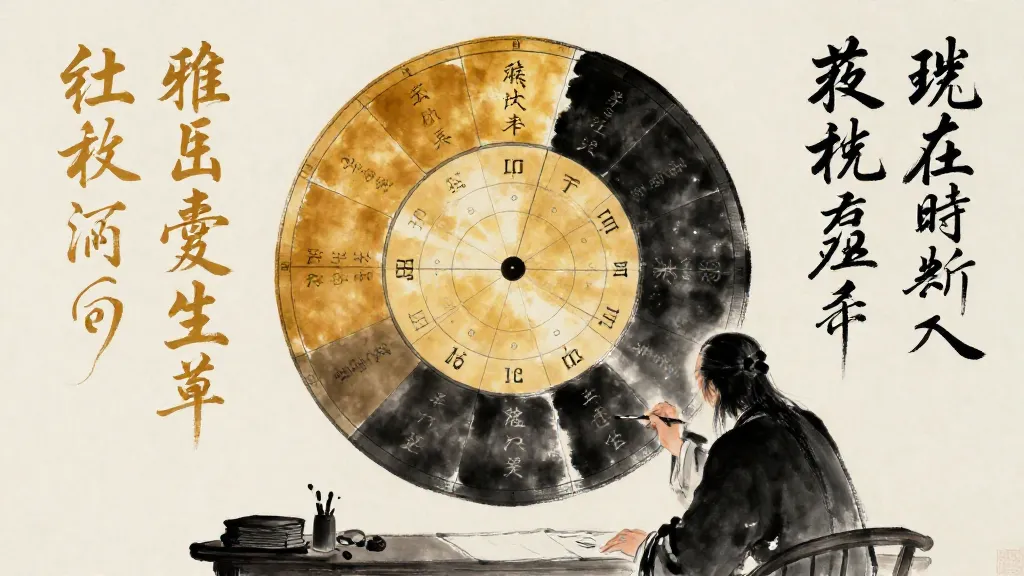
Most almanac apps show “Yellow Road Day” or “Black Road Day” as the primary rating. But the underlying mechanism isn't a vague good/bad judgment—it's a 12-spirit rotation where 6 spirits are beneficial and 6 are harmful, each with a name, an Earthly Branch, and an astronomical rationale.
Part 3 of Spirit Stars Explained — the computational rules behind the 116 spirit stars.
The Rating Everyone Sees But Nobody Explains
Open any Chinese almanac app—any one of them—and the first thing you'll see on a given day is a label: 黃道吉日 (Yellow Road Lucky Day) or 黑道凶日 (Black Road Unlucky Day). It's the primary classification. The headline rating. The thing that makes people feel good or bad about scheduling a wedding, signing a contract, or starting a renovation.
And for most users, that's where the understanding stops. Yellow = good. Black = bad. Move on.
Here's what people miss: that binary label is a summary of a 12-spirit rotation cycle. There are twelve named spirits—six classified as Yellow Road (auspicious) and six as Black Road (inauspicious)—and they take turns governing each day. A “Black Road day” isn't generically unlucky. It means a specific Black Road spirit is on duty, and that specific spirit has specific characteristics. The difference between a day governed by 天刑 (Heaven's Punishment) and one governed by 元武 (Dark Warrior) is not trivial.
The Twelve Spirits
The Xieji Bianfang Shu (欽定協紀辨方書), volume 7, lays out the system. Twelve spirits, numbered and classified:
| # | Spirit | English | Branch | Road |
|---|---|---|---|---|
| 1 | 青龍 | Green Dragon | 寅 | Yellow |
| 2 | 明堂 | Bright Hall | 卯 | Yellow |
| 3 | 天刑 | Heaven's Punishment | 辰 | Black |
| 4 | 朱雀 | Vermillion Bird | 巳 | Black |
| 5 | 金匱 | Golden Coffer | 午 | Yellow |
| 6 | 天德 | Heavenly Virtue | 未 | Yellow |
| 7 | 白虎 | White Tiger | 申 | Black |
| 8 | 玉堂 | Jade Hall | 酉 | Yellow |
| 9 | 天牢 | Heavenly Prison | 戌 | Black |
| 10 | 元武 | Dark Warrior | 亥 | Black |
| 11 | 司命 | Controller of Fate | 子 | Yellow |
| 12 | 勾陳 | Hook Formation | 丑 | Black |
Notice the pattern. The twelve spirits map directly onto the twelve Earthly Branches, from 寅 through 丑. They alternate in pairs: two Yellow, two Black, two Yellow, two Black, two Yellow, two Black. The rotation is perfectly regular. It's not random, not arbitrary, not based on vibes. It's a fixed sequence that repeats every twelve days.
What Makes a Spirit Yellow or Black
The six Yellow Road positions are: 子, 寅, 卯, 午, 未, 酉. The six Black Road positions are: 丑, 辰, 巳, 申, 戌, 亥.
The Xieji Bianfang Shu explains why these six are auspicious and those six are not. The reasoning is cosmological, not supernatural. The six Yellow Road branches correspond to the positions of fundamental cosmic processes:
- 子 (Controller of Fate) — The pivot of the Big Dipper, center of celestial rotation. “At the position where the celestial axis rests, at the center of the Dipper.”
- 寅 (Green Dragon) — Start of the Eastern direction, where the Azure Dragon constellation begins. The year renews at 寅.
- 卯 (Bright Hall) — The Hall where the Heavenly King administers, corresponding to the 房 and 心 lunar lodges. The ruler's seat.
- 午 (Golden Coffer) — The Supreme Subtlety enclosure (太微), seat of law and governance.
- 未 (Heavenly Virtue) — The position where myriad things reach completion. The 坤 (Earth/receptive) brings things to fruition here. Completion is virtuous.
- 酉 (Jade Hall) — The mirror of 明堂. Where the Bright Hall is the emperor's hall facing east, the Jade Hall is the empress's court facing west—like sun and moon.
The remaining six branches, lacking these cosmological anchors, are Black Road. The text is explicit: 天刑 at 辰 is the seat of punishment because the Celestial Hook (天罡) resides there. 白虎 at 申 corresponds to the Western White Tiger, the killing-qi of autumn. 天牢 at 戌 means “all things are completely destroyed”—quoting the Shiji directly.
The Rotation Mechanism
Here's where it gets mechanical. The twelve spirits don't just sit at fixed branches. They rotate through the branches based on the month, using a device called 天罡 (the Celestial Hook)—which is the tail of the Big Dipper.
The method: take 天罡 and add it to the monthly “build” position (月建). Then read which spirit lands on which branch. The starting point shifts by month-pair:
| Month Pair | Green Dragon Starts At |
|---|---|
| 寅月 & 申月 | 子 |
| 卯月 & 酉月 | 寅 |
| 辰月 & 戌月 | 辰 |
| 巳月 & 亥月 | 午 |
| 子月 & 午月 | 申 |
| 丑月 & 未月 | 戌 |
Once you know where 青龍 (Green Dragon) starts for a given month, the remaining eleven spirits follow in fixed order. Day by day, branch by branch. The same system applies to hours: for hour selection, you add 天罡 to the “day build” (日建) instead of the monthly build.
The Xieji Bianfang Shu calls this “the pivot mechanism of the spirit path” (神道之樞機). It's the same principle used in Qimen Dunjia, the military divination system: “every month always add 戌, every hour the build-and-break cycle applies” (月月常加戌,時時建破軍). Different traditions, same underlying math.
The Editors' Verdict: “There Is No Deep Meaning”
Here is the remarkable thing about this section. The Qianlong-era editors—the same team that compiled the most authoritative almanac in Chinese history—explicitly state that the name “Yellow Road” has no genuine astronomical basis.
黃黑道云者亦即吉凶之別名而非有深義決矣
“What are called ‘Yellow Road’ and ‘Black Road’ are merely alternate names for auspicious and inauspicious—there is decidedly no deep meaning.”
The real Yellow Road (黃道) in Chinese astronomy is the ecliptic—the sun's apparent path through the sky. The almanac's “Yellow Road” is not the ecliptic. It's a conventional label. The editors knew this. They said it. “Black Road” (黑道) does not appear in classical texts at all—it was invented as a contrast term.
This matters because it tells you what kind of text the Xieji Bianfang Shu is. It is not a work of mysticism. It's a work of systematization by scholars who were perfectly willing to say “this name is conventional, not cosmic” while still preserving the computational system behind it.
The Failed Explanations
Before the Qing editors arrived at their own analysis, two scholars had tried to explain why some spirits are auspicious and others aren't:
曹震圭 (Cao Zhengui) attempted to explain the system through 納甲 (Na-Jia), the hexagram-branch mapping system. He used 庚, 坎, and 離 to derive the classifications. The editors' verdict: “absurd and unfounded” (荒唐不經).
泰衡 (Tai Heng) tried to pair the 12 spirits with the Jianchu (建除) system—the 12-day officer cycle. The editors pointed out the math simply doesn't work: you have 6 yang and 6 yin spirits, but the Jianchu cycle has its own auspicious/inauspicious logic that doesn't map onto a clean half-and-half split.
The editors preserved both explanations in the text—then dismantled them. This is the Xieji Bianfang Shu's editorial method: record the tradition, then show why most of it is wrong. They kept the 12-spirit rotation because it works computationally. They discarded the explanations because they don't.
A Black Road Day Is Not Universally Bad
This is the practical insight that most almanac apps obscure. When an app shows “Black Road Day,” it's telling you that one of the six Black Road spirits is governing that day. But which one matters enormously.
天刑 (Heaven's Punishment) at the 辰 position is about legal and punitive energy—bad for starting new ventures, but the almanac does not prohibit all activities under it. 朱雀 (Vermillion Bird) at 巳 relates to speech and communication conflicts. 白虎 (White Tiger) at 申 carries autumn killing-qi—problematic for medical procedures but not necessarily for closings and completions. 天牢 (Heavenly Prison) at 戌 is about confinement. 元武 (Dark Warrior) at 亥 is about concealment and the unknown. 勾陳 (Hook Formation) at 丑 is about entanglement.
Each of these has a different character. A day governed by 元武 is not a good day to start construction—but it might be perfectly fine for activities that benefit from concealment or withdrawal. The binary Yellow/Black label flattens this nuance into a single bit of information. The original system is twelve bits.
Yellow Road and the Jianchu System
The Yellow/Black Road classification operates alongside the Jianchu (建除) twelve-day officer cycle, not as a replacement for it. A day can be a Yellow Road day with an unfavorable Jianchu officer, or a Black Road day with a favorable one. The two systems overlay: one tracks the spirit rotation, the other tracks the day-officer cycle.
The Xieji Bianfang Shu treats these as independent layers. When evaluating a day for a specific activity, the text checks both systems—plus the specific suitable and taboo stars for that activity. A Yellow Road day is a favorable starting condition, not a guarantee. A Black Road day is a caution flag, not a prohibition.
The same principle applies to hours. The 12-spirit rotation runs through the hours of each day just as it runs through the days of each month. A Black Road day can contain Yellow Road hours, and vice versa. The system is layered, not binary.
The Astronomical Machinery
Underneath the spirit names is a piece of astronomical machinery: the rotation of the Big Dipper. 天罡 is the Dipper's tail, and its position relative to the monthly “build” determines which spirit governs each day. As the text puts it: “天罡 is the handle of the Northern Dipper, which governs and controls the four directions. Therefore it is added to the build position” (天罡為北斗臨制四方之柄故以加建).
When 天罡 is added to the yang-build (陽建), the break (破) points to the yin-build (陰建). This creates a yin-yang dynamic: the spirits' positions are determined by the tension between build and break, yang and yin, the Dipper's handle and the branch it points toward.
Two special conditions emerge from this rotation. In certain months, the build and break positions mirror each other—this is called 伏吟 (hidden moaning). In others, they swap completely—this is 反吟 (reverse moaning). These conditions are also tracked in the Qimen Dunjia system, which shares the same astronomical foundation.
What Six Lines Does With This
Six Lines implements the full 12-spirit rotation, not just the binary Yellow/Black label. When the app shows you which spirit governs a given day, it's running the 天罡-to-monthly-build calculation from volume 7 of the Xieji Bianfang Shu. You see which of the twelve spirits is active, not just whether it's “Yellow” or “Black.”
The next article in this series covers the Heavenly Noble (天乙貴人)—the most powerful auspicious star in the system, the one that can override misfortune. Its derivation is even more intricate than the Yellow/Black Road, and it involves the Five Combinations of the Heavenly Stems.
References
Primary Source
欽定協紀辨方書 (Qinding Xieji Bianfang Shu), juan 7: 義例五 (Principles, Part 5), section 黃道黑道. Compiled under Emperor Qianlong, 1739. Siku Quanshu edition, pages 16–25.
Additional Sources Cited in the Text
神樞經 (Shenshu Jing) — source of the 12-spirit system as transmitted into common almanac use.
春秋文耀鈎 (Chunqiu Wenyao Gou) — “The North Palace Black Emperor, whose essence is 元武.”
春秋說題辭 (Chunqiu Shuotici) — “房心 is the Bright Hall, the palace where the Heavenly King administers.”
史記律書 (Shiji, Treatise on Pitch Pipes) — “戌 means all things are completely destroyed.”