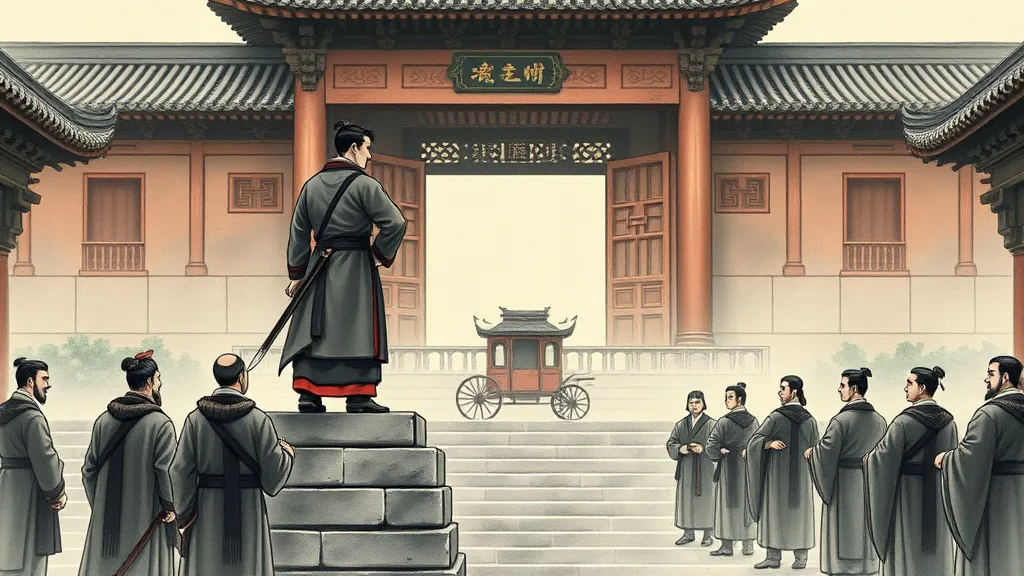
The Awl in the Bag: How Mao Sui Recommended Himself Into History
In 258 BC, Qin's armies surrounded Zhao's capital. A diplomat needed twenty retainers for a life-or-death mission and could only find nineteen. The twentieth man volunteered himself, talked his way onto the team, walked up to a king with a sword, and changed the language forever.
Part of the Warring States Playbook — diplomatic stories from the Zhanguoce. See the Warring States world brought to life at Warring States Day.
The Situation: Handan Under Siege
The year is 258 BC, and Zhao is in catastrophic trouble. Two years earlier, at the Battle of Changping, the Qin general Bai Qi had annihilated Zhao's main army—the traditional figure is 400,000 soldiers buried alive after their surrender, a number that may be inflated but whose scale of disaster is not disputed. Now Qin's armies have turned on Handan itself, Zhao's capital city. The population is eating bark. Children are being exchanged between families so that parents do not have to consume their own. The city is weeks from falling.
Zhao's only hope is an alliance with Chu, the great southern kingdom whose territory and military resources could counterbalance Qin's dominance. The man assigned to negotiate this alliance is Lord Pingyuan (平原君, Zhao Sheng), a prince of Zhao's royal house and one of the era's most powerful patrons. Lord Pingyuan maintains thousands of retainers—advisors, warriors, diplomats, specialists of every kind—and he needs twenty of the best for this mission: men who are both eloquent enough to argue the case and formidable enough to back it up with force if talking fails.
He finds nineteen. The twentieth slot stays empty. Among thousands of retainers, he cannot identify one more person who meets both requirements.
Here's what people miss about this setup: the failure is not a talent shortage. Lord Pingyuan has thousands of men on his payroll. The failure is a recognition problem. The system—the patron evaluating retainers based on reputation, word-of-mouth, and demonstrated accomplishment—has failed to surface someone who is perfectly capable of the job. The talent exists. The mechanism for finding it does not work.
The Awl and the Bag
A retainer named Mao Sui (毛遂) steps forward and volunteers himself. The Shiji records his words precisely: he has heard that Lord Pingyuan needs twenty men, he counts only nineteen, and he would like to fill the last spot.
Lord Pingyuan's response is one of the most quoted lines in Chinese literature. “A man of real talent in this world is like an awl placed in a bag—its sharp point immediately pokes through the fabric. You have been in my household for three years, sir, and nobody around me has ever mentioned your name. You have nothing to show. Please stay behind.”
The Chinese original is even more compact: 夫賢士之處世也,譬若錐之處囊中,其末立見。 A worthy man in the world is like an awl in a sack—the point shows through at once.
Mao Sui's reply is the line that enters the permanent lexicon. “I am only asking to be placed in the bag today. If I had been placed inside earlier, the entire awl-head would have pierced through, not just the tip.” (臣乃今日請處囊中耳。使遂蚤得處囊中,乃穎脫而出,非特其末見而已。)
What Mao Sui is actually saying, underneath the metaphor, is devastating: the problem is not that I lack talent. The problem is that you never gave me a chance to demonstrate it. The awl was never defective. It was never put in the bag. Your system of evaluating people by reputation and third-party recommendation has a structural blind spot, and I am standing in it.
Lord Pingyuan agrees. The nineteen other retainers exchange glances and smirk—the Shiji records this detail with characteristic precision: 十九人相與目笑之而未廢也, “the nineteen looked at each other and smiled but did not object.” They think Mao Sui is a joke. They will stop thinking this fairly soon.
The Road to Chu
On the journey south, Mao Sui debates with the nineteen other retainers on topics of strategy and philosophy. The Shiji gives this a single devastating sentence: 十九人皆服—“all nineteen submitted.” By the time they reach the Chu court, Mao Sui has already demonstrated that Lord Pingyuan's talent-recognition system was indeed broken.
At Warring States Day, the diplomatic missions between kingdoms are among the highest-stakes decisions in the simulation. An AI agent playing Zhao in 258 BC faces exactly this problem: whom to send, and whether the retainers you have invested in are actually the right ones for the moment. The Mao Sui episode suggests that the answer is often no—and that the person you need is the one you overlooked.
Ten Steps From the King of Chu
The negotiation at the Chu court does not go well. Lord Pingyuan presents the case for an alliance from morning until noon. The King of Chu will not commit. The arithmetic is reasonable from Chu's perspective: joining Zhao against Qin means provoking the most powerful military machine in the known world. Why take that risk for a state that just lost 400,000 soldiers?
The nineteen retainers, those elite men of both civil and martial talent, look at each other and say: “Sir, please go up.” They are asking Mao Sui to do what they cannot.
What happens next is one of the most dramatic scenes in the Zhanguoce tradition. Mao Sui places his hand on his sword and walks up the ceremonial steps to the king's dais. The King of Chu shouts at Lord Pingyuan: “Who is this person?” Lord Pingyuan says: “He is my retainer.” The king turns on Mao Sui: “Get down! I am speaking with your lord. What business is it of yours?”
Mao Sui does not get down. He grips his sword and steps closer. His speech, as recorded in the Shiji, is a masterpiece of controlled escalation:
“The reason Your Majesty dares to shout at me is because you rely on Chu's multitudes. But within ten steps, Your Majesty cannot rely on Chu's multitudes. Your life hangs from my hand. My lord is present—what cause have you to shout?”
This is not diplomacy. This is a threat of assassination delivered in the throne room with the target's own guards watching. And having established that he is willing to die and take the king with him, Mao Sui pivots to the actual argument:
“Chu's territory spans five thousand li. You command a million spearmen. This is the foundation of a hegemon. With Chu's strength, no power under heaven should be able to stand against you. Yet Bai Qi—that worthless whelp—led a few tens of thousands and defeated Chu in battle after battle. He took Ying, your capital. He burned Yiling, your ancestral temple. He humiliated your forebears. This is a shame that should burn for a hundred generations—and Zhao feels it more keenly than you seem to. This alliance serves Chu, not Zhao. And yet you shout at my lord?”
The King of Chu says: “Yes. Yes, it is as you say. I pledge our state to the alliance.”
Mao Sui does not stop. “Is the alliance settled?” The king says it is. Mao Sui calls for chicken, dog, and horse blood. He presents the ritual basin to the king, then to Lord Pingyuan, then signs the covenant himself—third, after a king and a prince. He turns to the nineteen retainers below and says: “You gentlemen may smear your blood down there. You are what they call men who accomplish things by riding on others' efforts.”
The phrase he uses—因人成事—is still current Chinese for someone who takes credit for work they did not do.
What Mao Sui Actually Did
Here's what people miss: Mao Sui didn't just talk his way onto the mission. He walked up to the King of Chu with a sword and threatened him. Self-recommendation plus execution—the talk and the walk. The idiom 毛遂自薦 (“Mao Sui recommends himself”) captures only the first half. The second half is a man willing to die in a foreign throne room to close the deal.
The combination matters. Volunteering without competence is bluster. Competence without volunteering means the talent never surfaces. Mao Sui understood that both parts were necessary and that the system around him would never supply the second on its own.
The Aftermath
Lord Pingyuan returns to Zhao and makes a statement that became as famous as the awl metaphor itself: “I will never again presume to judge men. I have evaluated talents by the thousands, sometimes by the hundreds, and believed I had not missed anyone worthy under heaven. Yet I nearly missed Master Mao.”
The full quote is worth preserving: 毛先生以三寸之舌,彊於百萬之師— “Master Mao's three inches of tongue proved mightier than a million soldiers.” Lord Pingyuan promoted Mao Sui to the rank of senior retainer and never again relied solely on reputation-based evaluation.
The alliance with Chu held. Chu sent Lord Chunshen with an army. Simultaneously, Lord Xinling of Wei stole the tiger tally and brought Wei's army as well. The combined relief force broke the siege of Handan. Zhao survived.
Whether Zhao's survival was worth the cost is another question. The state never recovered its military strength after Changping and was eventually conquered by Qin in 228 BC. But it lasted another thirty years, and the alliance Mao Sui sealed was a significant reason why.
The System Problem
The Mao Sui story is usually read as a parable about courage and self-confidence. But the more interesting reading is about institutional failure. Lord Pingyuan's retainer system—one of the most sophisticated talent networks of the ancient world—could not identify a man who was already inside it. Mao Sui had been eating Lord Pingyuan's food for three years. He was not hidden. He was not distant. He was sitting in the building, and nobody noticed him.
The awl-in-the-bag metaphor, as Lord Pingyuan uses it, assumes that talent is self-revealing. Put a sharp point in a soft container and the point will show through. Mao Sui's correction is that the metaphor has a precondition: someone has to put the awl in the bag first. Talent that never gets an opportunity to demonstrate itself is invisible, and an evaluation system that depends on prior demonstration will systematically miss everyone who hasn't had a chance to perform.
This is a problem that every organization that has ever existed would recognize. The retainer economy of the Warring States, the civil examination system of imperial China, the modern corporation, the academic tenure track—all of them suffer from the same structural defect. They surface people who have already been surfaced. They miss people who haven't.
Mao Sui's solution—self-recommendation—is radical because it bypasses the system entirely. It says: your mechanism for finding talent is broken, so I will find myself. The Chinese tradition remembered this as legitimate. The idiom 毛遂自薦 is not pejorative. It is used approvingly. When someone in modern Chinese says they are “recommending themselves like Mao Sui,” they are claiming competence that has been overlooked, not displaying arrogance.
At Warring States Day, the talent-surfacing problem plays out in miniature. AI agents must decide which advisors to trust for which missions, and the simulation regularly produces situations where the best-known advisor is not the right one—and where an overlooked retainer would have changed everything. The Mao Sui problem is not ancient history. It is a design flaw in every hierarchy.
References
Primary Sources
史記·平原君虞卿列傳 (Records of the Grand Historian, Biography of Lord Pingyuan and Yu Qing), Chapter 76. Chinese Text Project
戰國策·趙策 (Strategies of the Warring States, Zhao Strategies). Chinese Text Project
Full translated texts with commentary available in the Warring States Day Zhanguoce archive.