The 600-Li Lie: How Zhang Yi Broke the Alliance One Deal at a Time
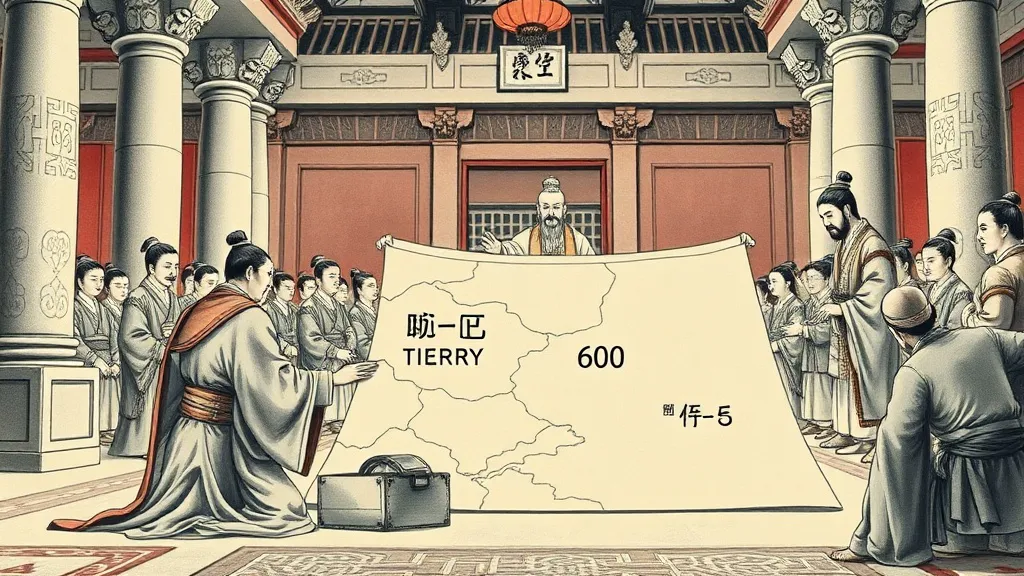
Zhang Yi promised the King of Chu 600 li of Qin territory to break with Qi. When the envoy arrived to collect, Zhang Yi said he'd only promised 6. The 600-li deception is the most famous move in Warring States diplomacy—but the real lesson is structural, not personal.
Part of the Warring States Playbook — self-contained diplomatic stories from the Zhanguoce. Read the full classical text at Warring States Day.
The Mirror Image
Su Qin and Zhang Yi studied under the same teacher—Guiguzi (鬼谷子), the legendary hermit strategist of the Gui Valley. They learned the same arts of persuasion, the same methods of reading rulers, the same techniques for manipulating the balance of power between states. Then they graduated and went to work for opposite sides.
Su Qin built the Vertical Alliance (合縱): six states united north-to-south against Qin, the western power that threatened them all. Zhang Yi built the Horizontal Counter-Strategy (連橫): Qin forming bilateral deals east-to-west with individual states, peeling them away from the alliance one at a time.
Here's what people miss about this rivalry. It wasn't a contest between two equally viable strategies. The vertical alliance was the harder structure to maintain. It required six states to trust each other, coordinate their armies, and resist the temptation of private deals with the strongest power in the system. The horizontal counter required Qin to make six separate offers—each tailored, each private, each exploiting whatever the target state feared most. Su Qin had to hold a coalition together. Zhang Yi only had to break it.
That asymmetry determined the outcome before either man spoke a word.
Zhang Yi Goes to Chu
The Zhanguoce records Zhang Yi's mission to Chu in the chapter “Qin Er” (秦二)—the second Qin volume. The setup is simple. Qin wanted to attack Qi, but Chu and Qi had a defensive pact. As long as Chu stood with Qi, Qin could not move east. King Hui of Qin summoned Zhang Yi and said: “Qi and Chu are close. Think of something.”
Zhang Yi's plan was elegant in its dishonesty. He traveled south to the Chu court and made King Huai of Chu an offer: if Chu would sever its alliance with Qi, Qin would cede the territory of Shang and Yu (商於)—an area of 600 li, roughly 250 kilometers on a side. This was a staggering amount of land. King Huai was delighted.
大王苟能閉關絕齊,臣請使秦王獻商於之地,方六百里。
“If Your Majesty will close the passes and sever relations with Qi, I shall have the King of Qin present the territory of Shang and Yu, a full 600 li square.”
King Huai announced the deal to his court. Everyone congratulated him. One man did not.
The One Man Who Saw It Coming
Chen Zhen (陳軫) was the court advisor who refused to celebrate. His analysis was precise:
夫秦所以重王者,以王有齊也。今地未可得而齊先絕,是楚孤也,秦又何重孤國?
“The reason Qin respects Your Majesty is that you have Qi. If you give up Qi before securing the land, Chu stands alone. Why would Qin respect an isolated state?”
Chen Zhen's logic was flawless. Chu's leverage over Qin was the Qi alliance itself. The moment Chu severed that alliance, the leverage evaporated. Qin would have no reason to honor the promise because Chu would have nothing left to threaten Qin with.
Chen Zhen recommended a test: demand the land first, break with Qi second. If Qin delivers, the deal is real. If Qin refuses to lead, then the offer is a trap.
King Huai did not listen. He told Chen Zhen to shut up and wait. The Zhanguoce records his exact words:
吾事善矣!子其弭口無言,以待吾事。
“My plans are excellent! Close your mouth and say nothing while you watch them unfold.”
Six Hundred Becomes Six
Chu broke with Qi. Not tentatively—King Huai sent envoys to Qi with insults. The text says he sent them twice, to make sure the break was irreversible (使者未來,又重絕之). Meanwhile, Zhang Yi returned to Qin and arranged for Qin to secretly establish diplomatic relations with Qi. The Chu-Qi alliance was shattered; the Qin-Qi axis was born in its place.
When Chu sent a general to collect the promised 600 li of land, Zhang Yi suddenly fell ill and could not receive him. For three months. King Huai wondered whether he had not been aggressive enough in cutting ties with Qi. He sent warriors to publicly curse the King of Qi. Only then did Zhang Yi rise from his sickbed and meet the Chu envoy.
從某至某,廣從六里。
“From here to there—six li in width and breadth.”
The envoy protested: “I was told 600 li, not 6 li.” Zhang Yi replied:
儀固以小人,安得六百里?
“I am only a minor official. How would I have 600 li to give?”
This is the most brazen moment in the Zhanguoce. Not the deception itself—deception is common in the Warring States. What is extraordinary is the openness. Zhang Yi did not bother constructing a plausible denial. He simply refused to honor the deal and dared Chu to do something about it. The logic was: what will you do? You have already lost Qi. Your only option now is to fight Qin alone—which is exactly what you cannot do.
The Aftermath
King Huai of Chu, furious, launched a military campaign against Qin. It was precisely the outcome Zhang Yi had engineered. Chu attacked alone. Qin and Qi, now allied, counterattacked. Han joined the Qin side. The Zhanguoce records the result: “Chu suffered a great defeat at Duling” (楚兵大敗於杜陵).
The text is blunt about the cause: Chu's territory and people were not inferior. Its near-destruction was the result of ignoring Chen Zhen's advice and falling for Zhang Yi's scheme (計失於陳軫,過聽於張儀). Chen Zhen, remarkably, tried again after the defeat. He advised King Huai to cut his losses: give land to Qin, then jointly attack Qi to recover what he had lost. King Huai refused this too.
The Horizontal Tour
The Chu deception was Zhang Yi's masterpiece, but it was not his only campaign. The Zhanguoce preserves his pitch to every major state. In each case, the structure is identical: Zhang Yi arrives, describes Qin's overwhelming military strength, explains why the vertical alliance cannot protect the target state, and offers bilateral peace.
To Wei: “Wei's territory is flat and indefensible. If Qin attacks from the west while Zhao presses from the north, Wei is finished within a year. Join Qin and your borders are guaranteed.” Wei submitted.
To Han: “Han is the smallest state. Its weapons are fine but its land is poor. One bad harvest and your army cannot eat. Qin borders you on three sides. What will the vertical alliance do for Han when Qin decides to walk in?” Han submitted.
To Qi: “Qi is strong, yes. But your southern border faces Chu, and Chu has just been beaten by Qin. Your western border faces Zhao, and Zhao is unreliable. The alliance asks you to fight Qin's battles for states that will not fight yours.” Qi submitted.
To Zhao: “Qin's army has broken every force it has faced. Your alliance partner Su Qin turned out to be a double agent working for Yan. The man who built the vertical alliance was a fraud.” Zhao submitted.
In every case, Zhang Yi tailored the threat to the specific vulnerability. He did not make the same speech six times. He made six different speeches, each designed to exploit the particular fear that kept each king awake at night.
Why Bilateral Beats Multilateral
The deeper lesson of Zhang Yi's career is not about deception. Deception was the tactic. The strategy was structural: bilateral deals beat multilateral alliances because they are cheaper to maintain.
A multilateral alliance has a collective action problem. Each member benefits from the alliance existing but has an incentive to defect—to make a private deal with the enemy while the other members continue to bear the cost of resistance. The more members the alliance has, the greater the temptation for each individual member to free-ride. And every defection makes the alliance weaker, which makes the next defection more likely.
A bilateral deal has none of these problems. It involves two parties. The terms are clear. The enforcement is simple: if you break the deal, the other party retaliates against you specifically. There is no coordination problem because there is no coalition to coordinate.
This is why Zhang Yi won and Su Qin lost. Not because Zhang Yi was smarter—the Zhanguoce treats them as intellectual equals—but because the horizontal strategy aligned with the grain of political reality while the vertical strategy fought against it. Asking six states to trust each other is asking for something that the structure of the system makes nearly impossible. Offering six states individual deals is offering something that the structure of the system makes nearly inevitable.
The Collective Action Trap
What makes the Zhang Yi story relevant beyond ancient China is the generalizable principle. Collective action problems are easier to exploit than to solve. This applies to trade negotiations, military alliances, cartels, labor unions, and any situation where a group must cooperate against a more powerful actor.
The powerful actor does not need to defeat the group in battle. It only needs to offer each member a better deal than the group can provide. If the private deal is even slightly more attractive than the shared sacrifice of group membership, rational actors will defect. And once defection begins, it cascades.
Su Qin understood this vulnerability. Before leaving to build his alliance, he reportedly said that if Qin appointed a competent strategist, the vertical alliance would not last. He was right. Zhang Yi was appointed, and the alliance collapsed not through military force but through a sequence of private negotiations— each perfectly reasonable from the perspective of the state that accepted it, each catastrophic for the alliance as a whole.
Reading the Source
The 600-li deception appears in “Qin Er” (秦策二, Strategies of Qin, Part 2) of the Zhanguoce. Zhang Yi's persuasion of Chu's king to break the vertical alliance appears in “Chu Yi” (楚策一, Strategies of Chu, Part 1). His systematic pitches to the other states are scattered across the corresponding state chapters: Wei Yi (魏策一), Han Yi (韓策一), Qi Yi (齊策一), and Zhao Er (趙策二).
What is striking about reading these chapters together is how consciously the Zhanguoce editors juxtaposed the two strategies. Su Qin's pitches for the vertical alliance and Zhang Yi's counterarguments for the horizontal counter are placed in the same state chapters, one after the other. The reader watches the same king hear both arguments. The editorial structure itself is an argument about the nature of political persuasion.
Read the full Zhanguoce text at Warring States Day.