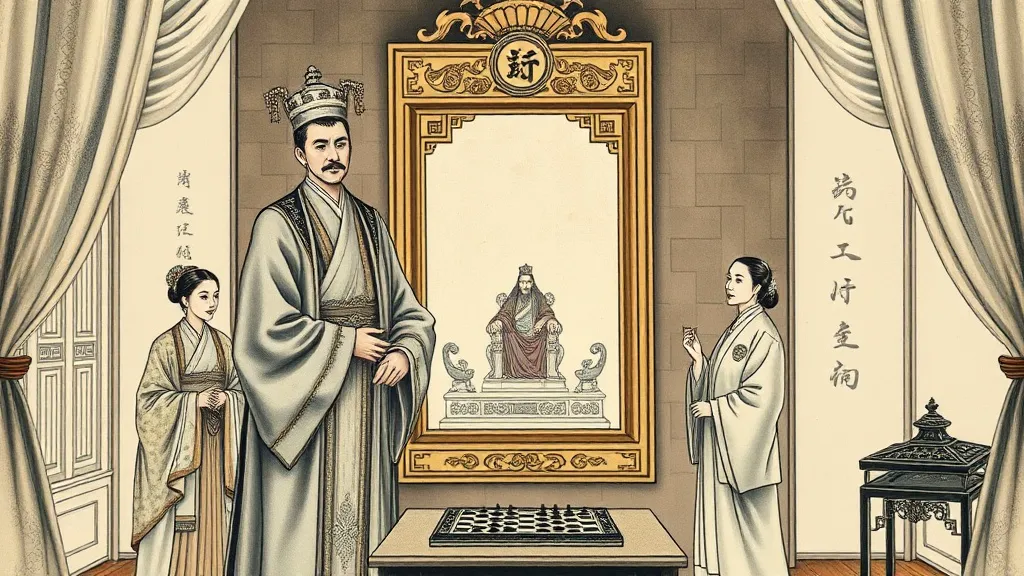
Zou Ji's Mirror: When Your Advisors Are Lying to Your Face
A Qi minister realizes everyone is flattering him about his looks—then extrapolates from vanity to statecraft. The result is one of the most elegant policy pitches in Chinese history, and a reward system for criticism that actually worked.
Part of the Warring States Playbook — self-contained diplomatic stories from the Zhanguoce. See the Warring States world brought to life at Warring States Day.
The Setup: A Tall Man and a Mirror
Zou Ji (鄒忌) was more than eight chi tall and, by the standards of his era, strikingly handsome. One morning, dressing for court, he looked in the mirror and asked his wife: “Between me and Xu Gong of the north city—who is more handsome?”
Xu Gong (徐公) was famous throughout Qi for his beauty. Everyone knew this. Zou Ji's wife answered without hesitation: “You are far more handsome. How could Xu Gong compare to you?”
Still not convinced, Zou Ji asked his concubine the same question. Same answer: “How could Xu Gong compare to you?”
The next day, a guest visited. Zou Ji, still turning the question over, asked the guest. The guest said: “Xu Gong is not as handsome as you.”
Three people. Three confirmations. Anyone else would have moved on, satisfied. But the following day, Xu Gong himself came to visit. Zou Ji looked at him carefully. Then he looked in the mirror again. The gap was not close. It was not ambiguous. Xu Gong was simply, obviously, more handsome.
The Deduction: Three Kinds of Flattery
That evening, Zou Ji lay in bed and worked out the logic:
吾妻之美我者,私我也;妾之美我者,畏我也;客之美我者,欲有求於我也。
“My wife called me handsome because she loves me. My concubine called me handsome because she fears me. My guest called me handsome because he wants something from me.”
Here is what people miss about this passage. The deduction is not “people are liars.” It is much more precise than that. Zou Ji identifies three distinct mechanisms of distortion, and each one has a different emotional engine. Love, fear, and self-interest produce the identical output—the same flattering sentence—for entirely different reasons. If you only look at the output, you cannot distinguish them. You have to model the incentives behind the speaker.
This is, incidentally, a problem that anyone who manages people will recognize instantly. The junior employee who agrees with you because they admire you, the mid-level manager who agrees because their promotion depends on you, and the external consultant who agrees because you are paying them—all three produce the same nodding head. The information content of agreement, in a hierarchical environment, approaches zero.
The Pitch: From Mirror to Kingdom
The next morning, Zou Ji went to court and made his case to King Wei of Qi (齊威王):
臣誠知不如徐公美。臣之妻私臣,臣之妾畏臣,臣之客欲有求於臣,皆以美於徐公。今齊地方千里,百二十城,宮婦左右,莫不私王;朝廷之臣,莫不畏王;四境之內,莫不有求於王。由此觀之,王之蔽甚矣!
“I know I am not as handsome as Xu Gong. But my wife loves me, my concubine fears me, and my guest wants something from me—so all three told me I was more handsome. Now: your kingdom spans a thousand li. You rule 120 cities. Your court ladies and attendants all love you. Your ministers all fear you. Everyone within your borders wants something from you. If this is so—how much more deceived must you be than I was?”
The analogy works because of its economy. Zou Ji does not present an abstract theory of governance. He presents a concrete personal experience that the king can immediately verify against his own situation. The proportional scaling is devastating: if a minor official with one wife, one concubine, and one guest is this thoroughly deceived, then a king with an entire court, an entire bureaucracy, and an entire population cannot possibly be receiving accurate information about anything.
King Wei's response was two characters: “善” —good. Which in the Zhanguoce usually means: I see it, and I'm going to act on it.
The Innovation: Three Tiers of Reward
Here is what people miss: Zou Ji's genius was not the mirror analogy. It was what came next. He didn't just identify the problem—he engineered a solution that made truth-telling profitable. King Wei issued a decree creating three reward tiers for criticism:
群臣吏民,能面刺寡人之過者,受上賞;上書諫寡人者,受中賞;能謗議於市朝,聞寡人之耳者,受下賞。
“Any minister, official, or commoner who criticizes my faults to my face shall receive the highest reward. Anyone who submits a written critique shall receive a middle reward. Anyone whose public criticism reaches my ears through the marketplace shall receive the lowest reward.”
The tier structure is worth examining. Face-to-face criticism is hardest and therefore most valuable—top reward. Written criticism requires effort but not personal courage—middle reward. Public gossip that filters upward is the easiest and least risky—lowest reward, but still a reward.
This is incentive design. The system does not rely on people being virtuous. It does not assume that ministers will suddenly become honest because the king asked nicely. It creates a financial gradient that makes each level of candor proportionally profitable. The braver you are, the more you earn. And crucially, even the least brave form of truth-telling—anonymous marketplace grumbling—still pays. The system captures information across the entire courage spectrum.
The Result: From Flood to Silence
The Zhanguoce records the outcome in three stages:
令初下,群臣進諫,門庭若市。數月之後,時時而間進。期年之後,雖欲言,無可進者。
“When the decree was first issued, ministers crowded the court with criticisms—the gates were as busy as a marketplace. After several months, they came less frequently. After a full year, even those who wanted to criticize could find nothing left to say.”
This three-phase trajectory is itself interesting. Phase one is the backlog—all the things people have been wanting to say but couldn't. Phase two is course correction—the king is responding to the criticism and fixing problems, so the supply of valid complaints decreases. Phase three is equilibrium—the system has been optimized to the point where there is nothing significant left to criticize.
And then the strategic payoff:
燕、趙、韓、魏聞之,皆朝於齊。此所謂戰勝於朝廷。
“When Yan, Zhao, Han, and Wei heard about this, they all came to pay court to Qi. This is what is called ‘winning a war in the court.’”
The final line is the Zhanguoce at its most compressed. A domestic policy reform produces a foreign policy result. A king who governs well attracts allies without fighting. The text calls this 戰勝於朝廷 —victory won in the court, not on the battlefield. The implication is that the most effective military strategy is not military at all. It is institutional transparency.
Why This Story Survives
This is one of the most anthologized passages in all of Chinese literature. It appears in virtually every classical Chinese textbook. Its fame is partly structural—the three-part parallel (wife, concubine, guest) mapping onto another three-part parallel (court ladies, ministers, populace) is the kind of rhetoric that Chinese literary culture particularly admires. But the deeper reason is that the story captures something that most political philosophy only talks about in the abstract: the problem of truth in hierarchical organizations.
Every organization with a chain of command faces the same problem. Information travels upward through layers of people who have incentives to distort it. The distortion is not malicious—it is structural. The wife loves Zou Ji. She is not trying to deceive him. She genuinely believes he is more handsome because her emotional investment in him makes objectivity impossible. The concubine's fear and the guest's ambition produce the same result through different channels, but none of the three are consciously lying. They are doing what their position in the system makes rational.
The hardest intelligence problem is hearing truth when everyone around you has incentives to tell you what you want to hear. Zou Ji's answer was not to exhort people to be honest. It was to restructure incentives so that honesty pays better than flattery. That is why the story is taught in management courses and political science seminars 2,300 years later. The problem it identifies has not been solved by any subsequent civilization.
In the Warring States Day simulation, the intelligence problem is identical. AI kingdoms receive information from subordinate agents who have their own objectives. Whether a border report is accurate or self-serving depends on who is sending it and what they want. The kings who build systems for cross-checking information tend to outperform the ones who simply trust their best general. Zou Ji would recognize the dynamic immediately.
References
Primary Source
戰國策·齊策一,鄒忌修八尺有餘 (Strategies of the Warring States, Qi Strategies Part 1). Liu Xiang, compiler. The Zou Ji mirror passage is one of the most cited texts in the Zhanguoce. Chinese Text Project
Full translated text with commentary available in the Warring States Day Zhanguoce archive.