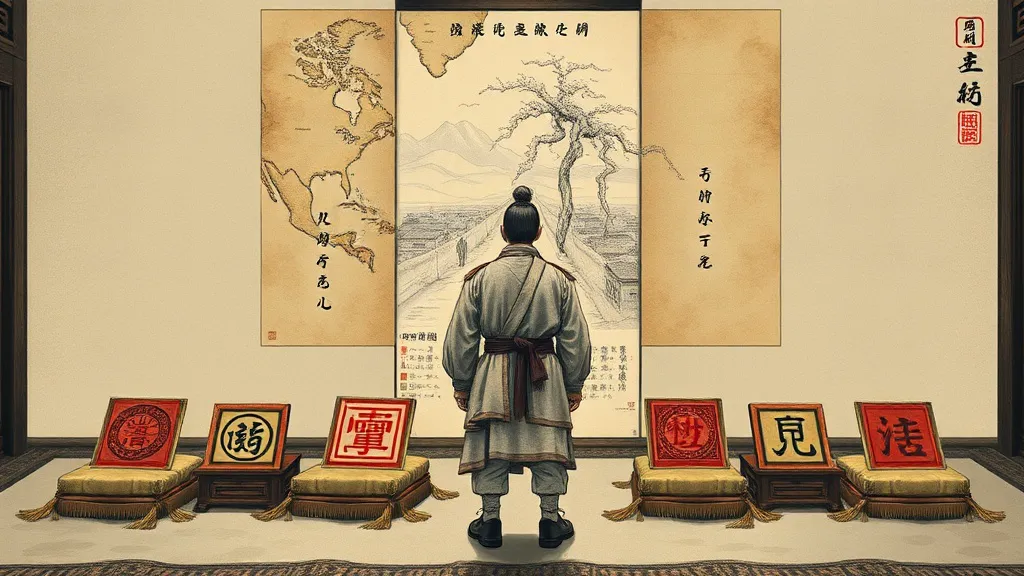
Six Seals: How Su Qin Talked Six Kingdoms Into an Alliance
A broke student returned home in rags, and his own family refused to speak to him. A few years later, he was wearing the chancellor's seal of six kingdoms simultaneously. The story of Su Qin is the most dramatic career reversal in Chinese political history—and the most instructive failure.
Part of the Warring States Playbook — diplomatic stories from the Zhanguoce. Read the original text at Warring States Day.
The Pitch That Failed
Around 334 BC, a young man from Luoyang named Su Qin (蘇秦) traveled west to the state of Qin with a proposal. He had studied under the legendary teacher Guiguzi (鬼谷子)—the “Master of Ghost Valley,” a figure so shadowy that later traditions made him a Daoist immortal—and he believed he had mastered the arts of strategic persuasion. His pitch to King Hui of Qin was a straightforward case for conquest: Qin had the land, the army, and the geography to swallow the other six states. All it needed was the will.
The Zhanguoce (《戰國策》, Strategies of the Warring States) records his opening argument in loving detail. He cataloged Qin's advantages like a property listing: the fertile lands of Ba and Shu to the west, the cavalry resources of the northern steppes, the natural fortress of the Hangu Pass to the east. “With ten thousand war chariots and a million soldiers,” Su Qin told the king, “you could swallow the world and rule as emperor.”
King Hui of Qin said no. The refusal was polite—the Zhanguoce gives it in the king's own voice: “A bird whose feathers are not yet full cannot fly high. A man whose learning is not yet complete cannot punish others.”—but it was total. Su Qin submitted his proposal ten times, and ten times it was rejected. The text says: 說秦王書十上而說不行, “he submitted his persuasion ten times and ten times it did not work.”
Here is what people miss about this part of the story. Su Qin was not rejected because his analysis was wrong. His description of Qin's strategic position was accurate—Qin would eventually do exactly what he proposed, conquering all six states within a century. He was rejected because he himself was not yet credible. He was a nobody from Luoyang with no track record, no patron, and no army. The king's polite refusal was, translated into modern terms: “You are correct in theory and irrelevant in practice.”
The Walk Home
The Zhanguoce describes Su Qin's return home in one of the most vivid passages in pre-imperial Chinese literature. His black sable fur coat was worn through. His hundred jin of gold was spent. He had no resources left. He walked home in rope sandals and torn leggings, carrying his books on his back, “his face dark and weathered, his appearance emaciated” (形容枯槁,面目犁黑).
And then the detail that made this story immortal: 歸至家,妻不下紝,嫂不為炊,父母不與言. “When he arrived home, his wife did not get up from her loom, his sister-in-law did not cook for him, and his parents did not speak to him.”
This is not a throwaway detail. In the Warring States moral universe, family was the foundation of all social obligation. For your own wife to not rise from her weaving, for your own sister-in-law to refuse you a meal, for your own parents to go silent—this was total social annihilation. Su Qin had not just failed professionally. He had been erased from the only community that was supposed to be unconditional.
His response, as recorded in the Zhanguoce, was not self-pity but fury: “My wife does not treat me as a husband, my sister-in-law does not treat me as a brother-in-law, my parents do not treat me as a son. This is all Qin's fault!” The phrasing is important: 是皆秦之罪也. He did not say “this is my fault.” He said “this is Qin's fault”—meaning the state of Qin, which had rejected him. The man who would build the world's first multinational alliance began with a grudge.
The Awl and the Thigh
What happened next became one of the most referenced idioms in Chinese culture. Su Qin went into his library, opened dozens of chests of books, and found a text called the Yin Fu (《太公陰符》, the Secret Talisman of Lord Taigong)—a work on strategic manipulation attributed to the legendary advisor who helped the Zhou dynasty overthrow the Shang. He studied it day and night. And when he became drowsy while reading, he stabbed his own thigh with an awl to stay awake: 讀書欲睡,引錐自刺其股,血流至足. “When he grew sleepy while reading, he took an awl and stabbed his thigh. Blood flowed down to his feet.”
This image—combined with a similar story about another scholar who tied his hair to a roof beam to prevent nodding off—became the four-character idiom 懸梁刺股 (“hang from the beam, stab the thigh”), still used today to describe extreme dedication to study. Every Chinese schoolchild encounters it. What they may not absorb is the context: Su Qin was not studying for a degree or pursuing enlightenment. He was studying so that he would never be humiliated again. The motivation was revenge. The discipline was real, but the fuel was rage.
After a year of this, Su Qin declared: “This is truly sufficient to persuade the rulers of our age!” He had not changed his analysis. He had changed his approach.
The Vertical Alliance
Su Qin's original pitch to Qin had been a horizontal strategy: help the strongest state conquer east-to-west. When Qin rejected him, he flipped the board entirely. Instead of selling conquest to the strong, he would sell survival to the weak. Instead of a horizontal alliance (連橫, liangheng, literally “linking horizontally”) serving Qin, he would forge a vertical alliance (合縱, hezong, literally “joining vertically”) against it.
The geography makes this concrete. Qin sat in the far west. The other six major states—Yan, Zhao, Wei, Han, Qi, and Chu—stretched roughly north-to-south in a line down the eastern side of the map. “Vertical” meant linking these states along their north-south axis. “Horizontal” meant any of them peeling off to ally east-to-west with Qin. The entire diplomatic contest of the late Warring States period can be understood through this axis: vertical versus horizontal, collective resistance versus individual submission.
What made Su Qin's approach brilliant was that he did not make the same pitch to every state. He tailored his argument to each king's specific fears, specific geography, and specific vanity. The Zhanguoce preserves each pitch separately, and reading them in sequence is like watching a master salesman work a floor of different buyers. The product was the same. The framing was always different.
Six Pitches, Six Kings
He started in the north, with Yan. His pitch to King Wen of Yan was geographical: Yan is safe because Zhao shields it from the south. Qin is far away—even if Qin conquered Yan, it could not hold the territory. But Zhao is close. If Zhao attacked, armies would reach Yan's capital in four or five days. The real threat is not Qin but a Zhao that has been absorbed by Qin. Therefore, Yan must ally with Zhao to prevent that absorption. The king of Yan agreed, and gave Su Qin carriages, gold, and silk to continue south.
In Zhao, Su Qin pitched the same alliance from the opposite direction: Zhao is the keystone. If Zhao falls, the other five states fall in sequence. If Zhao holds, six states together can contain Qin indefinitely. The Zhanguoce says Su Qin spoke to King Su of Zhao “in a great hall, striking his palm on the table as he talked” (抵掌而談). The king was so impressed he made Su Qin Lord of Wuan (武安君) on the spot and gave him the chancellor's seal.
To Han, the pitch was pride. Su Qin cataloged Han's military assets with lavish specificity—the crossbows of Xizi and Shaofu, each shooting six hundred paces; the swords of Longquan and Taihe, which could cut through horses and cattle on land and geese and cranes in water. Then the hook: “With such strength, and with your majesty's wisdom, you would serve Qin? Build a palace for the Qin emperor? Present tribute every spring and autumn? To humiliate your altars of state and be laughed at by the world—nothing exceeds this!” The king of Han flushed red, slapped his hand on his sword, and declared he would die before serving Qin.
The line that sealed it became proverbial: 寧為雞口,無為牛後, “Better to be the beak of a chicken than the rear end of an ox.” Better to lead a small state than follow a great one. Two thousand years later, this idiom is still in active use.
To Wei, Su Qin emphasized geography and population density. To Qi, he painted a picture of Qi's wealth so vivid it reads like tourism copy—the streets of Linzi where carriages jammed hub-to-hub, where people walked shoulder-to-shoulder, where everyone played music and gambled on cockfights. Then the pivot: “With such power and wealth, to bow west and serve Qin? I am ashamed on your behalf.” To Chu, the largest and southernmost state, he emphasized military capacity and the shame of yielding territory.
In each case, the underlying logic was the same: Qin cannot be fought alone, but Qin also cannot fight all six at once. The six states had different reasons to be afraid, but the solution was identical. Su Qin's genius was understanding that you do not sell an alliance by explaining the alliance. You sell it by making each buyer feel that the alliance was their idea all along.
Six Seals
The result was unprecedented. Su Qin held the chancellor's seal (相印) of all six states simultaneously. No one before him had done this; no one after him would. The Zhanguoce describes his power in a passage that generations of Chinese readers have memorized:
“At that time, the world was vast, the people were numerous, the lords were powerful, the strategists were shrewd—and all wished to be guided by Su Qin's strategy. Without spending a bushel of grain, without troubling a single soldier, without stringing a single bow, without breaking a single arrow, the feudal lords drew closer to each other than brothers.”
不費斗糧,未煩一兵,未張一士,未絕一弦,未折一矢,諸侯相親,賢於兄弟. The passage is a study in rhetorical escalation: each “without” raises the stakes, culminating in the claim that diplomacy achieved what warfare could not. For the Zhanguoce's authors, this was the supreme vindication of the persuader's art. Words, properly deployed, were more powerful than armies.
And then the text adds a devastating coda about the man himself: “Moreover, Su Qin was merely a scholar from a humble alley with a wicker gate and a mulberry-wood door latch” (蘇秦特窮巷掘門、桑戶棬樞之士耳). Not a prince. Not a general. A commoner who talked his way to the top of the world.
The Sister-in-Law's Crawl
The Zhanguoce saves the best scene for Su Qin's return home. On his way to persuade the king of Chu, he passed through Luoyang. His parents, hearing of his approach, swept the roads and set up music and banquets, coming out thirty li to greet him. His wife stood “looking sideways, inclining her ear”—not daring to face him directly. And his sister-in-law—the same one who had refused to cook for him—crawled on the ground like a snake (蛇行匍伏), prostrated herself four times, and begged forgiveness.
Su Qin, with the magnificent pettiness of a man who has been keeping count, asked: “Sister-in-law, why so arrogant before and so humble now?” (嫂,何前倨而後卑也?) She answered with brutal honesty: “Because your position is high and your gold is plentiful” (以季子之位尊而多金).
Su Qin sighed and said what became the moral of the story: 貧窮則父母不子,富貴則親戚畏懼. “When a man is poor, even his parents do not treat him as a son. When he is rich and powerful, even his relatives tremble before him.” Then the bitter conclusion: “A man's position and wealth in this world—how can they be disregarded?” (人生世上,勢位富貴,蓋可忽乎哉!)
This is not a happy ending. It is a clear-eyed statement about how the world works, delivered by a man who has tested it experimentally. The Zhanguoce does not moralize. It simply records what happened when the same man showed up twice—first without power, then with it—and observes the difference.
Why the Alliance Failed
Here is what people miss: the vertical alliance was not about shared values. It was about shared fear. And the moment Qin stopped being scary enough—or, more precisely, the moment any individual state decided that cooperating with Qin was less frightening than trusting its neighbors—the alliance collapsed.
The Zhanguoce itself preserves Qin's counter-analysis in King Hui's exasperated complaint to his advisor: “Su Qin has deceived me. He wants to use one man's cleverness to overturn the rulers east of the mountains and use this coalition to intimidate Qin.” Then the devastating simile: the allied states were like chickens tied together—they could not even roost on the same perch (猶連雞之不能俱止於棲之明矣). You cannot make a flock out of birds that are bound to each other, because binding prevents the very coordination it was meant to enforce.
This turned out to be exactly right. The alliance held for approximately one to two years—sources differ on the exact duration—before Qin's diplomats began picking it apart. The specific instrument of its destruction was Zhang Yi (張儀), another student of Guiguzi, who deployed the opposite strategy: the horizontal alliance (連橫). Where Su Qin had linked the six states together against Qin, Zhang Yi peeled them off one at a time, offering each state individual deals with Qin that were more attractive than collective resistance.
The structural problem was simple. A six-state alliance has fifteen bilateral relationships that all need to hold simultaneously. Qin only needed to break one. Every state in the alliance had a reason to defect: a border dispute with a neighbor, a trade concession from Qin, a general who wanted to be bribed. Su Qin could assemble the coalition, but he could not maintain it, because maintenance required all six states to trust each other every day, while destruction only required one state to stop trusting on one day.
The Zhanguoce, characteristically, does not take sides. It records Su Qin's triumphs and Zhang Yi's counter-moves with equal admiration. Both men were persuaders. Both were brilliant. One built; the other dismantled. And the text's verdict on Zhang Yi's victory is given in a single sentence: 卒用張儀,而蘇秦之從遂散, “In the end, Zhang Yi was employed, and Su Qin's vertical alliance dissolved.”
The Persuader's Paradox
Su Qin's story reveals a paradox that applies to every coalition in history. A defensive alliance is hardest to maintain precisely when it is most successful. If the alliance deters the threat, the threat recedes, and the members begin to ask why they are bearing the costs of participation. If the alliance fails to deter the threat, the members begin to ask why they are bearing the costs of a strategy that does not work. In either case, the incentive to defect increases over time. The alliance is most stable at the moment of maximum fear, and fear is not a renewable resource.
Su Qin understood this. His pitches were calibrated to maximize fear of Qin in each individual court. But fear is a depreciating asset. It peaks at the moment of the pitch and declines from there. The alliance was strongest on the day it was formed and weaker every day afterward. Su Qin's real achievement was not the alliance itself but the demonstration that it was possible—that six hostile states could, for a brief historical moment, be talked into acting as one.
The later tradition assigned Su Qin a tragic end. The Shiji (Records of the Grand Historian) reports that he was eventually assassinated in Qi, where he had been working as a double agent for Yan. On his deathbed, he told the king of Qi to execute his own body in the marketplace, announcing that Su Qin had been a Yan spy—knowing this would draw the real assassin out of hiding. Even his death was a stratagem.
Whether this account is accurate or legend grafted onto legend is an open question. What is not in question is that Su Qin became the archetype of a figure who recurs throughout Chinese history: the persuader who changes the world with nothing but language, and whose power lasts exactly as long as his audience keeps listening.
What We Learn
The Zhanguoce is not a moral text. It does not tell you that Su Qin was right or wrong, virtuous or wicked. It tells you what he did and what happened. The lessons are structural, not ethical:
First: the same analysis can succeed or fail depending on who delivers it and to whom. Su Qin's assessment of Qin's strength was identical whether he was pitching conquest to King Hui or resistance to the other six kings. The content did not change. The audience did.
Second: a defensive coalition is inherently less stable than an offensive one. Attackers have a natural coordination mechanism—the target. Defenders have to coordinate against an abstraction: the possibility of attack. The moment the possibility feels remote, the coordination breaks down.
Third: personal motivation and public achievement operate independently. Su Qin's fuel was humiliation and rage. His product was an international peace framework. The quality of the output does not depend on the nobility of the input.
And fourth, the one the sister-in-law taught him: 勢位富貴,蓋可忽乎哉. Power and position are not things that can be disregarded. The world responds to what you are, not what you deserve.
Next in this series
Zhang Yi (張儀), Su Qin's classmate and nemesis, who took apart the vertical alliance one state at a time using the horizontal strategy—and whose career raises the same question from the opposite direction: if building an alliance requires genius, what does it take to destroy one?
The original Zhanguoce passages referenced in this article can be found in Qin ce yi (秦策一), Yan ce yi (燕策一), Zhao ce yi (趙策一), Han ce yi (韓策一), Qi ce yi (齊策一), and Chu ce yi (楚策一). Read the full texts at Warring States Day.