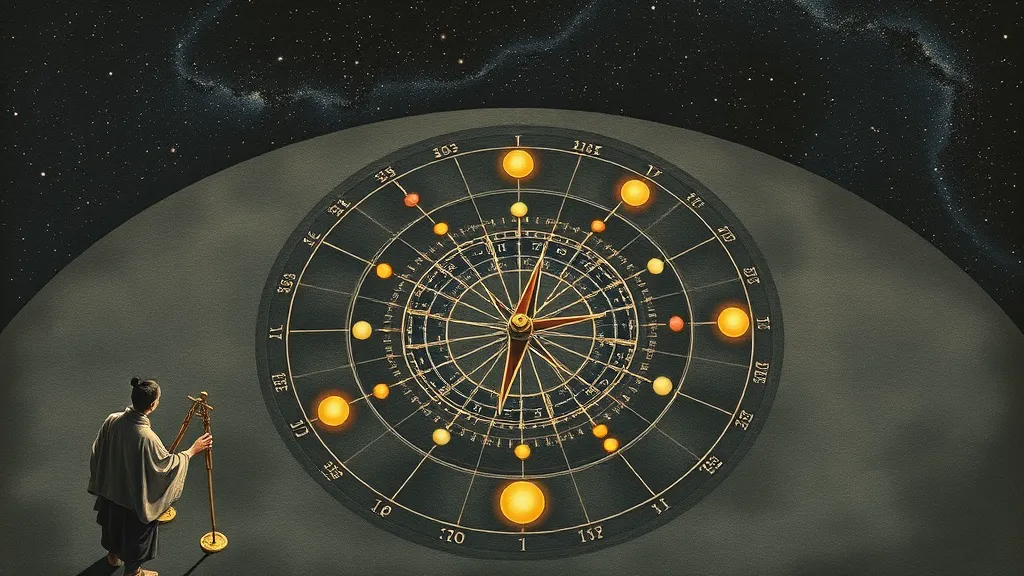
The Other Chinese Astrology: What Ziwei Doushu Actually Is
Most people think “Chinese astrology” means the 12 animals. That's like thinking “Western music” means Happy Birthday. Ziwei Doushu is a complete natal chart system—12 palaces, 14 major stars, dozens of minor stars, each with a personality and a job to do.
Chinese Divination Systems series, Part 1
The Zodiac Problem
Ask someone what Chinese astrology is, and they will tell you about the twelve animals. Rat, ox, tiger, rabbit, and so on, cycling every twelve years. They might tell you that 2024 was the Year of the Dragon, that Dragon babies are considered lucky, that your birth year determines your personality.
This is not wrong, exactly. It is incomplete in the way that saying “Western astronomy is about knowing your star sign” would be incomplete. The twelve-animal cycle is one component of a much larger system—specifically, it's the Earthly Branch (地支) of your birth year, dressed up with animal mascots sometime during the Han dynasty for popular consumption. It tells you almost nothing. It is a postal code when what you need is a full street address.
Ziwei Doushu (紫微斗數)—Purple Star Astrology—is the full street address.
What Ziwei Doushu Is
Ziwei Doushu is a natal chart system. You feed it your birth year, month, day, and hour—all four pillars of time, expressed in the Heavenly Stems and Earthly Branches—and it produces a chart. Not a single animal. Not a personality quiz result. A chart: twelve palaces arranged in a square grid, each governing a different domain of life, each populated by stars whose positions were calculated from your birth data.
The chart looks like a twelve-cell grid. Four cells across the top, four across the bottom, two on each side. Each cell is a palace. Each palace is a life domain. And each star that lands in a palace modifies that domain's expression—for better, for worse, for complicated.
Here is what people miss: Ziwei Doushu shares the same Heavenly Stems and Earthly Branches as Liu Yao divination. Same mathematical infrastructure, completely different application. Liu Yao uses the stems and branches to analyze a single question in a moment of time. Ziwei Doushu uses them to map an entire life.
The 12 Palaces
The twelve palaces are the architecture of the chart. Every Ziwei Doushu reading is a reading of palaces and the stars that inhabit them. The palaces are:
| Palace | Chinese | Domain |
|---|---|---|
| Life (Ming) | 命宮 | Core personality, fundamental nature |
| Siblings | 兄弟宮 | Brothers, sisters, peer relationships |
| Spouse | 夫妻宮 | Marriage, romantic partnerships |
| Children | 子女宮 | Offspring, creative output |
| Wealth | 財帛宮 | Money, earning capacity |
| Health | 疾厄宮 | Illness, physical constitution |
| Travel | 遷移宮 | Movement, external environment |
| Friends | 僕役宮 | Subordinates, social network, help received |
| Career | 官祿宮 | Work, public role, achievement |
| Property | 田宅宮 | Real estate, assets, home environment |
| Fortune | 福德宮 | Inner happiness, spiritual life, leisure |
| Parents | 父母宮 | Mother, father, also physical appearance |
That last detail—the Parents palace doubling as the Appearance palace—is the kind of thing that reveals how the system thinks. In the Ziwei Doushu worldview, your face is an inheritance. How you look is governed by the same palace that governs your relationship with your parents. The system is not arbitrary. It is associative, and the associations are usually revealing.
The palaces are fixed in sequence. They always appear in the same order, counterclockwise from the Life palace. What changes from person to person is where the Life palace falls—which of the twelve Earthly Branch positions it occupies—and that depends on your birth month and birth hour. Two people born in the same year but different months will have their entire palace structure shifted.
The 14 Major Stars
Once the palaces are set, the stars move in. Ziwei Doushu has 14 major stars (正曜), divided into two groups: the Northern Dipper system, led by the Purple Star itself, and the Southern Dipper system, led by the Heavenly Minister. Each star has a character, a personality, a way of behaving in different palaces.
The original text—the Ziwei Doushu Quanshu (紫微斗數全書), attributed to Chen Xiyi—describes the Purple Star this way: it is the ruler of the South Pole, sovereign among all stars, capable of subduing evil and dissolving misfortune. The language is imperial. Ziwei is the Emperor star. Where it sits in your chart is where the court is held.
Here are the 14 major stars and their essential characters:
| Star | Chinese | Group | Character |
|---|---|---|---|
| Ziwei | 紫微 | North | Emperor. Dignified authority, the central ruler. |
| Tianji | 天機 | North | Strategist. Intelligence, adaptability, nervous energy. |
| Taiyang | 太陽 | North | Sun. Outward brilliance, generosity, public life. |
| Wuqu | 武曲 | North | Warrior of Finance. Decisive, wealth-oriented, blunt. |
| Tiantong | 天同 | North | Harmonizer. Easygoing, pleasure-seeking, emotionally soft. |
| Lianzhen | 廉貞 | North | Judge. Intense, principled, dangerous when cornered. |
| Tianfu | 天府 | South | Treasury Minister. Stable, conservative, wealth-preserving. |
| Taiyin | 太陰 | South | Moon. Inward, reflective, feminine, nurturing. |
| Tanlang | 貪狼 | South | Greedy Wolf. Desire, charisma, versatility, appetite. |
| Jumen | 巨門 | South | Giant Gate. Analytical, argumentative, sharp-tongued. |
| Tianxiang | 天相 | South | Seal Keeper. Administrative, diplomatic, people-pleasing. |
| Tianliang | 天梁 | South | Heavenly Beam. Elder, protective, moralistic, long-lived. |
| Qisha | 七殺 | South | Seven Killings. Military, ruthless, transformative force. |
| Pojun | 破軍 | South | Army Breaker. Destroyer, innovator, starts from wreckage. |
Notice the characters. The system does not think in abstract qualities like “fire” or “earth.” It thinks in roles. Ziwei is the emperor. Tianfu is his treasury minister. Tanlang is the appetitive courtier who wants everything. Pojun is the general who destroys the old order so something new can be built. Each star is a person in a court drama, and your natal chart tells you which actors showed up in which scenes of your life.
The Northern Dipper stars (led by Ziwei) move in one direction. The Southern Dipper stars (led by Tianfu) move in another. They are placed according to your birth day and your Five Element Bureau (五行局)—a further refinement based on the Heavenly Stem and Earthly Branch of your Life palace. This means two people born on the same day but at different hours, with different Life palace positions, will see entirely different star placements.
Beyond the 14: The Supporting Cast
The 14 major stars are not the whole story. The Ziwei Doushu Quanshu describes dozens of auxiliary stars—literary stars like Wenqu (文曲) and Wenchang (文昌) that govern intelligence and examination success; power stars like Zuofu (左輔) and Youbi (右弼) that function as the emperor's left and right ministers; destructive stars like Huoxing (火星) and Lingxing (鈴星) that bring urgency and volatility; wealth stars like Lucun (祿存) that sit where your fortune stabilizes.
Each auxiliary star has its own placement rules. Some follow the birth year's Heavenly Stem. Some follow the Earthly Branch. Some follow the birth month. Some follow the birth hour. The result is a chart with 30 to 40 stars scattered across 12 palaces, each combination producing a different reading.
And then there are the Four Transformations (四化)—Hua Lu (化祿), Hua Quan (化權), Hua Ke (化科), and Hua Ji (化忌)—four modifiers that attach to specific stars based on your birth year's Heavenly Stem. Lu brings prosperity. Quan brings power. Ke brings fame. Ji brings obstruction. When Ji attaches to a star in your Life palace, that domain gets complicated. When Lu attaches to a star in your Wealth palace, money flows. The Four Transformations are what make Ziwei Doushu dynamic rather than static. They are the verb in a system that would otherwise be all nouns.
Where It Came From
The Ziwei Doushu Quanshu attributes the system to Chen Xiyi (陳希夷), also known as Chen Tuan (陳摶), a semi-legendary Daoist sage of the Song dynasty who lived on Mount Hua. The text's title page reads: “Authored by the hermit of Huashan, Master Xiyi, Chen Tunan of the Great Song.”
The attribution is probably more honorific than historical. Chen Xiyi (circa 871–989) was a real person—a Daoist cultivator famous for sleeping for months at a time and for his work on the Taiji diagram. But the Quanshu as we have it was compiled and annotated much later, passing through the hands of his “eighteenth-generation descendant” and a Ming-dynasty editor from Nanjing. The system likely crystallized over several centuries, drawing from earlier star-fate (星命) traditions that existed during the Tang dynasty.
What matters is not whether Chen Xiyi personally wrote every formula—he almost certainly did not—but that the system carries his cosmological DNA. The Quanshu opens with a Ba Gua (八卦) diagram, showing the eight trigrams arranged around a central Taiji symbol, with Heavenly Stems and Earthly Branches at their directional positions. The very first page of the system declares its lineage: this is an extension of the I-Ching cosmological framework, applied to natal chart reading.
The I-Ching Connection
This is the part that matters most for readers of Six Lines. Ziwei Doushu and Liu Yao divination are siblings, not strangers. They share the same parents:
- Heavenly Stems and Earthly Branches—the same 10 Stems and 12 Branches that Liu Yao assigns to hexagram lines, Ziwei Doushu uses to calculate palace positions, star placements, and the Four Transformations.
- Five Elements—the same generation and control cycles (金生水, 水剋火, etc.) that drive Liu Yao's line strength analysis are what determine which stars are in “temple” (strong) or “fallen” (weak) positions in each palace.
- Najia (納甲)—the system of attaching Stems and Branches to trigrams, which is the foundation of Liu Yao, also governs how the Heavenly Stems are overlaid onto the twelve palaces in Ziwei Doushu. The Quanshu calls this process “capping the stems” (冠蓋天干).
- The Sixty Jiazi cycle—the 60-unit cycle of Stem-Branch combinations that generates the Nayin (納音) Five Element assignments, which Ziwei Doushu uses to determine your Five Element Bureau.
The infrastructure is identical. What differs is the question being asked. Liu Yao asks: “What will happen with this specific situation?” Ziwei Doushu asks: “What is the overall pattern of this person's life?” One is event-based and time-specific. The other is natal and life-spanning. But the math under the hood—the stems, the branches, the elements, the cycles—is the same math.
Time Periods: The Great Limit and Small Limit
A Ziwei Doushu chart is not a snapshot. It has a time dimension. The system divides life into “Great Limits” (大限)—ten-year periods, each governed by a different palace—and “Small Limits” (小限)—single-year cycles. The direction in which the Great Limit advances (clockwise or counterclockwise) depends on whether you are a Yang Male, Yin Female, Yang Female, or Yin Male. Gender and the yin-yang quality of your birth year interact to determine the flow of time through your chart.
This means the same natal chart produces different readings at different ages. Your twenties are governed by one palace. Your thirties by another. The stars in that palace, combined with the “flying stars” (流星) of the current year, produce the reading for that period. Ziwei Doushu practitioners do not say “you are X type of person.” They say “you are in your X period, and here is what the stars look like there.”
What This Is Not
Ziwei Doushu is not Western astrology with a Chinese coat of paint. There are no zodiac signs. There is no sun sign, moon sign, or rising sign in the Western sense. There are no planetary transits through constellations. The “stars” of Ziwei Doushu are not physical celestial objects you can point to in the sky—they are calculated positions derived from calendrical mathematics.
It is also not the Four Pillars system (四柱八字, Bazi), which is the other major Chinese natal chart tradition. Bazi uses the same Stems and Branches but structures them differently—four pillars of two characters each, representing year, month, day, and hour. Bazi and Ziwei Doushu are complementary systems that sometimes agree and sometimes don't. Many Chinese astrologers practice both.
And it is emphatically not the twelve-animal zodiac. The zodiac tells you your birth year's Earthly Branch. Ziwei Doushu takes that branch, combines it with nine other variables, and produces a twelve-palace chart with forty stars. The zodiac gives you one data point. Ziwei Doushu gives you a system.
Why This Matters
The Ziwei Doushu Quanshu is not a curiosity. It is a working system that millions of people in Taiwan, Hong Kong, Southeast Asia, and mainland China use for major life decisions. When Taiwanese politicians choose their announcement dates, when Hong Kong businesspeople assess a partnership, when families evaluate a potential marriage match—Ziwei Doushu is often part of the consultation.
Understanding it—even at the introductory level presented here—changes how you see the entire Chinese metaphysical tradition. The I-Ching is not an island. It is part of a continent. Liu Yao, Ziwei Doushu, date selection, Feng Shui, the Four Pillars—they all share the same Stem-and-Branch infrastructure, the same Five Element dynamics, the same cosmological assumptions that the Xici Zhuan articulated two thousand years ago.
The next article in this series will go deeper into the star placements—how to actually calculate where Ziwei lands, how the Northern and Southern Dipper stars follow, and what it means when certain stars meet certain palaces. For now, the point is simpler: when someone says “Chinese astrology,” know that you are hearing about the postal code. The full address is considerably more interesting.
Source
All technical details in this article are drawn from the 紫微斗數全書 (Ziwei Doushu Quanshu), annotated edition by Nanbei Shanren (南北山人), based on the Ming-dynasty woodblock print from the Tang Yixuan (唐益軒) edition, Nanjing. The opening pages of the text provide the Ba Gua chart framework, the twelve-palace construction method, the Heavenly Stem overlay procedure, and the star placement formulas referenced throughout this article.