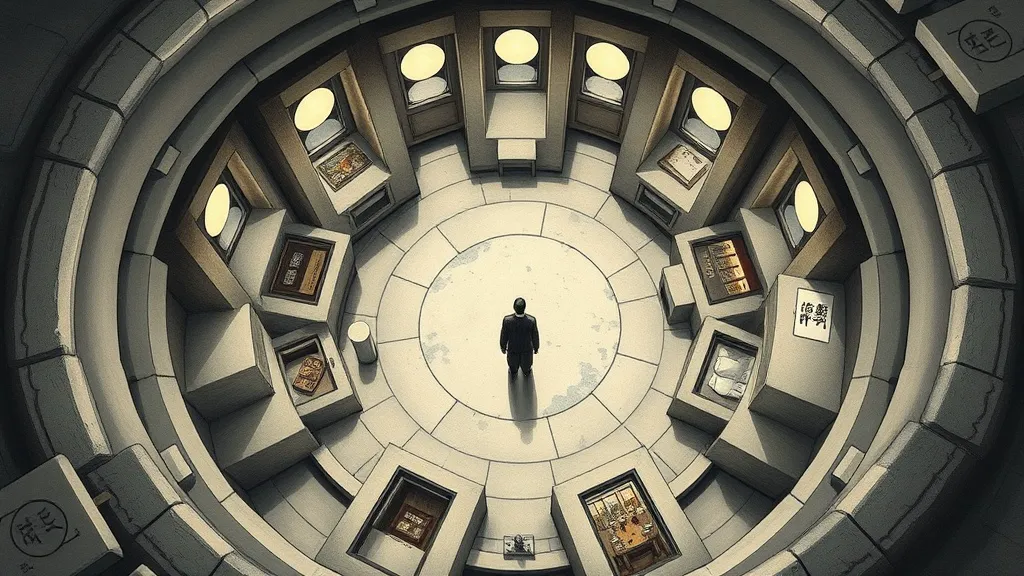
The Twelve Palaces: Life Mapped Onto a Circle
A Ziwei Doushu chart has twelve cells, each governing a domain of life—personality, wealth, marriage, career, health, and more. But the palaces aren't independent boxes. They talk to each other across the chart. The palace opposite yours modifies it. The palace next to it colors it. And every decade, a different palace activates.
Chinese Divination Systems series, Part 2
The Clock Face
Picture a clock. Twelve positions, arranged in a square grid—four across the top, four across the bottom, two on each side. Each position corresponds to one of the twelve Earthly Branches: Zi, Chou, Yin, Mao, Chen, Si, Wu, Wei, Shen, You, Xu, Hai. These are fixed. They never move. They are the grid itself.
Now place your Life Palace (命宮) on one of those positions. Which one depends on your birth month and birth hour—a calculation the first article in this series described. Once the Life Palace is placed, everything else follows. The remaining eleven palaces fill in counterclockwise, one per position, in a fixed sequence that never changes.
Here is what people miss: the palaces aren't independent. The palace opposite yours (對宮) modifies it. Your Career Palace is colored by whatever sits across from it. Your Spouse Palace is influenced by the palace six positions away. The chart is not twelve isolated rooms. It is a conversation happening in a circle.
The Life Palace (命宮): Your Core Character
The Life Palace is the center of gravity. Every other palace is read in relation to it. The stars that land here define your fundamental nature—not your personality in the pop-psychology sense, but the deep grain of how you move through the world.
When Ziwei (紫微), the Emperor star, lands in your Life Palace, the Quanshu says you will be “dignified, thick-waisted, loyal and honest by nature.” You carry authority naturally. People defer to you without being asked. But the text immediately adds: if Ziwei sits here without the support of Zuofu (左輔) and Youbi (右弼)—the left and right ministers—then it is “a lone emperor,” dignified but ineffective. Authority without a cabinet.
Compare that to Tanlang (貪狼), the Greedy Wolf, in the Life Palace. The text describes “desire, versatility, charisma, appetite.” This is someone who wants everything—food, drink, status, experience. With auspicious stars flanking it, Tanlang in the Life Palace produces the person who succeeds through sheer magnetism. With malefic stars, it produces the person who ruins themselves through excess.
The Life Palace is also where the Quanshu's judgment formulas begin. The text provides specific readings for Ziwei in each of the twelve Earthly Branch positions—Ziwei in the Zi position, Ziwei in the Chou position, and so on—each with different implications depending on which stars share the palace and which birth years are favorable.
The Siblings Palace (兄弟宮): Your Peer World
Immediately counterclockwise from the Life Palace sits the Siblings Palace. It governs brothers, sisters, and by extension, close peer relationships—the people who are roughly your equals in the social hierarchy. The Quanshu notes that when the Great Limit (大限) or Small Limit (小限) transits this palace with auspicious stars, “siblings are harmonious and one receives their help.” When malefic stars converge, “brothers and sisters suffer disaster, and the bond fractures.”
In modern practice, astrologers often extend this palace to cover business partners, close colleagues, and anyone who functions as a peer ally. The principle is structural, not literal: this palace governs horizontal relationships.
The Spouse Palace (夫妻宮): Marriage Quality
The Spouse Palace is where people look first after the Life Palace, and for obvious reasons. The Quanshu states that when the Small Limit and the Annual Star (太歲) both arrive in this palace with auspicious stars in the three directional positions (三方四正), it indicates “betrothal or marriage that year for the unmarried, and harmony for those already married.” With malefic stars, the text turns blunt: “ten years of discord between husband and wife.”
Here is where Ziwei Doushu gets concrete. Say Taiyang (太陽), the Sun star, lands in your Spouse Palace in a strong position. This suggests a marriage partner who is generous, outward-facing, publicly oriented—someone whose light shines outward. But Taiyang in a weak position in the Spouse Palace suggests a partner who burns too bright and exhausts the relationship. The same star, different dignity, opposite readings.
Now consider Lianzhen (廉貞), the Judge star, in the Spouse Palace. Lianzhen is intense, principled, and dangerous when cornered. In the Spouse Palace, it often indicates a marriage with deep feeling but also sharp conflict. The Quanshu notes that Lianzhen with the Heavenly Minister (天相) in the same palace produces stability—because Tianxiang's diplomatic water tempers Lianzhen's fire. Without that moderating star, the reading is more volatile.
The Wealth Palace (財帛宮): Financial Patterns
The Wealth Palace does not tell you whether you will be rich. It tells you how you make and lose money. The Quanshureads: “When the Great Limit reaches this palace with auspicious stars in the three directions, ten years of financial prosperity. When malefic stars converge, loss and labor without reward.”
Wuqu (武曲), the Warrior of Finance, is the star most naturally at home here. Wuqu in the Wealth Palace with supporting stars means decisive financial accumulation—the person who earns through direct action, who is blunt about money, who accumulates through force of will. But the text warns: if Wuqu sits in the Wealth Palace with Qisha (七殺) and malefic stars, “wealth comes by the sword and goes by the sword.” The same decisiveness that earns also destroys.
Tianfu (天府), the Treasury Minister, in the Wealth Palace suggests a different pattern: conservative accumulation, stable holdings, wealth that grows through preservation rather than conquest. It is the difference between a trader and a trust fund manager.
The Career Palace (官祿宮): Professional Destiny
The Career Palace—literally the “Official Emolument Palace”—reflects the system's imperial origins. In a society where the civil service examination was the primary path to achievement, this palace governed whether you would pass the exams, receive an appointment, and hold your position.
The Quanshu states: “When the Annual Star reaches this palace with auspicious stars in the three directions, that year sees career advancement and business success. With malefic stars, hard labor that produces nothing.”
Ziwei in the Career Palace is the most classically favorable placement. The emperor in the hall of governance. But even here, the text adds qualifications: Ziwei alone is a lone sovereign. Ziwei with Tianfu is sovereign and minister together—real authority. Ziwei with Pojun (破軍), the Army Breaker, means authority through destruction and rebuilding—the career that advances by tearing down what came before.
Now move Pojun to the Career Palace without Ziwei. The Quanshudescribes a career pattern of dramatic reversals—great rises followed by collapses, the professional life that looks like a seismograph. With good auxiliary stars, these reversals resolve upward. Without them, each crash gets worse.
The Travel Palace (遷移宮): The World Outside Your Door
The Travel Palace—more accurately the Migration Palace—governs your relationship with the external environment. It is not just about literal travel. It covers how you fare outside your native territory: business trips, relocations, encounters with strangers, your luck in foreign contexts.
The Quanshu is direct: “When the Great Limit reaches this palace with auspicious stars, ten years of great benefit. Going out brings good fortune, business flows smoothly. With malefic stars, hardship and difficulty.”
This palace has special structural importance because it sits directly opposite the Life Palace. Whatever stars land in your Travel Palace constitute the “opposite palace” (對宮) of your Life Palace, and they modify your core character from the outside. A person with strong stars in the Life Palace but weak stars in the Travel Palace is someone whose inner qualities don't translate well to external situations. The reverse—strong Travel Palace, weaker Life Palace—suggests someone who comes alive outside the home but struggles with their own nature.
The Remaining Six Palaces
The Children Palace (子女宮) governs offspring and, in modern readings, creative output—anything you produce and send into the world. Auspicious stars bring “prosperous children and good fortune”; malefic stars bring “disaster and illness among the children, with clashing and harm.”
The Health Palace (疾厄宮) is precisely what it sounds like: physical constitution, chronic conditions, vulnerability to specific types of illness. The Quanshu notes that when the Great Limit sits here with auspicious stars, the decade is peaceful. But with severe malefic convergence during an unfavorable year, “there is danger to life itself.”
The Friends Palace (僕役宮)—literally the Servants Palace—governs subordinates, social networks, and help received from others. The Quanshu reads: auspicious stars mean “one receives constant aid from peers and subordinates.” Malefic stars mean “servants lack loyalty”—in modern terms, the people around you do not have your back.
The Property Palace (田宅宮) covers real estate, inherited assets, and domestic environment. It tells you whether you will acquire property, whether your home life is stable, and whether your inheritance will materialize. The text warns that with malefic stars, “selling property is easy but recovering it is hard.”
The Fortune Palace (福德宮) governs inner happiness, spiritual inclination, and leisure—the quality of your mental life when you are not working. Auspicious stars here mean “ten years of abundant fortune and thick virtue.” Malefic stars mean “meager fortune and thin virtue, solitary and incompatible.”
The Parents Palace (父母宮) does double duty. It governs your relationship with your parents and also your physical appearance. The text notes that severe malefic convergence here indicates “parental harm, separation from blood relatives, and the risk of disfigurement.” The connection between parents and appearance is characteristically Ziwei Doushu: your face is your inheritance, literally.
How Palaces Interact: The Three Directions and Four Positions
No palace is ever read in isolation. The Quanshu introduces two structural concepts that govern how palaces interact: the Three Directions (三方) and the Four Positions (四正).
The Three Directions of any palace are the three other palaces that form a triangle with it on the chart. If your Life Palace sits at the Yin (寅) position, then the Shen (申), Si (巳), and Hai (亥) positions are its Three Directions. Any stars in those positions “shine toward” (拱照) your Life Palace and influence it. The text is explicit: “The Three Directions should be examined with the Wealth, Travel, and Career palaces”—these three palaces form the primary triangular relationship with the Life Palace.
The Four Positions include the palace itself plus its Three Directions. When the Quanshu says “auspicious stars in the three directions and four positions,” it means the entire triangular framework is favorable. When it says “malefic stars converge in the three directions,” disaster follows not because one palace is afflicted but because the whole structural triangle is compromised.
Then there is the Opposite Palace (對宮). Every palace has one palace directly across the chart from it, six positions away. The Opposite Palace acts as a mirror—it modifies the palace it faces. The Quanshu states that when a palace has no major stars of its own, the reading should be taken from its Opposite Palace. This is called “borrowing stars from the opposite position” (借星安宮), and it means an empty palace is not necessarily weak—it depends on what faces it.
The Great Limit (大限): Decades Activating the Chart
A natal chart is not static. Ziwei Doushu divides life into ten-year periods called Great Limits. Each Great Limit activates a different palace, meaning the stars and conditions of that palace become the dominant theme for an entire decade.
The starting age of the first Great Limit depends on your Five Element Bureau (五行局)—Water Bureau begins at age 2, Wood at 3, Metal at 4, Earth at 5, Fire at 6. From there, each subsequent decade advances to the next palace. The direction of advance—clockwise or counterclockwise—depends on gender and the yin-yang quality of your birth year: Yang Males and Yin Females move clockwise; Yin Males and Yang Females move counterclockwise.
The Quanshu provides specific readings for each palace when the Great Limit arrives. For the Life Palace: “The Great Limit necessarily corresponds to childhood; with auspicious stars in the same palace but malefic stars in the three directions, young children face the danger of early death.” For the Wealth Palace: “The Great Limit here with auspicious stars in the three directions brings ten years of financial prosperity.”
The key insight is that the Great Limit does not replace the natal chart—it overlays it. Your natal star positions remain fixed. The Great Limit adds a temporal lens. A person with excellent natal stars in their Wealth Palace but a difficult Great Limit decade will experience their financial potential being obstructed. A person with mediocre natal stars but a strong Great Limit decade will see unexpected improvement.
The Small Limit (小限): Year by Year
Within each Great Limit decade, individual years are governed by the Small Limit. The Small Limit cycles through the twelve palaces year by year, providing annual readings that nest inside the decadal reading.
When both the Great Limit and the Small Limit arrive at the same palace simultaneously, the Quanshu calls this a “double limit convergence” (二限疊逢). The text says: “If auspicious, that year is even more auspicious. If malefic, that year is even more malefic.” The principle is amplification—when both time cycles focus on the same palace, whatever that palace contains becomes louder.
The Annual Star (太歲) adds a third layer. Each year, the Annual Star enters a specific palace based on the Earthly Branch of that year. When the Annual Star, the Small Limit, and the Great Limit all converge on the same palace, the Quanshu describes this as the most intensified reading possible. The text's language turns dire for negative confluences: “When all three converge with White Tiger, Illness Talisman, and Death Talisman, not one in ten survives.”
The Heavenly Net and Earthly Snare
The Quanshu identifies two palace positions as structurally dangerous: the Xu (戌) position, called the Heavenly Net (天羅), and the Chen (辰) position, called the Earthly Snare (地網). When the Great Limit or Small Limit enters these positions with Huoxing (火星, the Fire Star) or Tuoluo (陀羅, the Spinning Top), the text becomes severe: “One must teach the soul to meet King Yama” —a classical way of saying the danger is mortal.
This is one of the harsher features of Ziwei Doushu that modern practitioners tend to soften. The Quanshu does not soften it. The original text says what it says: certain positions, certain star combinations, certain temporal convergences are dangerous. Whether you read that literally or metaphorically is your business. The system itself does not hedge.
The Seven Killings Recurrence
One of the most feared configurations involves Qisha (七殺), the Seven Killings star. The Quanshu describes a pattern called “Seven Killings Recurrence” (七殺重逢): when Qisha appears in the Three Directions of your Life Palace, and then the Annual Star enters a position where it also encounters Qisha, the destructive energy doubles. If the Small Limit simultaneously enters a palace with Qisha, “the malice tripled is nine out of ten times fatal.”
The related pattern “Bamboo-Screen Three Limits” (竹羅三限) occurs when Qisha, Pojun (破軍), and Tanlang (貪狼) —the three most volatile stars—occupy the Three Directions of the Life or Body palace, and all three temporal limits converge there. The Quanshu says plainly: “Of ten lives, nine die; the structure does not hold.”
Reading the Chart as a Whole
The mistake beginners make is reading palaces as independent fortune-cookie slots: good Wealth Palace means rich, bad Spouse Palace means lonely. The Quanshu repeatedly insists on reading the chart as an interconnected system. The annotator Nanbei Shanren (南北山人) adds a revealing note at the end of the star placement chapters:
“The readings given here for stars in each palace and their auspicious or malefic qualities are merely general outlines, not definitive verdicts. Observing fate through the Dipper must be done with living flexibility. One must not cling to fixed rules and digest the ancients without transformation, lest one's livelihood become pointless.”
This is the system speaking honestly about its own limitations. The twelve palaces are a framework, not a fortune. Stars in palaces are tendencies, not verdicts. The Great Limit and Small Limit add time to the reading, but time is a modifier, not a destiny. The entire system is designed to be read with judgment, not swallowed whole.
The next article in this series will examine the 14 major stars in detail—their individual characters, how they behave in different palace positions, and the specific readings the Quanshu provides for each star-palace combination.
Source
All technical details and quoted passages are drawn from the 紫微斗數全書 (Ziwei Doushu Quanshu), annotated edition by Nanbei Shanren (南北山人), based on the Ming-dynasty woodblock print, particularly pages 31–75 covering the twelve-palace judgment methods, Great and Small Limit analysis, Annual Star interactions, and the star-in-palace reading formulas.