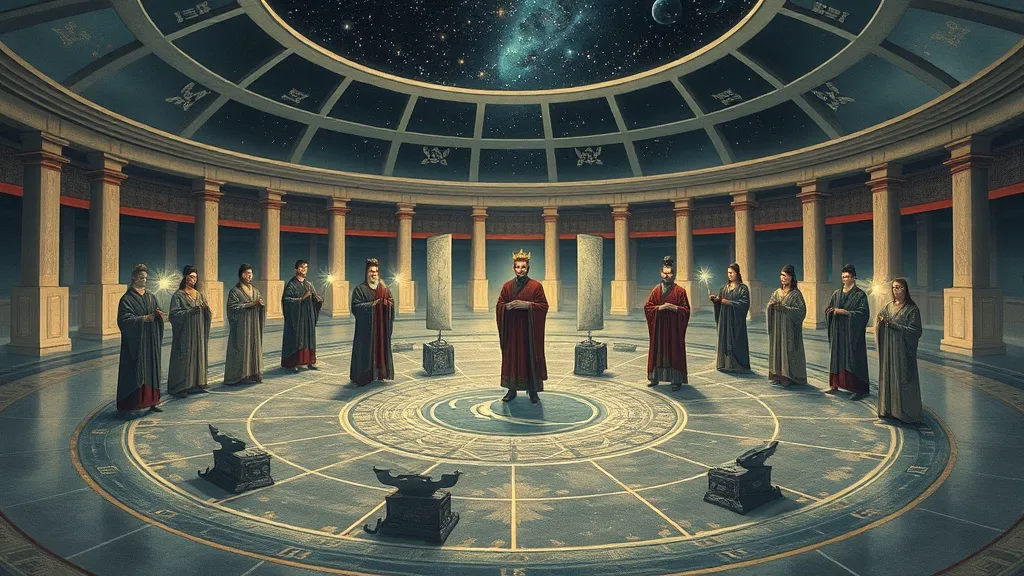
The 14 Major Stars: A Cast of Characters in Your Natal Chart
Here's what people miss: the stars aren't abstract forces. They're personalities. And when two personalities share a palace, they modify each other the way colleagues do—sometimes brilliantly, sometimes disastrously.
Chinese Divination Systems series, Part 3
Not Symbols. Characters.
In the first article of this series, I introduced the 14 major stars of Ziwei Doushu as a table—names, groups, one-line summaries. That was a cast list. This article is the character study.
The thing that makes Ziwei Doushu structurally different from, say, Western natal astrology is that its stars are not planets. They are not physical objects whose gravitational relationships produce effects. They are, and I mean this precisely, characters. The Ziwei Doushu Quanshu (紫微斗數全書) describes each star the way a novelist describes a person: their temperament, their strengths, their fatal flaws, what happens when they meet certain other people, and how they behave in different rooms of the house.
The rooms are the twelve palaces. The people are the fourteen stars. And the drama of your natal chart is what happens when these specific people show up in these specific rooms.
The Northern Dipper: The Emperor's Court
The six Northern Dipper (北斗) stars form the ruling apparatus. They move as a group, their positions calculated from the position of Ziwei—the Emperor star—which is itself determined by your birth day and your Five Element Bureau. Find the Emperor, and you find his court.
Ziwei (紫微) — The Emperor
The Quanshu calls Ziwei “the sovereign star of the Central Heavens, master of creation, the hub around which all stars revolve.” This is not hyperbole. Every other star in the system takes its placement from Ziwei's position. Where Ziwei sits is where the court convenes.
As a personality: dignified, commanding, magnanimous. Ziwei people are natural authority figures—the kind who walk into a room and the room rearranges itself. The original text emphasizes that Ziwei is “loyal, honest, and thick-skinned” (忠厚老成), capable of suppressing evil stars like Seven Killings and dissolving the threat of Fire and Bell.
But here is the catch, and the Quanshu is quite clear about this: Ziwei without Left Assistant (左輔) and Right Assistant (右弼) is an “orphan emperor” (孤君). Dignified but isolated. Authority without apparatus. A CEO with no staff. The system thinks in court dynamics, and an emperor who holds court alone is not powerful. He is merely lonely.
Tianji (天機) — The Strategist
The Quanshu describes Tianji as “the benevolent star of the Southern Dipper that governs longevity”—but its actual behavior is more nervous than serene. Tianji is the advisor, the planner, the person in the meeting who has already mapped out three scenarios before anyone else has finished reading the agenda. Quick intelligence. Restless energy. Mechanical aptitude—the character 機 literally means “mechanism” or “trigger.”
The text notes that Tianji people are “diligent with the six relationships, suited to the forest and spring”—meaning they do well in scholarly or contemplative environments but can struggle with the blunt-force demands of political life. When Tianji meets Seven Killings or Heavenly Beam, the strategist becomes anxious. When it meets literary stars (文昌, 文曲), it becomes brilliant.
Taiyang (太陽) — The Sun
Taiyang is the only star in the system whose brightness visibly changes based on which palace it occupies. In the East (寅, 卯, 辰)—its rising positions—Taiyang is radiant, generous, publicly successful. In the West (申, 酉, 戌)—its setting positions—it dims. The text says this directly: “if the Sun is in retreat, the person labors restlessly, drifts from home, and may have eye ailments.”
The personality is outward-facing: generous, good-hearted, fond of helping others. The Quanshu says Taiyang people have “purple complexions, are fond of giving and charity.” But Sun people give to everyone, which means they sometimes give too much. When Taiyang sits in the Spouse palace, it can mean a partner who is outwardly brilliant but never quite present at home.
Wuqu (武曲) — The Warrior of Finance
Wuqu belongs to the Metal element and governs wealth. The Quanshu declares: “Wuqu, Metal of the Northern Dipper, in destiny it governs wealth, and serves as the master of the Wealth palace.” But Wuqu is not a money magnet in the passive sense—it is decisive, blunt, militaristic. Short-bodied, loud voice, bold temperament. The text describes Wuqu people as “resolute and decisive” (剛強果斷), with unusual hair.
Wuqu is most dangerous when it meets Pojun (Army Breaker). The Quanshu warns: Wuqu with Pojun and Seven Killings plus Fire and Bell—“a youth who drowns in rivers.” Money star meets destroyer star meets killing star meets volatility stars: the result is financial ruin that turns physical. But with Tianfu (Treasury) as its ally, Wuqu stabilizes beautifully, producing what the text calls “financial and career brilliance” (財官雙美).
Tiantong (天同) — The Harmonizer
Tiantong is the star of blessings and ease. The text calls it “the master of the Fortune palace” (福德宮之主), governing happiness, leisure, and emotional comfort. This is the person at the dinner party who makes everyone feel welcome. Agreeable. Warm. Pleasure-seeking in the best sense.
The problem with Tiantong is structural: it is soft. The Quanshu warns that when Tiantong falls into weak positions or meets destructive stars (擎羊, 陀羅, 火星, 鈴星), the result is “solitary, disfigured, with eye ailments.” A harmonizer in a hostile environment does not harmonize. It gets crushed. Tiantong's great virtue—its gentleness—becomes its liability when the palace it occupies demands toughness.
Lianzhen (廉貞) — The Judge
Lianzhen is the most complex star in the Northern Dipper group. The Quanshu introduces it as “Fire of the Northern Dipper, the secondary Peach Blossom killing star”—a double designation as both a romance star and a danger star. In office it governs rank and position. In the Career palace, Lianzhen excels. It is the judge, the inspector, the person who holds others to standards.
But touched wrong, Lianzhen explodes. The text uses the character 囚 (prisoner) in its description: when Lianzhen's energy is blocked—“touch it and you cannot resolve it, encounter it and it brings no blessing”—the result is lawsuits, prison, or self-destruction. With Pojun or Seven Killings, the text warns of “drowning or hanging.” Lianzhen is the star that rewards discipline and punishes chaos, including its own.
Critically, the Quanshu notes: “This star most loves to be with Tianxiang (天相) in the same palace,” because Tianxiang's water element “controls Lianzhen's fire.” The system thinks in elemental checks and balances. Even the most volatile character can be managed if you seat it next to the right colleague.
The Southern Dipper: The Minister's Council
The eight Southern Dipper (南斗) stars move in the opposite direction from the Northern group. Their positions are calculated from Tianfu—the Treasury star—which moves inversely to Ziwei. If the Northern Dipper is the emperor's court, the Southern Dipper is the administrative apparatus that actually runs the empire.
Tianfu (天府) — The Treasury Minister
Tianfu is the anchor of the Southern Dipper group. The Quanshu declares it “the commanding star of the Southern Dipper, the deity of clothing and salary, governing power and fortune.” Where Ziwei is the emperor, Tianfu is the prime minister who manages the treasury. Stable. Conservative. Dependable. The text describes Tianfu people as “pure, refined, and upright” (端雅純淨).
The key phrase: “Tianfu is the granary of fortune; when destiny encounters it, there is always wealth.” (天府為祿庫,命逢終是富) Tianfu does not produce dramatic fortune. It preserves what exists. It “controls Ram and Camel” (能制羊陀) and “converts Fire and Bell into blessings.” In a chart full of volatile stars, Tianfu is the adult in the room.
Taiyin (太陰) — The Moon
Taiyin mirrors Taiyang: where the Sun governs the outward, public, masculine dimension, the Moon governs the inward, domestic, feminine. The Quanshu calls it “the essence of water, the master of property and real estate” (田宅主), and also “the mother star and the wife star.” Like the Sun, the Moon has bright and dim phases—strong in the evening positions (酉, 戌, 亥, 子), weak during the day (卯, 辰, 巳, 午).
In a man's chart, a bright Taiyin often indicates a beautiful, capable wife. In a woman's chart, it intensifies emotional depth, intuition, and artistic sensitivity. The personality is “intelligent, elegant, fond of learning” (聰明俊秀). But a dim Moon—fallen, beset by destructive stars—produces what the text calls a person of “little blood-energy and weak spirit” (血氣少精神).
Tanlang (貪狼) — The Greedy Wolf
Here is the star everyone wants to talk about. The Quanshu introduces Tanlang as “the first star of the Northern Dipper”—yes, despite being classified functionally with the Southern group—“the god who resolves calamities, Wood in element, transforming as the Peach Blossom.”
Tanlang is desire itself. Charismatic, versatile, hungry. The text describes a personality that is “calculating, acts impulsively, clever but produces clumsy results” (多計較,作事急速不耐靜,作巧成拙). This is the person who wants everything—money, romance, status, sensation—and who is willing to reinvent themselves endlessly to get it. They are the last person to leave the party and the first to spot an opportunity.
The dual nature is key. With Fire Star (火星), Tanlang becomes a military hero: “raise troops and establish border merit” (提兵指日立邊功). With Ram and Camel (擎羊, 陀羅), it becomes dissolute. The Quanshu does not mince words: “for women, many flaws; six Gui or six Xin birth years in Si-You-Chou-Hai—the main thief; women are mostly unchaste.” Tanlang in the wrong configuration is desire without governance. In the right configuration, it is ambition with results.
Jumen (巨門) — The Great Gate
Jumen is the analyst and the critic. The Quanshu calls it “the dark star” (化氣為暗)—not evil, but obscuring. It is the star of sharp analysis that easily becomes sharp criticism. Jumen people see through things. The text says they are “short in stature, fierce in temperament, stubborn” (矮小性剛威猛).
The critical detail: Jumen's darkness is relational. Meeting Taiyang (the Sun) in the same palace, Jumen's darkness is illuminated—“not fearing the Giant Gate, the wealth and honor extend far.” But alone in a fallen position, Jumen produces “gossip, lawsuits, and disputes” (是非口舌). This star does not create problems from nothing—it uncovers problems that were already there, and then will not shut up about them.
Tianxiang (天相) — The Seal Keeper
Tianxiang is the bureaucrat in the best sense. The Quanshu calls it “the star that governs official rank, transforming as the Seal” (化氣為印). This is the minister who carries the imperial seal—the person through whom all official acts are validated. Diplomatic, well-mannered, dependable, content with being second-in-command.
The text emphasizes one crucial function: “This star can control the evil of Lianzhen, for Tianxiang's water in abundance can extinguish Lianzhen's fire” (蓋天相之水旺盛,能赴廉之火也). In the logic of the system, Tianxiang is the constitutional check on executive excess. Put it next to the volatile judge-star, and the judge calms down. Remove it, and the judge becomes a tyrant.
Tianliang (天梁) — The Pillar
Tianliang governs longevity and protection. The Quanshu calls it “the second star of the Southern Dipper, governing longevity, transforming as the Protective Shadow” (化氣為蔭壽). This is the elder—the grandparent, the mentor, the person whose mere presence in a palace provides shelter.
The text describes Tianliang people as “weighty, warm, and upright, impartial and selfless, fond of charity” (厚重溫謙,循直無私,好施濟). But Tianliang can also be moralistic to the point of rigidity. Meeting Taiyang gives it warmth and public effectiveness. Meeting destructive stars turns the elder into a solitary moralist whom nobody listens to. The text is blunt: “Ram and Camel plus emptiness all meeting—one life enters the Yellow Springs” (羊陀空劫重相會,一命入泉鄉).
Qisha (七殺) — Seven Killings
Qisha is the most feared star in the system. The Quanshu introduces it as “the sixth star of the Southern Dipper, the supreme general among the stars, the solitary star of success and failure” (斗中之上將,實成敗之孤辰也). This is not a star you want to find in your Life palace unless it has company.
The personality: fierce, proud, militaristic, incapable of compromise. The text says Qisha people are “broad-backed, with furrowed brows, and a slanting waist” (背厚眉覺,腰斜性剛). They are conquerors. But conquest requires something to conquer, and without proper direction, Qisha turns inward. The Quanshu warns: “if the killing is strong and unrestrained, the young will die an evil death and descend to the Yellow Springs” (若是殺強無制伏,少年惡死到黃泉).
The critical modifier: Ziwei. When the Emperor star meets Seven Killings, the killer becomes the emperor's general—disciplined, directed, formidable. “Transforming authority and descending blessings, encountering Ziwei resolves all” (化權降福,遇紫微而可解). The entire logic of star combinations is compressed in this one pairing: uncontrolled force is destructive; force with governance is power.
Pojun (破軍) — The Army Breaker
Pojun is the star of destruction and renewal. The Quanshu calls it “Water of the Northern Dipper, transforming as the Depletion Star” (化耗星). Where it appears, something gets torn down. The question is whether what gets built afterward is worth the wreckage.
The personality is restless, innovative, impatient with the status quo. Pojun people “are difficult first and easy later” (先難後易)—they struggle in youth and find their footing in maturity, but only if the chart supports it. The text describes them as “clever, resourceful, capable of many skills” (聰明機巧,多學多能), but their skin tells the story: “when bright, spots appear; when fallen, pockmarks” (旺有暗著,陷有斑狼). Pojun's passage through your life leaves marks.
When Stars Share a Palace: The Logic of Combinations
The 14 major stars do not exist in isolation. The placement algorithm ensures that certain stars always appear in specific pairings in specific palaces. Ziwei and Tanlang can share a palace in Mao or You (卯/酉). Ziwei and Tianfu share Shen or Chen (辰/戌). Wuqu and Tianfu share Zi or Wu (子/午). These are not random collisions. They are structural features of the system, and the Quanshu evaluates each combination individually.
The principle is simple: when two stars share a palace (同宮), they modify each other. The modification follows personality logic, not abstract element theory—though the elements matter too. Ziwei with Tanlang is the emperor seduced by the courtier of desire. The result, per the text: “men and women are licentious; food and fame, financial and career brilliance”—but also “for women, unchaste, or a concubine or servant.” The emperor indulging the wolf produces wealth but costs reputation.
Wuqu with Pojun: the wealth star meets the destroyer. The text says: “difficult to be noble and prominent; in youth, unfavorable.” But add Ziwei's governance from the Three Harmonies position, and the destroyer becomes a builder. The Quanshu evaluates every combination palace by palace, year-stem by year-stem, producing hundreds of specific case readings.
The Four Transformations: Stars in Motion
A natal chart with stars in palaces is a photograph. The Four Transformations (四化) are what make it a film. Based on the Heavenly Stem of your birth year, four specific stars receive transformations—modifications that fundamentally alter how they behave:
| Transformation | Chinese | Effect |
|---|---|---|
| Hua Lu | 化祿 | Prosperity. The star becomes a wealth magnet, amplifying fortune in whatever palace it occupies. |
| Hua Quan | 化權 | Power. The star gains authority and decisiveness, but also rigidity and aggression. |
| Hua Ke | 化科 | Fame. The star attracts recognition, scholarly achievement, and public respect. |
| Hua Ji | 化忌 | Obstruction. The star becomes a source of complications, delays, obsessions, and loss. |
The Quanshu describes Hua Lu as “the deity of fortune and virtue” (福德之神). With Authority and Science stars in alignment, it produces “pillars of the state” (柱石之臣). Even malevolent stars that encounter Hua Lu “cannot do harm.” Hua Quan is “the deity who judges life and death” (掌判生殺之神)—it gives a star the power to act, but with Rams and Camels and Depletions, that power curdles into “listening to slander, disaster from lawsuits.”
Hua Ji is the transformation everyone fears. The Quanshu calls it “the deity of excessive management” (多管之神)—the star that meddles, obstructs, and complicates. “Guarding the Life palace, a lifetime of misfortune; the small limit meeting it, a year of trouble.” But the text includes a fascinating exception: when Taiyang is in Yin-Mao-Chen-Si and transforms to Ji, or when Taiyin is in You-Xu-Hai-Zi and transforms to Ji, “the reverse becomes prominent” (反為顯論). Bright stars transforming to obstruction in their strongest positions convert the obstruction into intensity. The obstacle becomes the fuel.
The System's Own Caveat
The Quanshu's editor, Nanbei Shanren (南北山人), appends an extraordinary note at the end of the star-in-twelve-palace section. After pages of specific predictions—this star in this palace with this year-stem produces wealth, or poverty, or death—he writes:
“The above examples of Ziwei in the twelve Life palaces, with the various stars sharing their auspicious and inauspicious meanings, are of the utmost importance when interpreting a chart. But these are only generalities—they do not guarantee that the stated outcomes will definitely be auspicious or definitely be inauspicious. One must observe with a living, flexible mind and not cling to established formulas or fossilize ancient methods. Otherwise, life will certainly seem absurd.”
斗觀命,一定在活變,不可拘泥成法,食古不化,否則生必託然也。
In other words: the text that just spent fifty pages giving you rules is now telling you not to follow the rules mechanically. This is the most honest thing any divinatory text has ever said. The stars are characters. The palaces are scenes. But the chart is not a script. It is, at best, a cast list with stage directions. What the actors actually do—that requires interpretation, and interpretation requires the kind of flexible intelligence that no formula can replace.
Source
All star descriptions, palace combinations, and transformation rules in this article are drawn from the 紫微斗數全書 (Ziwei Doushu Quanshu), annotated edition by Nanbei Shanren (南北山人), based on the Ming-dynasty woodblock print from the Tang Yixuan (唐益軒) edition. The star-by-star analyses appear in the section titled “諸星入命身限吉凶訣” (Verses on the Auspicious and Inauspicious Entries of Stars into Life, Body, and Limits), pages 61–75. The question-and-answer star analyses appear in the “諸星問答論” (Discussions in Question-and-Answer on the Stars), pages 80–90. The Four Transformations are discussed in pages 76–77 and 91.