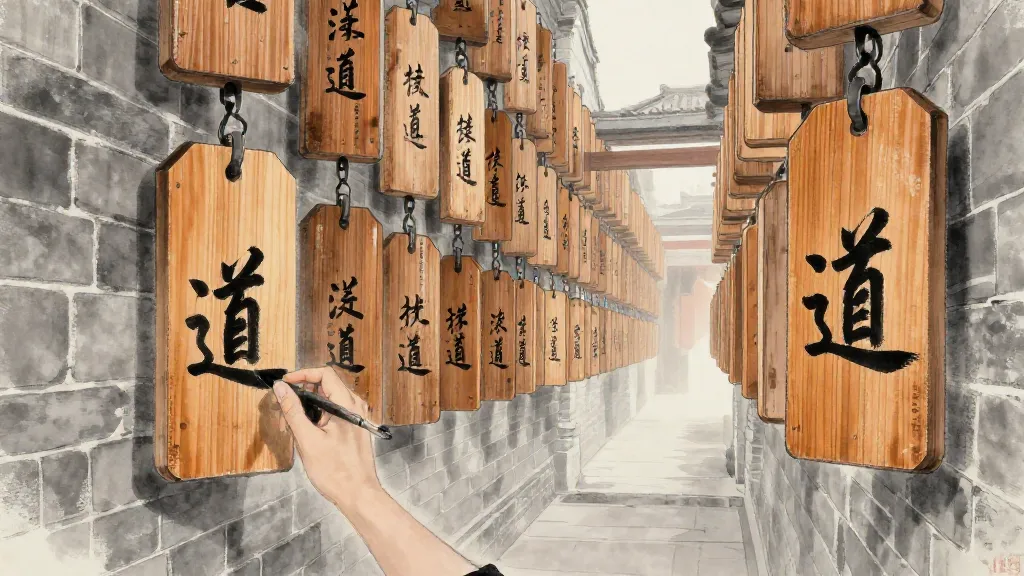
Why Your Practice Name Doesn't Need to Be Unique
In two thousand years of Chinese naming tradition, practice names were never unique. They were expressions, not usernames. Six Lines follows that convention.
Three Names, Three Purposes
If you lived in imperial China, you didn't have one name. You had at least three, and each one operated in a different register of your life.
Your ming (名) was your birth name, given by your parents and used in official records. It was the name the government knew you by. Your zi (字), the courtesy name, was given to you around age twenty at your capping ceremony—the ritual marking adulthood. It was the name your peers called you. Using someone's ming directly was considered presumptuous; the zi existed as a social buffer, a name that said “we are equals.”
And then there was the hao (號).
The hao was different from both. It was self-chosen. It was voluntary. It was an expression of who you aspired to be, what you valued, or where your mind dwelled. Su Shi chose 東坡居士 (“Layman of the Eastern Slope”) after the hillside garden he tended during his exile in Huangzhou. Li Bai took 青蓮居士 (“Blue Lotus Layman”), binding his identity to the Buddhist image of wisdom rising from mud. Wang Yangming became 陽明 (“Bright Sun”), a name that encoded his entire philosophical project of moral clarity.
No one assigned these names. No one approved them. And critically, no one checked whether anyone else was already using them.
No Registry, No Enforcement
The imperial Chinese state maintained registries for many things. The census tracked families and their ming for tax and corvée purposes. The examination system recorded the ming and zi of every candidate who sat for the civil service exams. Buddhist and Daoist ordination records (度牒, dudie) logged the dharma names given to monks and nuns within a particular monastery.
But for hao, there was nothing. No central list. No local list. No process for claiming or reserving a name. The hao existed entirely outside the bureaucratic apparatus. It was the one name that belonged wholly to you—not to your parents, not to your teacher, not to the state.
This wasn't an oversight. It was the point. The hao was an act of self-definition in a culture where most other forms of naming were assigned by someone with authority over you. The freedom to choose your own hao—and to change it whenever you wished—was the freedom to declare who you were becoming, on your own terms.
What Happened When Names Collided
They collided all the time. The literary landscape of imperial China was vast, spanning centuries and thousands of miles, and scholars drew from the same well of imagery. Mountains, rivers, bamboo, moonlight, clouds, the colours of seasons—the vocabulary of aspiration was shared, and so were the names that emerged from it.
When two people carried the same hao, the culture had organic ways of handling it. You might prefix a surname: not just 東坡 but 蘇東坡 (Su Dongpo). You might add a geographic marker: the 竹隱 of Jiangxi versus the 竹隱 of Zhejiang. In monastic contexts, you might reference the lineage: “Master Zhang's disciple Hongyi” versus “Master Li's disciple Hongyi.”
But most commonly, no one worried about it at all. The circles in which a scholar's hao circulated were usually regional, and within those circles, context was enough. When circles overlapped across centuries, fame did the work. Su Shi's 東坡 became his not because he filed a claim, but because his writing made the name unforgettable. The hao and the person became inseparable through the quality of the work, not through the uniqueness of the label.
The Daoist and Buddhist Approach
Religious traditions added one layer of structure, but it operated differently from what we might expect.
In Daoist monasteries—particularly the Quanzhen (全真) order that became dominant after the 13th century—masters assigned religious names (法名, faming) to disciples using generation poems (字輩, zibei). These were fixed sequences of characters, one per generation, so that all disciples of the same generation shared a character in their name. The Longmen (龍門) branch's generation poem has been in use for centuries, which means the same two-character religious names have appeared repeatedly across different eras and temples. The disambiguator was always the lineage and the era, never a uniqueness constraint on the name itself.
Buddhist temples followed a similar pattern. A master chose the dharma name (法名 or 法號) for a disciple at ordination. The name 弘一 (Hongyi) is most famous as the dharma name of Li Shutong (李叔同), the twentieth-century artist, musician, and monk. But the characters 弘 and 一 appeared in dharma names for centuries before and after him. His fame gave him ownership of the name in cultural memory. The temple's ordination records gave him ownership within his lineage. No global registry was needed because the name operated within a context that made its bearer clear.
The Digital Instinct and Its Limits
When we build software, the instinct to enforce uniqueness is almost reflexive. Usernames must be unique. Handles must be unique. Email addresses must be unique. The database needs a way to look you up, and the simplest way is a string that maps to exactly one row.
This instinct is correct for system identifiers—things the machine uses to route messages, authenticate sessions, and link records. But it is wrong for expressive identifiers—things a person uses to say who they are.
A practice name is not a username. It is not a handle. It is not a login credential. It is a statement of aspiration, chosen in a moment of reflection, sometimes with the help of a teacher or a tradition. Forcing it into a uniqueness constraint transforms it from an expression into a land grab—first come, first served. The person who registers 竹隱 on day one “owns” it, and every subsequent person whose practice naturally leads them to the same name must settle for 竹隱2 or 竹隱_real or some other indignity that the tradition would find incomprehensible.
How Six Lines Handles It
In Six Lines, your practice name (道號, daohao) is not unique. If your naming ritual leads you to 竹隱, and another practitioner has already chosen 竹隱, you both carry the name. There is no collision. There is no error message. There is no suggestion to pick something else.
Your identity in the system—for purchases, for syncing across devices, for print products—is your Apple ID, which is unique by nature. Your daohao is the name that appears on your seal stamp, on the Patrons of the Well gratitude wall, and eventually on the spine of your printed journal. It is yours in the way that Su Shi's 東坡 was his: not because a database said so, but because it means something to you.
If you share a name with another patron of the Well, consider it a connection. You drew from the same imagery, the same tradition, the same well of meaning. In a practice built on reading patterns of resonance, that is not a conflict. It is a finding.