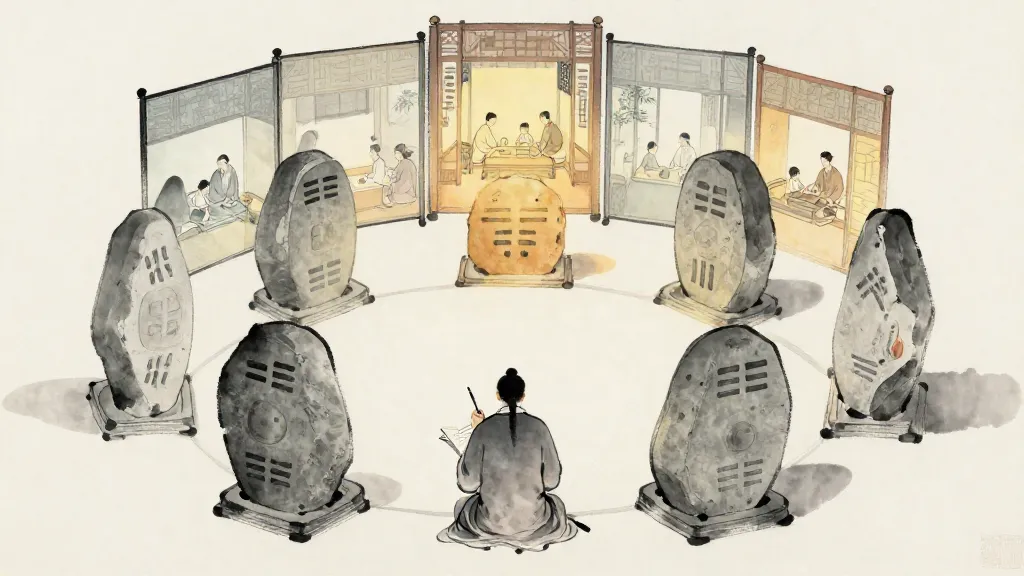
Eight Characters, Not Sixty-Four Cards
The I-Ching isn't sixty-four things to memorise. It's eight characters in every possible conversation. Learn the eight trigrams and you can read any hexagram.
Part 2 of The Other Oracle — a series for tarot readers who want to understand the I-Ching.
The Overwhelm Problem
Tarot has seventy-eight cards and that's already a lot. Most readers spend months, sometimes years, developing a working relationship with the full deck. The I-Ching has sixty-four hexagrams, and each hexagram has six lines, and each line can change—producing 4,096 possible transformations. If you think of this as 4,096 things to learn, you will never start.
But you don't need to learn 4,096 things. You don't even need to learn sixty-four. You need to learn eight.
The eight trigrams are the alphabet of the I-Ching. Every hexagram is a word spelled with two of these letters. Learn the alphabet and you can read any word—not fluently at first, but well enough to understand what's being said.
Meet the Eight Trigrams
Each trigram is three lines—either broken (yin, ⚊⚊) or unbroken (yang, ⚊). Three positions, two possibilities each, gives you exactly eight combinations. The Chinese tradition assigns each one a name, a natural image, a family role, an element, and a personality. Think of them as characters in a story.
☰ Qian — Heaven — The Father
Three unbroken lines. Pure yang. Qian is creative force, initiative, strength without compromise. In a family, he's the father. In nature, he's the sky—vast, active, above. When Qian appears in a hexagram, the energy is forward, powerful, and unrelenting. The danger with Qian is not weakness but excess: too much force, too much certainty, too little willingness to yield.
Tarot parallel: Think of the Emperor—structure, authority, creative will—but without the human figure. Qian is the principle itself, not a person embodying it.
☷ Kun — Earth — The Mother
Three broken lines. Pure yin. Kun is receptivity, vastness, the capacity to hold and sustain. She doesn't initiate; she receives, nourishes, and completes. In nature, she's the earth—endlessly patient, endlessly productive. When Kun appears, the counsel is to follow rather than lead, to receive rather than push, to trust the process of slow growth.
Tarot parallel: The Empress, but stripped of her human story. Kun is abundance and fertility as a cosmic principle, not as a personality.
☳ Zhen — Thunder — The Eldest Son
One yang line beneath two yin lines. Zhen is sudden movement—the crack of thunder, the first stir of spring, the shock that sets things into motion. He's the eldest son: energetic, impulsive, sometimes reckless. When Zhen appears, something is beginning. Energy that was dormant is waking up. The question is whether you're ready for it.
Tarot parallel: The Knight of Wands—sudden movement, initiative, energy that arrives before you expected it. But Zhen is the thunder itself, not the rider.
☴ Xun — Wind — The Eldest Daughter
One yin line beneath two yang lines. Xun is gentle penetration—wind that finds every crack, water that seeps into stone, influence that works slowly but reaches everywhere. She's the eldest daughter: subtle, persistent, effective without confrontation. When Xun appears, the advice is not to force anything. Work like the wind. Enter gradually. Be patient.
Tarot parallel: The Queen of Swords has some of this quality—keen perception, subtle influence—but Xun is less about intellect and more about how nature erodes mountains.
☵ Kan — Water — The Middle Son
One yang line between two yin lines. Kan is danger, depth, and flow. Think of water in a gorge—powerful, beautiful, and genuinely hazardous. He's the middle son: adaptable but potentially treacherous, always moving, filling whatever container he's placed in. When Kan appears, there is real danger, but also the possibility of flowing through it. Water doesn't fight the gorge; it follows the channel.
Tarot parallel: The Moon card carries some of Kan's energy—hidden depths, uncertain passage, the path through darkness. But Kan is literally the water you're navigating, not the landscape around it.
☲ Li — Fire — The Middle Daughter
One yin line between two yang lines. Li is clarity, illumination, beauty, and attachment. Fire clings to what it burns; it needs fuel to exist. She's the middle daughter: brilliant, perceptive, but dependent on something to shine upon. When Li appears, things become visible—patterns clarify, beauty emerges, understanding arrives. But Li also warns about attachment: clinging to what fuels you is both fire's nature and its limitation.
Tarot parallel: The Sun card, in its clarity and illumination. But Li includes the shadow that tarot's Sun doesn't—fire that clings, light that depends.
☶ Gen — Mountain — The Youngest Son
One yang line above two yin lines. Gen is stillness, stopping, contemplation. A mountain doesn't move. It defines the landscape by what it doesn't do. He's the youngest son: quiet, watchful, knowing when to stop. When Gen appears, the counsel is to pause. Not every moment requires action. Sometimes the wisest move is to become the mountain.
Tarot parallel: The Hermit—withdrawal, contemplation, the wisdom of solitude. Gen is the mountain the Hermit stands upon.
☱ Dui — Lake — The Youngest Daughter
One yin line above two yang lines. Dui is joy, exchange, openness, and communication. A lake's surface is open to the sky; it reflects, it gathers, it invites. She's the youngest daughter: expressive, sociable, sometimes dangerously charming. When Dui appears, the energy favours conversation, pleasure, and connection. But Dui has depth beneath her surface—the open mouth of the lake can also swallow.
Tarot parallel: The Star has Dui's openness and generosity. The three of Cups has her sociability. But Dui is simpler than either—she's the open surface, the place where exchange happens.
The Elemental Bridge
Tarot readers think in four elements: Fire, Water, Air, and Earth. These map to the four suits—Wands, Cups, Swords, Pentacles—and they describe the human experience: will, emotion, thought, and body.
The I-Ching thinks in five phases: Wood, Fire, Earth, Metal, and Water. These aren't static elements but processes of change—the Chinese term is wu xing (五行), literally “five movements.” Wood feeds Fire. Fire creates Earth (as ash). Earth yields Metal. Metal collects Water (as condensation). Water nourishes Wood. It's a cycle, not a list.
Where do they overlap? Here's an honest mapping:
- Fire ↔ Fire (Li): Direct overlap. Illumination, clarity, energy, transformation through burning. Tarot's Wands and the I-Ching's Fire trigram share this territory.
- Water ↔ Water (Kan): Direct overlap. Emotion, depth, danger, flow. Tarot's Cups and the I-Ching's Water trigram occupy similar ground.
- Earth ↔ Earth (Kun): Partial overlap. Both describe receptivity, material reality, patience. But the I-Ching's Earth is more specifically about yielding and nurturing than tarot's Pentacles, which lean toward wealth and physical security.
- Air ↔ ???: Here the systems diverge. Tarot's Air (Swords, thought, intellect, conflict) has no direct I-Ching equivalent. The closest is Wind (Xun), but Wind is about gentle penetration, not sharp analysis. The I-Ching doesn't separate “thinking” as its own element.
- No tarot equivalent ↔ Wood and Metal: The I-Ching has two phases that tarot doesn't: Wood (growth, spring, expansion) and Metal (contraction, autumn, refinement). These aren't exotic concepts—you know the difference between the energy of spring growth and autumn harvest—but tarot doesn't give them their own element.
Don't force the mapping to be cleaner than it is. The two systems grew from different soils. Tarot maps the interior of human experience. The I-Ching maps the cycles of the natural world. They overlap where humans and nature share the same patterns—and they diverge where the questions being asked are fundamentally different.
Benebell Wen has developed a detailed correspondence system mapping trigrams to tarot suits through an elegant 8×9 structure. We're taking a different approach here—focusing on the underlying logic rather than card-to-card mappings—but her reference table is worth exploring once you have the trigrams in hand.
How Trigrams Build Hexagrams
A hexagram is two trigrams stacked. The lower trigram represents the inner situation—what's happening beneath the surface, the foundation, the starting condition. The upper trigram represents the outer situation—what's visible, what's arriving, the environment you're operating in.
This is where it gets interesting. The same two characters in different positions tell different stories:
- Thunder below, Water above (Hexagram 3, Difficulty at the Beginning): New energy (Thunder) trying to emerge through danger (Water). A birth struggle. Everything is starting but nothing is easy yet.
- Water below, Thunder above (Hexagram 40, Deliverance): Danger (Water) is beneath you and movement (Thunder) is above. The crisis is resolving. The storm is breaking. Relief.
Same two characters. Reversed positions. Opposite readings. If you understand tarot's positional logic—the same card means different things in “past” versus “future”—this should feel familiar. The I-Ching builds that positional logic into the hexagram itself.
The Family on the Table
The Chinese tradition organises the eight trigrams as a family. This isn't a modern metaphor—it's the I-Ching's own framework, recorded in the Shuogua commentary over two thousand years ago.
| Trigram | Name | Image | Role | Phase |
|---|---|---|---|---|
| ☰ | Qian 乾 | Heaven | Father | Metal |
| ☷ | Kun 坤 | Earth | Mother | Earth |
| ☳ | Zhen 震 | Thunder | Eldest Son | Wood |
| ☴ | Xun 巽 | Wind | Eldest Daughter | Wood |
| ☵ | Kan 坎 | Water | Middle Son | Water |
| ☲ | Li 離 | Fire | Middle Daughter | Fire |
| ☶ | Gen 艮 | Mountain | Youngest Son | Earth |
| ☱ | Dui 兌 | Lake | Youngest Daughter | Metal |
Notice the pattern. The parents are pure—all yang (Heaven) or all yin (Earth). The children are defined by which line breaks the pattern: the eldest son has one yang line at the bottom (the first stirring), the middle son has one yang line in the middle (strength surrounded by yielding), the youngest son has one yang line at the top (stillness capping movement). The daughters mirror this with yin lines.
This family structure isn't decoration. It tells you how the trigrams relate. The sons carry their father's creative force in different positions—beginning, middle, end. The daughters carry their mother's receptive quality in the same way. When two trigrams meet in a hexagram, you're watching a family interaction: father and daughter, brother and sister, mother and son. The relationship between the characters shapes the meaning.
You Now Know the Alphabet
Eight characters. That's what you just learned. Heaven, Earth, Thunder, Wind, Water, Fire, Mountain, Lake. A father, a mother, three sons, three daughters. Five phases cycling through them.
With these eight characters, you can look at any hexagram and read its basic story. Who is below? Who is above? What happens when they meet? You won't catch every nuance yet—that takes practice, just as it takes practice with tarot—but you have the alphabet. You can spell the words.
If you want to explore how each trigram generates an entire family of eight hexagrams, our Eight Palaces series goes deep into that structure. But for now, you have what you need.
Next, we'll learn what makes the I-Ching genuinely different from tarot—the thing that makes it a living oracle rather than a book of fixed meanings. The lines move. And in Part 3, we'll learn how to listen.