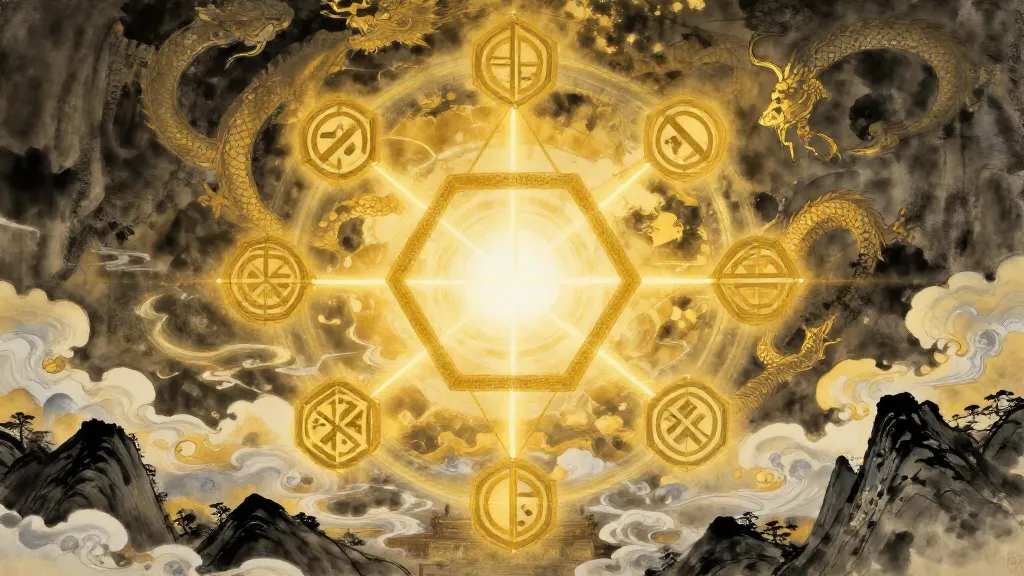
The Palace of Heaven: Qian and Its Family
How the creative force declines through yin infiltration, then returns to power — the eight hexagrams of the Qian palace.
The Eight Palaces System
The Eight Palaces (八宮, bā gōng) system organizes all 64 hexagrams into eight families of eight, each governed by a parent hexagram built from a single doubled trigram. This arrangement, attributed to the Han dynasty scholar Jing Fang (京房), reveals something the standard King Wen sequence obscures: the structural relationships between hexagrams as a trigram gradually transforms, line by line, from the parent figure.
The first palace belongs to Qian (乾), the Creative — pure yang, Heaven doubled. Its eight hexagrams trace the arc of creative authority as yin energy infiltrates from below, eroding the yang structure line by line, until the hexagram undergoes a reversal and yang reasserts itself. If you have read How to Read Hexagrams, you already understand that every hexagram is built from two trigrams. The palace system shows you how those trigrams shift and what the shift means.
The Progression: From Pure Yang to Transformation
The Qian palace begins with six unbroken yang lines and tracks what happens as yin replaces yang, one line at a time, starting from the bottom. Each step tells a story of decline, retreat, and eventually renewal.
- ䷀ Hexagram 1: 乾 Qián (The Creative) — Pure yang. Six unbroken lines. The origin point of creative force.
- ䷫ Hexagram 44: 姤 Gòu (Coming to Meet) — The first yin line enters at the bottom. A single broken line beneath five yang. The first sign of infiltration.
- ䷠ Hexagram 33: 遯 Dùn (Retreat) — Two yin lines now occupy the bottom. The wise response: strategic withdrawal.
- ䷋ Hexagram 12: 否 Pǐ (Standstill) — Three yin lines below, three yang above. Heaven and Earth no longer communicate. Complete stagnation.
- ䷓ Hexagram 20: 觀 Guān (Contemplation) — Four yin lines rise. Only two yang remain at the top, like a watchtower surveying the landscape.
- ䷖ Hexagram 23: 剝 Bō (Splitting Apart) — Five yin lines. A single yang clings to the top. The bed is stripped to its last support.
- ䷢ Hexagram 35: 晉 Jìn (Progress) — The soul hexagram (遊魂卦). Here the fourth line changes back, breaking the pattern of decline. Light emerges above earth.
- ䷍ Hexagram 14: 大有 Dà Yǒu (Great Possession) — The return hexagram (歸魂卦). The lower trigram restores itself to Qian. Fire blazes above Heaven — supreme success.
This sequence is not arbitrary. It follows the logic of change itself: what is full must decline, what declines must eventually transform, and from transformation comes renewal. The Qian palace tells the story of authority that knows when to act, when to retreat, and when to return.
The Parent: Qian — The Creative
The Judgment of Hexagram 1 is the most compressed statement in the entire I Ching:
乾:元,亨,利,貞。
Qián: Sublime Beginning, Success, Benefit, Correctness.
Four characters. Four virtues. Kong Yingda's Tang dynasty commentary explains that these are not merely attributes but active forces: yuan (元) is the power to initiate life; heng (亨) is the power to bring things to fruition; li (利) is the power to harmonize; zhen (貞) is the power to complete and sustain. Together they describe the full cycle of creative action.
The Image text reinforces this with one of the most famous lines in Chinese philosophy:
天行,健。君子以自強不息。
Heaven's movement is vigorous. The noble person accordingly strengthens himself ceaselessly.
This is not a description of brute force. It is a description of sustained, self-renewing effort — the kind that does not depend on external validation. The dragon imagery of Qian's six lines traces a complete arc from concealment (潛龍勿用, “the submerged dragon does not act”) through manifestation (飛龍在天, “the flying dragon is in heaven”) to overreach (亢龍有悔, “the arrogant dragon has regret”). The palace that begins here inherits this theme: even supreme power must understand its limits.
The First Crack: Gou — Coming to Meet
Hexagram 44 (姤 Gòu) is where the trouble begins. A single yin line appears at the base of five yang lines — Wind beneath Heaven. The Judgment is blunt:
姤,女壯,勿用取女。
Coming to Meet. The woman is strong. Do not take this woman in marriage.
Kong Yingda's commentary clarifies: “One yielding line encounters five firm lines — her wanton boldness is extreme.” The image is not about gender but about the nature of initial infiltration. The inferior element seems insignificant — just one broken line among five solid ones. But the I Ching warns that precisely this apparent harmlessness makes it dangerous. Like the lean pig in Line 1 that stamps its hooves, a small disruption contains the seed of much larger upheaval.
The Jiaoshi Yilin (焦氏易林), a Han dynasty divination text with 4,096 transformation verses, captures this dynamic in its verse for Qian transforming to Gou:
仁政不暴,鳳凰來舍。四時順節,民安其處。
Benevolent governance without violence — the phoenix comes to rest. The four seasons follow their order; the people are at peace in their places.
The verse offers an ideal: when the encounter between yin and yang is governed by principle, even the meeting of opposites produces harmony. The problem arises only when vigilance lapses.
The Art of Strategic Withdrawal: Dun and Pi
By Hexagram 33 (遯 Dùn, Retreat), two yin lines have established themselves. The Image text offers its famous counsel on how to handle ascendant inferior forces:
天下有山,遯。君子以遠小人,不惡而嚴。
Beneath heaven there is a mountain: Retreat. The noble person keeps the inferior at a distance — not with hatred, but with dignity.
This is one of the I Ching's most practical teachings. Hatred binds you to what you hate. Dignified distance stops the advance without creating entanglement. The hexagram's six lines progress from the dangerous “tail of the retreat” (遯尾, the one who leaves last and faces the pursuing enemy) through “graceful retreat” (好遯) to the ideal “bountiful retreat” (肥遯) of the top line, where Wang Bi's commentary notes: “The heart has no doubts or backward glances. Worries cannot weigh upon one; arrows cannot reach one.”
When the decline reaches its midpoint at Hexagram 12 (否 Pǐ, Standstill), communication between upper and lower breaks down entirely. Heaven above, Earth below — each moving away from the other. The great departs, the small arrives. But even here, Line 5 offers hope:
休否,大人吉。其亡其亡,繫于苞桑。
Bringing Standstill to rest — good fortune for the great person. “It will perish, it will perish!” — bound to a clump of mulberry trees.
The mulberry has numerous roots. The leader who constantly thinks “this could fail” is the one who finds security. Complacency is the real enemy, not the stagnation itself.
The Nadir and the Turn: Bo and Jin
Hexagram 23 (剝 Bō, Splitting Apart) represents the near-total erosion of yang. Five yin lines; one yang at the top. The bed metaphor — stripped first at the legs, then the frame, then the skin — traces destruction rising from the foundation upward. Yet the top line holds:
碩果不食。君子得輿,小人剝廬。
A large fruit is not eaten. The noble person gains a carriage; the petty person strips the hut.
The “large fruit not eaten” (碩果不食) is one of the I Ching's most resonant images. The seed that survives destruction contains the next cycle. What is not consumed becomes the source of renewal. Wang Bi's commentary: “It alone remains whole and does not fall.”
Then comes the turn. Hexagram 35 (晉 Jìn, Progress) is the “soul hexagram” (遊魂卦) of this palace — the point where the descending pattern reverses. Its Image text reads: “Brightness emerges above the earth — the noble person brightens his own luminous virtue” (明出地上,晉。君子以自昭明德). The sun rises. What had been stripped returns as clarity.
The Return: Da You — Great Possession
The palace concludes with Hexagram 14 (大有 Dà Yǒu, Great Possession), the “return hexagram” (歸魂卦). The lower trigram has restored itself to Qian (Heaven); the upper is Li (Fire). Fire blazing above Heaven — illumination at its most powerful. The Judgment says simply: 元亨 — “Sublime Success.”
But this is not the same as the original Qian. Where Qian was pure creative force, Da You is creative force refined by the experience of loss. Six in the Fifth — the ruler's position, held by a yielding yin line — shows that the power of Great Possession lies not in domination but in sincerity: “Its sincerity is such that all engage with it. Awe-inspiring — auspicious” (厥孚交如,威如,吉). Authority that has survived decline and returned understands that genuine influence comes through trustworthiness, not force.
Reading the Qian Palace in Practice
When hexagrams from the Qian palace appear in a reading, they speak to themes of authority, initiative, and the dynamics of strength meeting resistance. The palace as a whole teaches that creative power follows a natural cycle: it rises, meets opposition, must sometimes retreat, reaches a low point, and then transforms.
The practical question is always: where are you in the cycle? If you receive Gou, the infiltration has just begun — act early. If Dun appears, it is time to withdraw with dignity, not fight. Pi counsels patience in stagnation. Bo warns that the stripping is advanced but the seed remains. Jin and Da You signal the return of light and the possibility of renewed achievement.
In the Six Lines app, you can explore each of these hexagrams with the full classical Chinese text, character-by-character breakdowns, and the commentaries of Wang Bi and Kong Yingda. The palace structure provides a map for reading hexagrams not just individually but in relationship to one another — as movements in a larger story about how creative force operates in the world.