Upper Trigram
艮 Gèn
Mountain — Stillness
Lower Trigram
坤 Kūn
Earth — Receptive
Classical Texts
The Goal
Bo is not catastrophe — it is the recognition that dissolution is a structural phase, not a failure. The hexagram places Mountain (Gen) above Earth (Kun): a single yang line rests on top of five yin lines, the last solid element about to be eroded from below. The image is a bed being stripped from its legs upward — 剝牀以足, then 以辨, then 以膚, the foundation consumed before the surface falls. This is entropy made visible, and the hexagram's first instruction is to stop fighting it. The judgment is stark: 不利有攸往 — "not favorable to have somewhere to go." No 亨, no 利貞, no endorsement of action. There are times when the correct response is to not advance. The stripping is already underway. The five yin lines are not enemies to be fought but a phase to be endured. Attempting to act heroically during Bo — to reverse what is structurally inevitable — spends the last remaining resources and accelerates the collapse. But the Image does give work to do, and it is not resistance: 山附於地,剝;上以厚下安宅 — "the mountain rests upon the earth: Stripping Away. Those above secure their dwelling by making what is beneath them generous." The erosion runs upward from the base, so the only thing that can be done about it is done at the base. One does not defend the summit. One thickens the ground it stands on. The hexagram's deepest architecture appears in the top line: 碩果不食,君子得輿,小人剝廬 — "a large fruit uneaten; the superior person receives a carriage, the petty person's hut is stripped away." One seed survives the stripping, and the same moment divides. What is held in trust becomes the vehicle of the next phase; what was held for its own sake is taken down to nothing. Bo's actual goal is preservation of the essential through a period of loss — the discipline of knowing what can be saved and what must be released. The common misreading treats this as a hexagram of defeat. It is a hexagram about the intelligence of strategic retreat, holding the seed that becomes Hexagram 24's return.
The Judgment
Going forward is not supported. Three words and a closed door. No direction is supported. Don't go anywhere. The configuration is stripping things away and movement in any direction participates in the stripping. The only supported move is the one where you don't move.
The Image
The mountain rests upon the earth: splitting apart. Those above accordingly strengthen those below to secure their position. The mountain sitting on the earth — and the earth is eroding. The instruction to those on top: give to those on the bottom. Not out of kindness. Because the mountain rests on the base, and when the base goes, the summit follows. Generosity downward is structural engineering.
The Lines
Line 1
Splitting the bed at the legs. Disregarding sustained orientation: adverse. The legs of the bed go first. The foundation, the thing you don't look at. And anyone who disregards the need for sustained focus here gets an adverse verdict. Collapse starts where you don't look. The bed still looks like a bed. It just can't hold weight anymore.
Line 2
Splitting the bed at the frame. Disregarding sustained orientation: adverse. The frame now. Same bed, same collapse, one level higher. Still adverse for the person who ignores it. The text is repeating itself — same structure, same verdict. Because the person who watched the legs go and did nothing is now watching the frame go. The repetition is the point.
Line 3
Splitting from them. No fault. You split away. No fault. The hinge line, and the instruction is: separate yourself from the collapse. Not fix it — leave it. This is the one line in the stripping hexagram where the verdict is clean. The person who walks away from the building while it's still standing is the one the text calls faultless.
Line 4
Splitting the bed to the skin. Adverse. The stripping has reached the flesh. Not the furniture anymore — the person. Adverse. The collapse that started at the legs and moved through the frame has now arrived at the occupant. The bed is gone. You're exposed. This is what happens in the line after you were supposed to leave.
Line 5
A string of fish. Favor through the palace household. Nothing that isn't supported. Fish on a string — ordered, sequential, each in its place. And through this order: everything supported. In the middle of the splitting-apart hexagram, position five finds a way to arrange what's left into something functional. Not everything is saved. But what's left is in the right order. Sometimes that's the only rescue available.
Line 6
The large fruit is not eaten. The noble one gains a carriage. The lesser ones strip their own shelters. The big fruit survives. Uneaten. The noble person gets a vehicle — something to ride into the next cycle. The small people tear down their own huts. The top of the splitting hexagram and the seed that makes it through. Some things are so ripe they roll past the destruction. The fruit that isn't eaten becomes the next tree.
Yilin: Forest of Changes
From Jiao Yanshou's Forest of Changes (焦氏易林) — the verse for Hexagram 23 in its unchanging form. A Han dynasty collection of four-character verses interpreting every hexagram transformation.
行觸大諱與司命忤執囚束縛拘制於吏憂人有喜
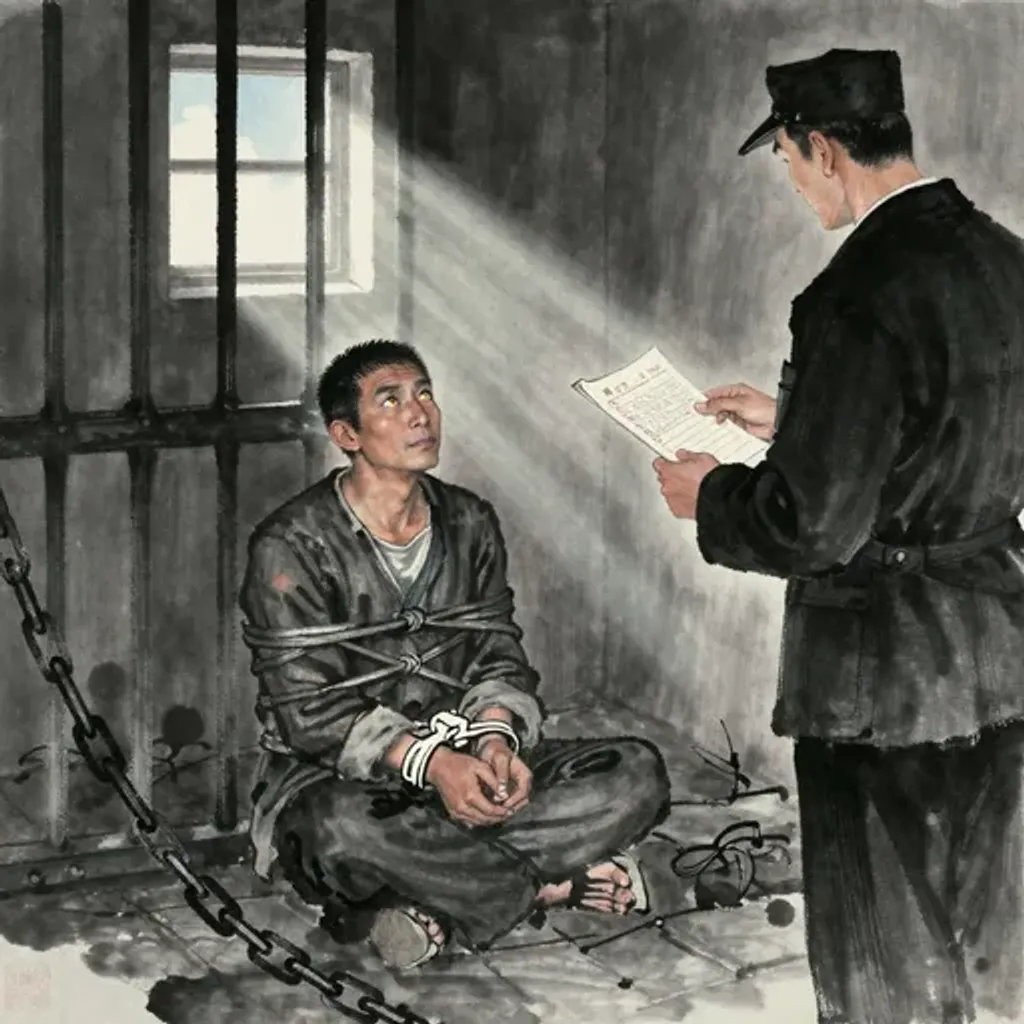
Actions transgress a great taboo, offending the Lord of Fate. Seized and bound as a prisoner, restrained in an official's custody. The secluded one finds cause for joy.
Read full commentary ↓
Mountain upon earth doubled — Splitting Apart meets itself. One's actions collide with the greatest taboo, offending the Lord of Fate himself. Bound and fettered, one is detained under an official's control. Yet the verse closes with a paradox drawn from the hexagram's own sixth line: 'The secluded person has joy.' To transgress against cosmic authority and be imprisoned by mortal authority is the worst of Splitting Apart's imagery. But confinement, in the Yi's logic, can also be protection. The 'secluded person' who finds joy in captivity has discovered that being stripped of everything external reveals an irreducible inner freedom. From Splitting Apart to itself, the lesson is recursive: at the nadir of dissolution, the single remaining fruit contains the seed of renewal.
中文註釋
山附於地,剝之自返。行觸大忌,與司命牾——所為觸犯最大禁忌,冒犯司命之神。執囚束縛,拘制於吏——被捕綁縛,受官吏管制。然末句「幽人有喜」直引剝卦上九爻辭。觸犯天條而入獄,為剝之極;然囚禁中反得喜悅,此為《易》之辯證:一切外在皆被剝盡之時,內在之自由不可再剝。從剝至剝,遞歸之象:消融之底點恰含重生之核。碩果不食——最後一顆果實不被吃掉,正因其中藏有復生之種。幽人之喜即此種子發芽之兆。
This commentary was written against an earlier reading of the verse. Where the reading has since changed, the interpretation itself may no longer apply.
Jiao Shi Yi Lin 《焦氏易林》, manuscript from the Wenyuan Pavilion Siku Quanshu, Qianlong period, Qing dynasty.
National Palace Museum, accession nos. 故庫017987–017990
Fascicle 2, page 32
Read from the manuscript leaf
Shown unpunctuated, as in the manuscript.
About this reading
Read from the scanned leaf.
Related Hexagrams
Same upper trigram: Mountain (艮)
Same lower trigram: Earth (坤)