Upper Trigram
坤 Kūn
Earth — Receptive
Lower Trigram
艮 Gèn
Mountain — Stillness
Classical Texts
The Goal
Qian 謙 (Modesty) is not self-deprecation. It is the active principle of equalization — the force that reduces what is excessive and augments what is insufficient, creating sustainable balance where extremes would otherwise produce collapse. The hexagram shows Earth (Kun) above Mountain (Gen): a mountain contained within the earth, great height concealed within what is low. The mountain does not lose its stature by remaining hidden; its height is held in a form that can endure. Traditional readers have therefore regarded Modesty as uniquely favorable across all six positions — not because every line is an unconditional blessing, but because every position still contains a workable form of modesty. The judgment — 亨,君子有終 — means "success; the superior person carries things to completion." The promise is not merely that modesty avoids blame, but that it enables completion. What is full is diminished; what remains low receives increase. The Image makes this mechanism explicit: 地中有山,謙;君子以裒多益寡,稱物平施 — "within the earth is a mountain: Modesty. The superior person reduces what is excessive and augments what is deficient, weighing things so that distribution is balanced." Modesty is not merely a feeling. It is an operation: taking from surplus, adding to deficit, and continuously restoring proportion. It is the discipline by which balance becomes sustainable. The hexagram's most difficult teaching appears in lines five and six, where modesty is joined to the use of force. 不富以其鄰,利用侵伐,无不利 means that without relying on wealth, one nevertheless gains the support of one's neighbors; it is favorable to take corrective action against what will not submit, and nothing is unfavorable. The upper line says 鳴謙,利用行師,征邑國 — "modesty made manifest; favorable to mobilize forces to correct one's own domain." These lines do not transform modesty into aggression. They show that modest authority need not become powerless. When persuasion no longer suffices and disorder must be corrected, force may be used — but without self-glorification, without arrogance, and within proper bounds. The upper line's restriction to one's own domain is crucial: before claiming the right to correct the world, one must first put one's own sphere in order. The goal of Qian is therefore the continuous regulation of excess — bringing down what has risen beyond measure and raising what has fallen below what is due. This is not accomplished once and for all. It is the ongoing work of maintaining a world that does not tear itself apart at its extremes.
The Judgment
Fulfillment. The noble one carries things through to completion. The only hexagram where every single line is favorable. Every one. Modesty isn't a strategy — it's the one configuration that never breaks. The noble one finishes things. Not because modesty makes you powerful. Because it removes the thing that makes people stop you.
The Image
A mountain within the earth: modesty. The realized person accordingly reduces what's excessive and increases what's lacking, weighing things to distribute evenly. A mountain — inside the earth. The biggest thing in the landscape, completely hidden. That's modesty: not the absence of substance, but substance that doesn't advertise. The realized person's job is redistribution — taking from too-much, giving to not-enough. The mountain does the weighing. Nobody needs to see it.
The Lines
Line 1
Modest and more modest, the noble one. Crossing the great river is supported. Resolves well. Modesty doubled. And now you can cross the river. You know what gets you across dangerous water? Not bravery, not a good boat — modesty so thorough that the river itself has no reason to resist you. The first line of the only hexagram where nothing goes wrong, and the secret is: keep going lower.
Line 2
Modesty that expresses itself. Sustained orientation resolves well. Modesty that other people can hear. Not performed — expressed. There's a difference. Performed modesty is a humblebrag. Expressed modesty is when the quality is so real it shows up in your voice without you arranging it. That's the one that resolves well.
Line 3
The hardworking, modest noble one. Carries things through. Resolves well. The person who works hard and doesn't inflate. Third line — the hinge, the position of maximum tension — and in this hexagram it's the person doing the labor without the announcement. Carries things through. That's the whole verdict. Achievement plus modesty equals the line that every other hexagram wishes it had at position three.
Line 4
Nothing that isn't supported in demonstrating modesty. Everything works. Every direction, every move — if it's done with genuine modesty, it's supported. The fourth line, where things become visible, and the instruction is: wave the banner of modesty. Not hide it. Demonstrate it. The distinction matters. Modesty at this position isn't about staying small. It's about moving openly without pretension.
Line 5
Not wealthy, yet using neighbors. Invasion and subjugation are supported. Nothing that isn't supported. Not rich. Using your neighbors. And the move that's supported is — invasion? In the modesty hexagram? Yes. Because modesty doesn't mean passive. When action is structurally required, the modest person strikes — and every direction is supported. This is the line that stops people from confusing modesty with timidity. They are not the same thing.
Line 6
Modesty that expresses itself. Deploying the army is supported. Marching on cities and realms. The top of the modesty hexagram and the image is: armies marching. Modesty at its limit becomes effective force. Not aggression — the kind of military action that's supported because the person ordering it has no ego in the game. The general with nothing to prove is the one the configuration trusts with the army.
Yilin: Forest of Changes
From Jiao Yanshou's Forest of Changes (焦氏易林) — the verse for Hexagram 15 in its unchanging form. A Han dynasty collection of four-character verses interpreting every hexagram transformation.
王喬無病狗頭不痛亡跛失履乏我徒從
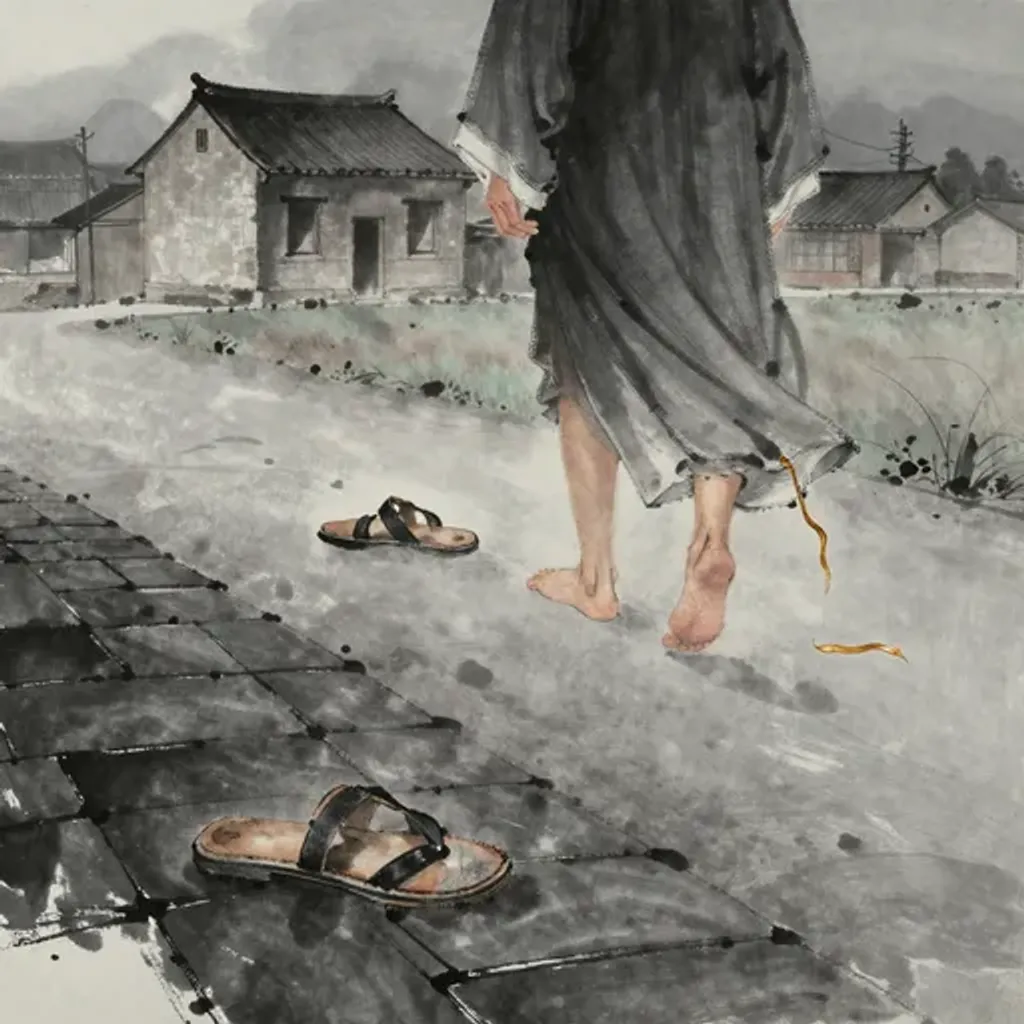
Master Wang Qiao has no ailment; Gou's head does not ache. One has lost and shattered one's shoes; I lack attendants and followers.
Read full commentary ↓
Modesty returns to itself. Wang Qiao — the immortal prince of Zhou who transcended mortality — knows no illness, and even trivial head-pains are absent. Yet the verse pivots: shoes are lost and broken, and there is no one to accompany or send off the traveler. The immortal has no bodily suffering but also no human companionship. From Modesty to Modesty, the hexagram does not transform; it echoes in place. The doubled stillness reveals both the blessing and the cost of perfect self-containment: the transcendent one is beyond pain but also beyond fellowship. When modesty meets modesty, nothing advances or connects. The mountain remains buried, complete and solitary.
中文註釋
地中有山,謙復歸謙。王子喬無病無痛,頭不苟痛——仙人超越肉身之苦。然亡破失履,鞋履殘破散失;乏我送從,無人相伴送行。仙人無身體之患,亦無人世之暖。從謙至謙,卦不變化,原地迴響。雙重靜止揭示完美自足之福與代價:超越者無痛亦無伴。謙遇謙,不進不連,山埋地中,完整而孤獨。此詩寓意:極致之謙退或超脫雖免於患,亦絕於情。
This commentary was written against an earlier reading of the verse. Where the reading has since changed, the interpretation itself may no longer apply.
Jiao Shi Yi Lin 《焦氏易林》, manuscript from the Wenyuan Pavilion Siku Quanshu, Qianlong period, Qing dynasty.
National Palace Museum, accession nos. 故庫017987–017990
Fascicle 1, page 156
Read from the manuscript leaf
Shown unpunctuated, as in the manuscript.
About this reading
Read from the scanned leaf.
Related Hexagrams
Same upper trigram: Earth (坤)
Same lower trigram: Mountain (艮)