
Upper Trigram
兌 Duì
Lake — Joyous
Lower Trigram
艮 Gèn
Mountain — Stillness
Classical Texts
The Goal
Xian is not romance. It is the principle of mutual influence — the capacity of two distinct entities to affect each other without coercion. Lake (Dui) above Mountain (Gen): the yielding rests above the still, the soft above the hard. The lake on the mountain is an image of natural responsiveness — water settled into the shape the mountain provides, the mountain receiving what the lake offers. Neither dominates. Neither disappears. Influence flows because both are genuinely open to being changed. The judgment says 亨,利貞 and adds 取女吉 — "taking a woman in marriage brings good fortune." This is the hexagram that opens the Lower Canon, and its placement is deliberate. The first thirty hexagrams deal with the cosmos and the individual; from Xian onward, the subject is relationship. The marriage reference is not about gender — it is about the quality of receptivity that makes mutual influence possible. The character 咸 is 感 ("to feel, to move") without the heart radical 心: influence prior to emotional attachment, resonance before sentiment enters. The Image names the mechanism in three characters: 山上有澤,咸;君子以虛受人 — "above the mountain is a lake: Influence. The superior person receives others through emptiness." 虛 is the condition of the mountain's hollow, which is why the lake can rest there at all. A person already full of their own position has nowhere for another to register. Receptivity here is not agreeableness; it is unoccupied space deliberately kept. The line texts map influence ascending through the body: 拇 the big toe, 腓 the calf, 股 the thigh, then 脢 the flesh of the back and 輔頰舌 the cheeks, jaws and tongue. 九四 names no body part, and Wang Bi puts the heart there: 在股之上…心神始感者也, above the thigh, where the spirit first feels. The line's own words are 憧憧往來,朋從爾思, "restless coming and going; friends follow your thoughts." Influence that arrives at the heart without stillness beneath it turns into anxious calculation, and gathers only those who track your preoccupations. Influence that stays in the lower body is instinctual; influence that ends at the jaws is talk. Only when it operates through the whole person — grounded in stillness, expressed through openness — does it become what Xian describes. The goal is not to influence others but to become capable of real influence.
The Judgment
Fulfillment. Sustained orientation is supported. Taking a wife resolves well. Mutual influence. And the configuration supports commitment — taking a wife resolves well. Not flirtation, not attraction, not chemistry. Marriage. The text skips past every interesting part of falling in love and goes straight to: does this become permanent? Because influence that doesn't land in commitment is just weather.
The Image
A lake atop the mountain: influence. The realized person accordingly receives others through emptiness. A lake on top of a mountain — the low thing above the high thing. Water above stone. And the instruction is: receive through emptiness. The person who is already full cannot be influenced. The person who is already certain cannot be moved. The lake sits on the mountain because it made room.
The Lines
Line 1
Influence in the big toes. The toes. The very first stirring, the lowest part. No verdict — because nothing has happened yet. The intention exists below the threshold of action. You know the feeling: something shifts in the room before anyone says a word. That's this line. The toes know before the brain does.
Line 2
Influence in the calves. Adverse. Remaining still resolves well. The calves — they follow whatever the feet do. Reflexive, not chosen. Adverse. But remaining still resolves well. The person whose legs start moving before their mind engages is in trouble. The fix isn't better walking. It's not walking. Yet.
Line 3
Influence in the thighs. Holding to what follows. Going forward: friction. The thighs follow wherever the body goes — they have no independent direction. And going forward from this place produces friction. Because following every impulse isn't responsiveness. It's a lack of spine. The thigh is literally between the decision center and the ground. It goes wherever it's told. That's the problem.
Line 4
Sustained orientation resolves well. Deviation detected dissolves. Restlessly going and coming — companions follow your thinking. Hold steady and it works. The wavering back and forth — should I go, should I stay — that's what creates the problem. And here's the kicker: your companions follow your thinking. Not your actions. Your thinking. The people around you can feel your indecision. They're waiting for you to stop oscillating. So are you.
Line 5
Influence in the back of the neck. No deviation detected. The back of the neck. The part you can't see, can't control, can't perform with. No deviation detected — because influence here isn't a choice. It's below the surface of the will. This is the line where influence has become so deep it's not influence anymore. It's just who you are.
Line 6
Influence in the jaws, cheeks, and tongue. Jaws, cheeks, tongue. Talking. All talking. No verdict again — and the silence is louder than any verdict would be. The hexagram walked you from the toes to the tongue, from the deepest stirring to the shallowest expression. Influence that lives in the mouth is influence that has already left the body.
Yilin: Forest of Changes
From Jiao Yanshou's Forest of Changes (焦氏易林) — the verse for Hexagram 31 in its unchanging form. A Han dynasty collection of four-character verses interpreting every hexagram transformation.
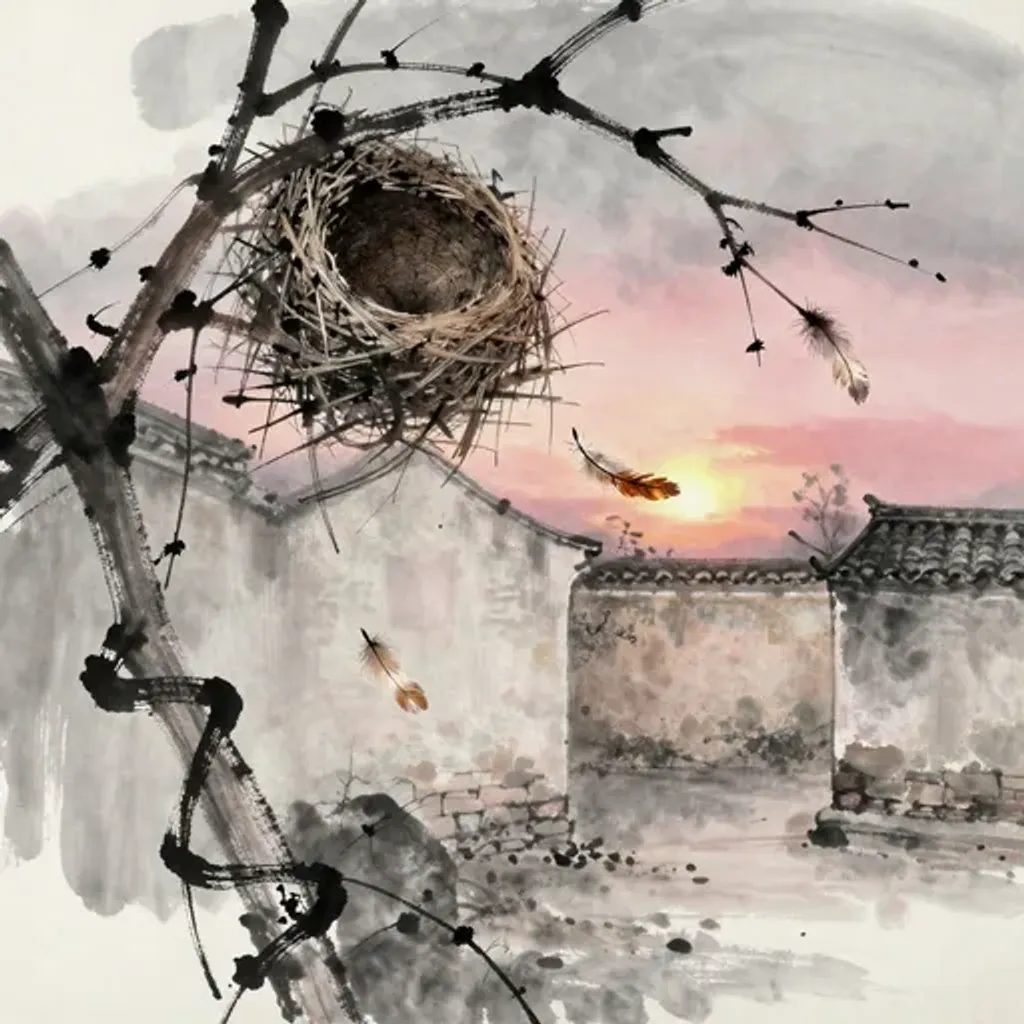
雌單獨居歸其本巢毛羽憔悴志如死灰
空巢殘羽風中搖,枯藤纏枝不堪撓。夕照餘暉照冷壁,影單形隻自蕭條。
An empty nest, remnant feathers sway in the wind; dead vines tangle the branches beyond untangling. The last rays of sunset illuminate a cold wall — a lone shadow, solitary form, desolate.
Read full commentary ↓
A lake upon a mountain returns to itself — Influence reflecting upon Influence. The original verse reads: a lone female bird dwells solitary, returning to her own nest, feathers withered and bedraggled, her spirit like dead ashes. This is desolation at its most intimate: not exile but voluntary retreat into an empty home, not anger but the extinction of desire itself. The 'dead ashes' (死灰) alludes to the Zhuangzi's image of the sage whose heart has become still as cold cinders. Yet here it carries no transcendence, only grief. From Influence to Influence, the hexagram does not transform — the lake remains upon the mountain, openness receives only its own echo. Mutual resonance, turned inward with no partner, becomes the loneliest of all conditions.
中文註釋
山上有澤,咸之自返。原詩:雌單獨居,歸其本巢——孤雌獨守空巢。毛羽憔悴——羽毛零落凋殘。志如死灰——心志冷如灰燼。此本《莊子·齊物論》「形固可使如槁木,而心固可使如死灰乎」之意象(今語作形如槁木、心如死灰),然無超脫之境,唯餘哀涼。非被逐而是自歸,非憤怒而是心死。咸之咸——卦不變,澤仍在山上,虛受之心迴響的只有自身之空。感應本為二者之間之事,一方退回自身、不再對外開放,則感通之道化為至深之孤寂。
Jiao Shi Yi Lin 《焦氏易林》, manuscript from the Wenyuan Pavilion Siku Quanshu, Qianlong period, Qing dynasty.
National Palace Museum, accession nos. 故庫017987–017990
Fascicle 3, page 3
Read from the manuscript leaf
Shown unpunctuated, as in the manuscript.
About this reading
Read from the scanned leaf.
Related Hexagrams
Same upper trigram: Lake (兌)
Same lower trigram: Mountain (艮)