Upper Trigram
離 Lí
Fire — Clinging
Lower Trigram
離 Lí
Fire — Clinging
Classical Texts
The Goal
Li is not brilliance for its own sake. It is the principle of illumination that depends entirely on what it clings to — fire that has no substance of its own and exists only by attaching to fuel. The hexagram doubles Fire: Li above Li, clarity upon clarity. But the defining quality of fire is not its brightness; it is its need. A flame that clings to nothing goes out. The most luminous force in the I-Ching is also the most structurally dependent. The judgment says 利貞,亨 and then specifies 畜牝牛,吉 — "raising a cow brings good fortune." This is the hexagram's corrective instruction, and it is deliberately anticlimactic. After the double fire, after the soaring clarity, the text prescribes the most patient and nourishing image it can find. The cow is the opposite of the flame: slow, steady, giving sustenance without display. Brilliance without grounding — intelligence without patience, insight without humility — burns through its fuel and collapses into darkness. The cow is what the fire must cling to. The Image supplies the other half of the answer, and it is about time rather than substance: 明兩作,離;大人以繼明照於四方 — "brightness rises twice: Clinging. The great person, continuing this brightness, illumines the four quarters." 繼 is succession — light handed on. The doubled trigram is not one fire burning twice as hot but a second fire lit from the first. What saves clarity from consuming itself is that it is passed to someone, and the text says 大人 rather than the usual 君子: this is a demand made of whoever actually holds the light. The common misreading celebrates Li as the hexagram of awareness and perception. Those are its qualities; its goal is their regulation. The doubled structure is a warning as much as an intensification — when fire meets fire the result is either illumination or conflagration, and 九四 shows the second: 突如其來如,焚如,死如,棄如, "coming suddenly, blazing, dying, cast away." Four states in eight characters, the whole arc of an unattached flame. Against it 九三 sets the slower failure: 日昃之離, the light of the declining sun — brilliance in decline because what it clung to is itself running out, which is this hexagram's own logic applied to time. Wang Bi reaches the same line from the succession side: 明在將終,若不委之於人,養志无為,則至于耊老有嗟 — the light is ending, and not entrusting it to someone else finishes in the lament of old age. Clinging to the ephemeral and refusing to hand on are the same failure seen from two ends. Clarity attached to the enduring illuminates. Clarity attached to the ephemeral consumes itself.
The Judgment
Sustained orientation is supported. Fulfillment. Tending the cow resolves well. Fire needs something to burn. That's not a weakness — that's the design. Tending the cow resolves well: the patient, docile, ongoing kind of care. Not the dramatic gesture. The cow. The text is telling you that clarity depends on what feeds it, and the best fuel is the least exciting kind.
The Image
Brightness arises twice: clinging fire. The great person accordingly perpetuates this clarity to illuminate the four directions. Two fires — one after another, like sunrise after sunrise. The great person's job is to keep the clarity going, not to be brilliant once. Illuminating the four directions isn't a spotlight. It's a sun. It doesn't choose where to shine. The continuation is the achievement.
The Lines
Line 1
Treading in confusion. Attending to this with respect: no fault. First steps, everything crisscrossed, nothing clear yet. And the instruction is: respect. Not clarity — you don't have that yet. Respect for the confusion itself. The person who treats their own disorientation with seriousness instead of panic is the one who walks out of it. No fault.
Line 2
Yellow radiance. Supremely resolves well. Yellow. Not white, not red — yellow. The middle color. The balanced light. Supremely resolves well — the best verdict in the book. And it goes to moderation. Not the brightest fire. Not the hottest. The one at the center that sustains without burning. The most powerful version of clarity turns out to be the gentle one.
Line 3
The radiance of the setting sun. Not drumming on clay pots and singing, but the lament of great old age. Adverse. The sun is going down and you have two choices: bang on pots and sing, or wail about getting old. The text says both are adverse. Both. The party and the funeral are equally wrong responses to decline. The setting sun doesn't need your commentary. It needs you to prepare for night.
Line 4
Suddenly it comes. Flaring up. Dying down. Discarded. Arrives suddenly. Burns. Dies. Gone. Four images, no verdict, no advice. Just the description of something that was too bright too fast. The text doesn't even bother telling you this is bad. It just describes the trajectory and lets the silence do the work. You've seen this person. You might be this person.
Line 5
Tears flowing like rain. Grief and lament. Resolves well. Weeping. Real, streaming, uncontrollable tears. And: resolves well. The fifth line of the fire hexagram and the verdict goes to grief. Because this isn't self-pity — this is the kind of crying that happens when you finally see clearly. Clarity and grief arrived at the same time. They usually do.
Line 6
The king deploys a campaign. There is merit in severing the leaders. The captives are not of the same kind. No fault. The king goes to war. Cuts the heads. Spares the rest. No fault. The last line of the clarity hexagram is about surgical force — knowing exactly where the problem starts and stopping there. The captives aren't the enemy. The leaders are. The person who can tell the difference between the disease and the carrier has earned the right to use fire.
Yilin: Forest of Changes
From Jiao Yanshou's Forest of Changes (焦氏易林) — the verse for Hexagram 30 in its unchanging form. A Han dynasty collection of four-character verses interpreting every hexagram transformation.
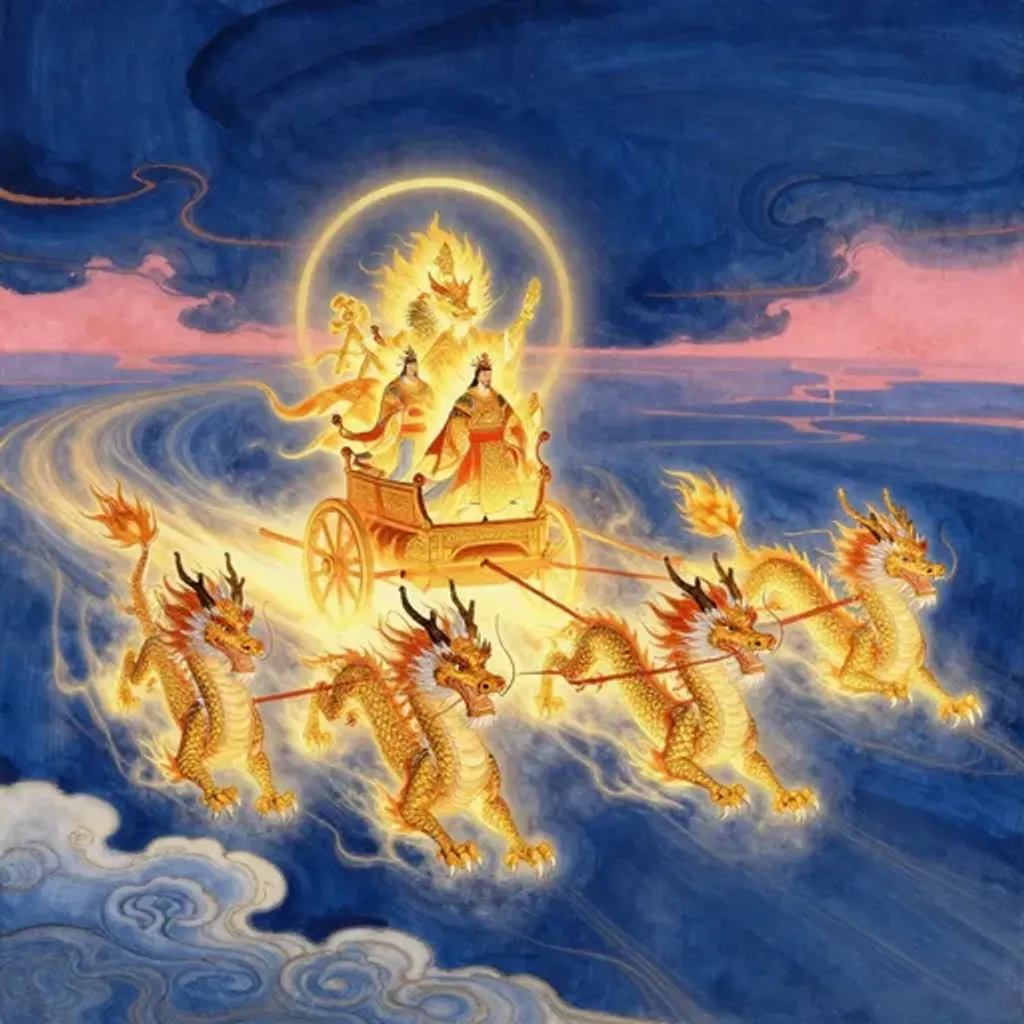
時乘六龍為帝使東達命宣旨無所不通
Riding the six dragons in season; serving as the emperor's envoy to the east. Proclaiming the mandate, declaring the edict; nothing that does not reach through.
Read full commentary ↓
Doubled fire meets itself: pure brilliance sustained. Riding the six dragons in season, one serves as the emperor's envoy to the east, proclaiming mandates and conveying edicts with nothing beyond reach. 'Riding the six dragons in season' quotes directly from the I-Ching's Qian hexagram commentary (Wenyan): the sage rides the six dragons to traverse the heavens. Here the envoy carries imperial light in all directions. From The Clinging to The Clinging, fire renews fire in perpetual succession. The great person 'continues brightness to illuminate the four quarters' — this is the hexagram's own image text made flesh. There is no transformation to manage, only the challenge of sustaining radiance without burnout, which the verse resolves through service: light that travels outward on behalf of another never exhausts itself.
中文註釋
明兩作離,離遇離,純明相繼。時乘六龍——出《易經·乾卦·文言》「時乘六龍以御天」。為帝使東——奉天子之命出使東方。達命宣旨,無所不通——宣佈詔令,暢達無阻。從離至離,明兩作,大人以繼明照於四方:離之自身映照。無卦變之張力,唯有光明延續之挑戰。詩以御天之龍為喻,明非自照而是為帝傳光,如使者奉命宣化四方。火之不滅,在於傳遞而非獨燃。
Jiao Shi Yi Lin 《焦氏易林》, manuscript from the Wenyuan Pavilion Siku Quanshu, Qianlong period, Qing dynasty.
National Palace Museum, accession nos. 故庫017987–017990
Fascicle 2, page 109
Read from the manuscript leaf
Shown unpunctuated, as in the manuscript.
About this reading
Read from the scanned leaf.
Related Hexagrams
Same upper trigram: Fire (離)
Same lower trigram: Fire (離)