Upper Trigram
震 Zhèn
Thunder — Arousing
Lower Trigram
離 Lí
Fire — Clinging
Classical Texts
The Goal
Feng is not prosperity as a permanent state. It is the zenith — the moment when clarity and power converge at maximum intensity, and the hexagram knows the convergence cannot hold. Thunder (Zhen) above Fire (Li) puts arousing movement over illuminating clarity. The judgment names the condition exactly: 亨。王假之。勿憂。宜日中 — "success; the king attains it; do not worry; be as the sun at midday." Midday is the fullest moment and the turning point in the same instant. The sun does not pause at its zenith, and the text does not pretend otherwise. The lines are dominated by eclipse: 豐其蔀,日中見斗 — the screen so heavy that the Dipper is visible at noon; 豐其沛,日中見沬 — the covering so dense that even the small stars come out. Abundance darkens itself. The common reading treats these as threats arriving from outside, but every one of them is a thing the abundant person has put up: a screen, a covering, a bigger house. 上六 finishes the sequence: 豐其屋,蔀其家,闚其戶,闃其无人,三歲不覿,凶 — "he enlarges his house, screens off his family; peer through the door and it is silent, no one there; for three years no one is seen; misfortune." Abundance pursued as private accumulation ends in a full house with nobody in it. Against that, 六五 shows what the peak is actually for: 來章,有慶譽吉 — "brilliance is brought in; there is blessing and praise; good fortune." What comes *in* is what turns abundance from an eclipse into a light. The judgment's 勿憂 is the operative instruction. Anxiety about the decline is itself the first move of the decline — it is what builds the screen. The Image redirects the energy: 雷電皆至,豐;君子以折獄致刑 — "thunder and lightning both arrive: Abundance. The superior person decides lawsuits and carries out punishments." At the peak, clarity and force are both available, which is what the hardest judgments require and what is not available at other times. That instruction is worth reading beside its neighbours. Hexagram 22 says 無敢折獄, do not presume to decide criminal cases, because grace illuminates only the surface. Hexagram 56 says 明慎用刑,而不留獄, judge with caution and do not let cases drag. The Yi does not give one rule about judgment; it assigns it to the condition that can carry it. Feng is that condition, and the window is finite.
The Judgment
Fulfillment. The king attains it. Do not worry. It befits the sun at midday. The king reaches abundance. Don't worry. Be the sun at noon. Four instructions and the hardest one is 'don't worry' — because abundance always carries the seed of its own decline. The sun at midday is at its peak, which means it's about to descend. The text knows this. It tells you not to worry anyway. Because the person who wastes their noon worrying about the afternoon never has a noon.
The Image
Thunder and lightning both arrive: abundance. The realized person accordingly decides disputes and carries out punishments. Thunder and lightning together — maximum force and maximum clarity at the same time. And the instruction is: judge. Decide cases. Carry out sentences. Because abundance provides the only conditions under which justice can be both clear and powerful simultaneously. The person who has both the insight to see and the force to act has a window. It won't last. Use it.
The Lines
Line 1
Meeting one's equal counterpart. Though it lasts ten days, no fault. Going forward has merit. You meet your match — your equal, your complement. And even if you stay together for the full cycle, no fault. Going forward has merit. The first line of abundance: the partnership that amplifies rather than diminishes. The person who finds their counterpart at the beginning of abundance has found the only thing that makes abundance usable. Not more resources. A partner.
Line 2
So abundant are the screens that the Big Dipper is visible at midday. Going forward brings suspicion and distrust. Having sincerity and manifesting it resolves well. Noon, and the screens are so thick you can see stars. The abundance has created its own eclipse. Going forward provokes suspicion. But sincerity — actually showing your truth — resolves well. The second line: when abundance darkens instead of illuminates, the only light that works is personal sincerity. Not strategy. Not explanation. The unfiltered transmission of who you actually are.
Line 3
So abundant are the banners that the Milky Way is visible at midday. Breaking the right arm. No fault. Total eclipse. The Milky Way at noon. And your right arm breaks. No fault. The darkness is so complete that the most capable limb is disabled, and the text says: not your fault. This is the line where the abundance turns completely against you and the only comfort is the verdict. You didn't cause this. The eclipse did.
Line 4
So abundant are the screens that the Big Dipper is visible at midday. Meeting the hidden master. Resolves well. Same screens, same midday stars — but this time you meet someone. The hidden master. The person in the darkness who knows the way. Resolves well. The fourth line of abundance: the eclipse hasn't changed, but what you found inside it has. The master was always there. You needed the darkness to see them.
Line 5
The pattern emerges. There is celebration and praise. Resolves well. Clarity arrives. The pattern becomes visible. Celebration, praise, resolves well. The fifth line of abundance, and the eclipse breaks. What was hidden is now seen, what was dark is now luminous. The text doesn't explain what changed. It just says: the pattern came through. Sometimes abundance needs to darken completely before it can illuminate completely.
Line 6
So abundant his dwelling. Screening off his household. Peering through the gate — desolate, no one there. For three years, seeing no one. Adverse. The biggest house. The thickest screens. And when you look through the gate: nobody. Three years of isolation. Adverse. The top of the abundance hexagram, and the final image is the person who used abundance to build walls so high they erased everyone. The house is magnificent. The family is gone. The abundance ate itself. Three years of looking through the gate at nothing.
Yilin: Forest of Changes
From Jiao Yanshou's Forest of Changes (焦氏易林) — the verse for Hexagram 55 in its unchanging form. A Han dynasty collection of four-character verses interpreting every hexagram transformation.
情懦行賈徑涉山阻與狄為市不憂危殆利得十倍
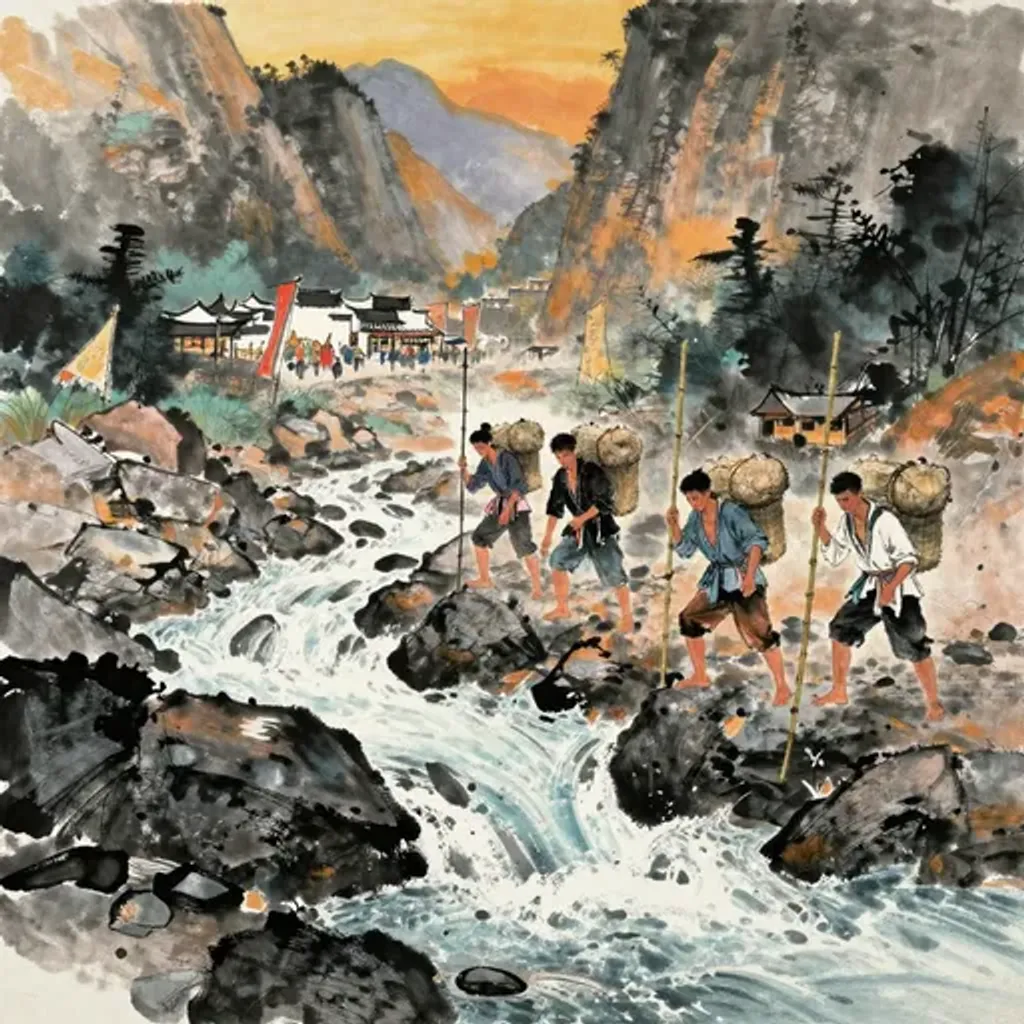
Young merchants set out trading, crossing great obstacles on the way. With staffs they make their market; undaunted by danger and peril. Profit gained tenfold.
Read full commentary ↓
Thunder and fire converge in Abundance upon itself — the hexagram unchanged. Young merchants set out on a trading venture, crossing great obstacles. They rely on their walking staffs for trade and do not worry about danger. Profits multiply tenfold. When Abundance transforms into itself, the pattern intensifies rather than shifts. The young traders embody Abundance's own energy: vigorous, bold, traversing difficulties with nothing but a staff and commercial instinct. Their fearlessness in the face of hardship yields extraordinary returns. The self-referential transformation suggests that true abundance perpetuates itself — those who fully inhabit the moment of fullness, without hesitation or anxiety, find that prosperity regenerates from within.
中文註釋
雷電皆至為豐,豐之豐——卦不變而自化自新,能量凝聚而不散逸。諸孺行賈,經涉大阻重險。與杖為市,不憂危殆,利得十倍。少年商人持杖涉險闖蕩天下,以勇氣與商才獲利十倍而不懼。豐之自我轉化意味著盛之更盛——全然投入豐盛之勢,無懼無疑,繁榮自我再生。此即豐之本色:雷電皆至之時,當其盛而行,莫遲疑莫猶豫,乘勢而動。
The commentary reflects an earlier reading and may refer to wording the manuscript does not carry.
Jiao Shi Yi Lin 《焦氏易林》, manuscript from the Wenyuan Pavilion Siku Quanshu, Qianlong period, Qing dynasty.
National Palace Museum, accession nos. 故庫017987–017990
Fascicle 4, page 109
Read from the manuscript leaf
Shown unpunctuated, as in the manuscript.
About this reading
Read from the scanned leaf.
Related Hexagrams
Same upper trigram: Thunder (震)
Same lower trigram: Fire (離)