Upper Trigram
震 Zhèn
Thunder — Arousing
Lower Trigram
兌 Duì
Lake — Joyous
Classical Texts
The Goal
Gui Mei is not merely an unfavorable omen. It is the hexagram that examines what happens when structural position and personal desire are misaligned — when someone enters a relationship or situation without the standing to shape its terms. Thunder (Zhen) above Lake (Dui) puts the eldest son's vigorous movement over the youngest daughter's yielding joy. The judgment is one of the very few in the book with nothing favorable in it at all: 征凶,无攸利 — "to go forward brings misfortune; nothing furthers." The title encodes the problem. 歸妹 is the younger sister who goes with the bride as secondary wife under Zhou marriage custom, entering the household not on her own terms but as an appendage to someone else's arrangement. The lines then complicate the judgment rather than illustrating it. 初九 — 歸妹以娣,跛能履,征吉 — "she goes as the secondary wife; lame, she can still walk; to go forward brings good fortune." The judgment says 征凶 and the first line says 征吉. The contradiction is the hexagram's real content: what is unfavorable as a structural arrangement may still be navigable by the person actually inside it. 九二 continues in the same register — 眇能視,利幽人之貞, "one-eyed, she can still see; the constancy of one who lives in seclusion furthers." Partial sight, partial mobility, and enough of both to proceed. 九四 adds the other resource: 歸妹愆期,遲歸有時 — "the marriage is past its term; a late marriage has its time." Delay is not forfeiture. 六五 gives the tradition's set piece, 帝乙歸妹, King Di Yi giving his sister in marriage, where 其君之袂,不如其娣之袂良 — the princess's sleeves are not as fine as her attendant's. Commentators read this as rank yielding to conduct; the text itself says only that the more elaborately dressed woman was outshone. 上六 removes the last pretence: 女承筐无實,士刲羊无血,无攸利 — "the woman holds the basket and it has nothing in it; the man cuts the sheep and no blood comes; nothing furthers." Both perform the marriage rite correctly and neither act contains anything. When form is all that is exchanged, nothing has been exchanged. The goal of Gui Mei is not to condemn desire or secondary arrangements but to make their structural costs visible, and its Image gives the discipline that makes them survivable: 澤上有雷,歸妹;君子以永終知敝 — "the superior person keeps the far end in view, and so knows where a thing wears through."
The Judgment
Advancing: adverse. No direction is supported. Nothing works. No direction supported. The marrying maiden hexagram shuts every door at once — the harshest judgment in the book for a hexagram about marriage. Because this isn't about marriage. It's about entering a situation where you have no power and no exit. The text doesn't say 'be careful.' It says: nothing. Is. Supported.
The Image
Thunder above the lake: the marrying maiden. The realized person accordingly understands the transitory through the permanence of the end. Thunder over the lake — stirring the surface but the depths remain. And the instruction is: understand what's temporary by looking at what's permanent. The end outlasts the middle. The realized person who can see through the current situation to its eventual conclusion has the only advantage available in this hexagram: knowing how it ends.
The Lines
Line 1
The marrying maiden as a junior wife. The lame who can still walk. Advancing resolves well. Second wife. Subordinate position. And yet: the lame can still walk. Advancing resolves well. The first line turns the harsh judgment upside down. You're limping, you're secondary, you're not the main event — and it works anyway. Because the person who accepts a diminished role without diminished dignity can still move forward. Limping is still walking.
Line 2
The one-eyed who can still see. The sustained orientation of a solitary person is supported. One eye. Still sees. The solitary person's persistence is supported. The second line: diminished capacity, full function. The person who lost half their sight and kept looking has more vision than the person with two eyes who stopped paying attention. Solitude and persistence — the combination that works when nothing else does.
Line 3
The marrying maiden as a servant. Returns to marry as a junior wife. Started as a servant. Came back as a second wife. No verdict — just the trajectory. Down, then up, but not all the way up. The third line describes the person who accepts the lowest position first and returns to something better. Not great. Better. The text doesn't judge this path. It just shows you the shape of it.
Line 4
The marrying maiden exceeds the appointed time. A delayed marriage has its moment. Past the deadline. The appointed time came and went. And: a delayed marriage has its moment. The fourth line says what nobody tells the person who missed their window: another window exists. It's not the original one. It might be better. The text doesn't rush you. It reminds you that timing isn't a single opportunity. It's a rhythm.
Line 5
Emperor Yi gave his maiden daughter in marriage. The princess's sleeves were not as fine as the attendant's. The moon nearly full resolves well. The emperor's daughter — and her dress is plainer than the bridesmaid's. The moon is almost full. Resolves well. The most beautiful image in the hexagram: the person of high station who dresses below their rank. Not from poverty. From understanding. The moon that's almost full is more beautiful than the moon that IS full. The last sliver of darkness is what makes it luminous.
Line 6
The woman holds the basket without fruit. The man slaughters the sheep without blood. No direction is supported. Empty basket. Bloodless sheep. Nothing real. The form of the ritual exists but the substance is gone — no fruit, no blood, no life in the ceremony. No direction supported. The top of the marrying maiden hexagram, and the final image is hollow performance. The person who goes through the motions with nothing inside them has completed the most elaborate version of nothing.
Yilin: Forest of Changes
From Jiao Yanshou's Forest of Changes (焦氏易林) — the verse for Hexagram 54 in its unchanging form. A Han dynasty collection of four-character verses interpreting every hexagram transformation.
堅氷黃鳥常悲哀鳴不見甘粒但歡藜荊數驚鷙鳥為我心憂
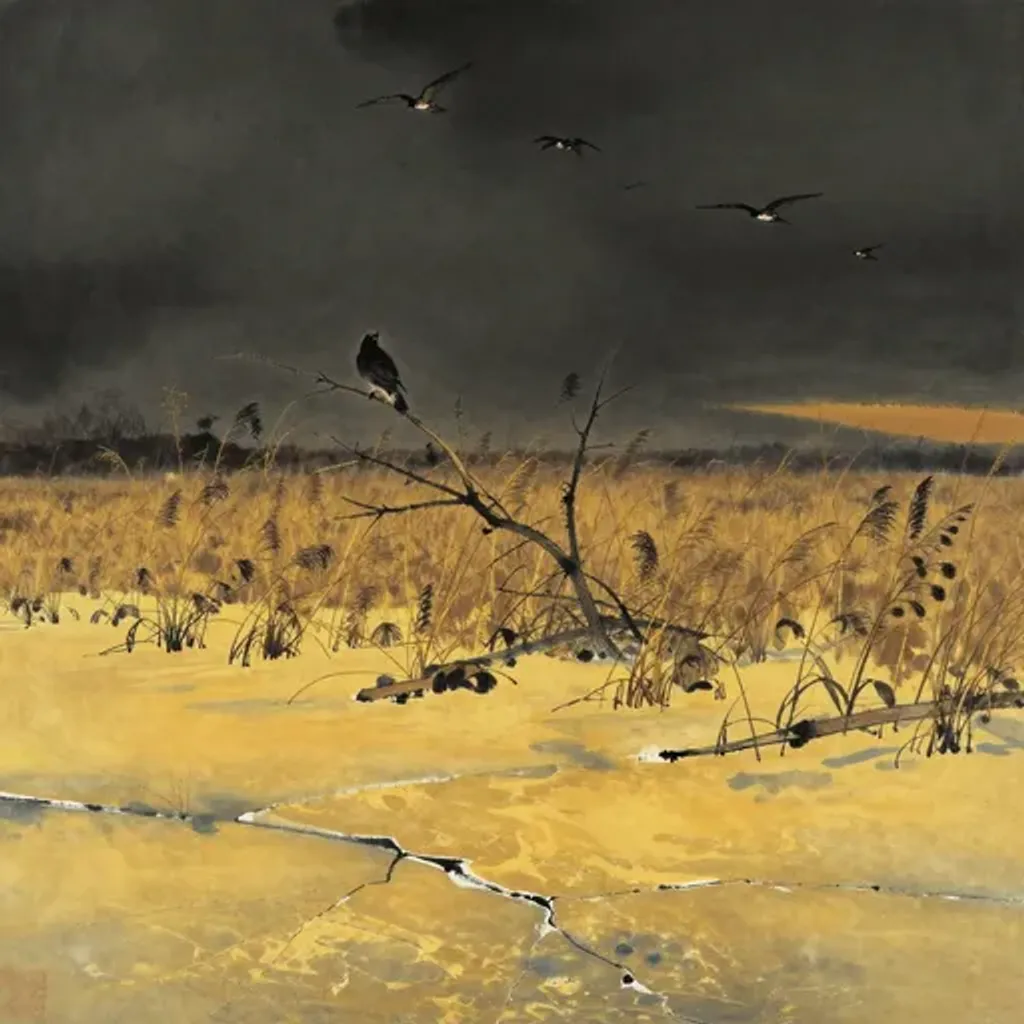
Hard ice and yellow earth; the bird mourns in sorrow. No white grain to be seen, only goosefoot and wormwood. Startled again and again by birds of prey; this weighs upon my heart.
Read full commentary ↓
Thunder over lake returns to itself: the Marrying Maiden unchanged, its pattern intensified. Hard ice and yellow garments; birds cry in sorrow. No white grain is visible, only goosefoot and mugwort. Raptors startle repeatedly, becoming a constant worry. The verse is bleak beyond measure: winter ice, mourning birds, famine food replacing grain, and predators circling overhead. When the hexagram transforms into itself, there is no movement, no escape, no resolution. The maiden's subordinate position deepens into permanence. The yellow garment evokes the Kun hexagram's line-six warning, while the ice recalls the hexagram's opening: 'Treading on frost, solid ice will come.' From the Marrying Maiden to itself, the pattern locks into place without relief.
中文註釋
澤上有雷為歸妹,歸妹之歸妹。堅冰黃裳,鳥哀悲愁;不見白粒,但覩藜蒿;數驚鷙鳥,為我心憂。冰封大地,黃裳喪色,哀鳥悲鳴。五穀不見,唯藜蒿充飢。猛禽頻驚,令人憂懼。歸妹之歸妹,無變無動,困局自我強化。黃裳呼應坤卦上六之象,堅冰則暗引初六「履霜堅冰至」之警。當卦變回歸自身,無出路、無轉機,歸妹「永終知敝」之訓化為切膚之痛。
This commentary was written against an earlier reading of the verse. Where the reading has since changed, the interpretation itself may no longer apply.
Jiao Shi Yi Lin 《焦氏易林》, manuscript from the Wenyuan Pavilion Siku Quanshu, Qianlong period, Qing dynasty.
National Palace Museum, accession nos. 故庫017987–017990
Fascicle 4, page 98
Read from the manuscript leaf
Shown unpunctuated, as in the manuscript.
About this reading
Read from the scanned leaf.
Related Hexagrams
Same upper trigram: Thunder (震)
Same lower trigram: Lake (兌)