Upper Trigram
震 Zhèn
Thunder — Arousing
Lower Trigram
坎 Kǎn
Water — Abysmal
Classical Texts
The Goal
Xie is not victory. It is the release of tension — the moment when obstruction dissolves and movement becomes possible again. Thunder (Zhen) above Water (Kan) shows arousing energy breaking out of danger: the storm that ends the oppressive stillness before it. The judgment gives two conditional instructions: 无所往,其來復吉 — "if there is nowhere to go, returning brings good fortune" — and 有攸往,夙吉 — "if there is somewhere to go, going early brings good fortune." The hexagram demands that you tell these apart at once. Deliverance is time-sensitive, and lingering in the moment of release, savouring the freedom instead of spending it, wastes what the clearing made possible. The Image defines what kind of release is meant: 雷雨作,解;君子以赦過宥罪 — "thunder and rain arise: Deliverance. The superior person pardons errors and is lenient with crimes." The link between the weather and the amnesty is structural, not decorative. The storm discharges what has built up, and deliverance requires the same discharge of accumulated grievance — a situation is not actually cleared while the accounts from it are still open. Not everything is pardoned, and 上六 marks the exception: 公用射隼于高墉之上,獲之无不利 — "the duke shoots a hawk on a high wall; he takes it, nothing unfavorable." When one hardened obstacle stays perched in a position of power after the general situation has cleared, removing it is warranted. The line is placed last for a reason: this is what is left after the amnesty, not an alternative to it. 六五 gives the test of whether deliverance is real — 有孚于小人, the small people are won over — because a release that only the powerful feel has not happened. The goal of Xie is to govern the passage from constrained to unconstrained conditions, and above all to keep the newly freed from building new entanglements. 六三 names that failure exactly: 負且乘,致寇至 — "carrying a load on the back and riding in a carriage; this brings robbers." Someone who has come out of hardship and assumes privileges he has not earned invites fresh danger. Deliverance restores the starting conditions; it does not confer advantage. Freedom, like a cleared sky, is not an achievement to celebrate but a condition to use before it changes again.
The Judgment
The southwest is supported. With nowhere to go, returning brings resolve well. If there is somewhere to go, acting promptly resolves well. Two situations, two instructions. Nothing to do? Go home. Something to do? Do it now. The text is allergic to lingering. Deliverance isn't a vacation — it's a window. The tension broke, the pressure lifted, and you have exactly enough time to either rest or act. Not both. Not eventually. Now.
The Image
Thunder and rain arise: deliverance. The realized person accordingly pardons transgressions and forgives offenses. Thunder and rain — the storm that clears the air. And the instruction is: forgive. Pardon the mistakes, forgive the wrongs. Because deliverance that carries grudges into the next cycle isn't deliverance. It's just a pause before the next obstruction. The storm washed everything clean. Let it stay clean.
The Lines
Line 1
No fault. Two characters. No fault. The first line of deliverance and there's nothing else to say. The tension is over. You're here. No fault. The text gave you nothing to do because there's nothing to do. After everything you went through in the obstruction hexagram, the first instruction of freedom is: rest.
Line 2
In the field, capturing three foxes. Finding the golden arrow. Sustained orientation resolves well. Three foxes caught, golden arrow found. The foxes are the sly things that need removing — the deceptions, the manipulations, the creatures that operated while the tension was high. The golden arrow is directness itself. Resolves well. The work of deliverance isn't just relaxing. It's hunting down whatever made the obstruction possible.
Line 3
Carrying a burden while riding in a carriage. Inviting thieves to approach. Sustained orientation: friction. You're riding in a carriage — free, delivered — but still carrying the bag on your back. And thieves see it. Of course they do. You're advertising. The person who carries the old burden into the new freedom doesn't look strong. They look like a target. Friction. Put the bag down or get out of the carriage. You can't do both.
Line 4
Release your big toe. When companions arrive, trust is established. Let go of the toe — the small attachment, the thing you're gripping with the lowest part of yourself. When you do, the companions show up and trust becomes possible. The text knows that the smallest attachments are the hardest to release. Nobody fights to keep a kingdom the way they fight to keep a habit. Let go of the toe.
Line 5
The realized person alone has deliverance. Resolves well. Having sincerity toward the petty. Only the realized person can truly be free. Resolves well — but with an instruction: be sincere even toward the small people. Because deliverance that excludes anyone isn't complete. The person who is free and still genuine toward the people who aren't? That's the line. Freedom that forgets the others is just a nicer cage.
Line 6
The duke shoots a falcon atop the high wall. Capturing it — nothing that is not supported. The falcon on the wall. One shot, one hit, everything supported. The last line of deliverance and the image is precision. Not a war — a single arrow at a single target on the highest point. The obstruction had a specific source. Deliverance required a specific act. The duke who can name the bird and hit it from below has finished the work.
Yilin: Forest of Changes
From Jiao Yanshou's Forest of Changes (焦氏易林) — the verse for Hexagram 40 in its unchanging form. A Han dynasty collection of four-character verses interpreting every hexagram transformation.
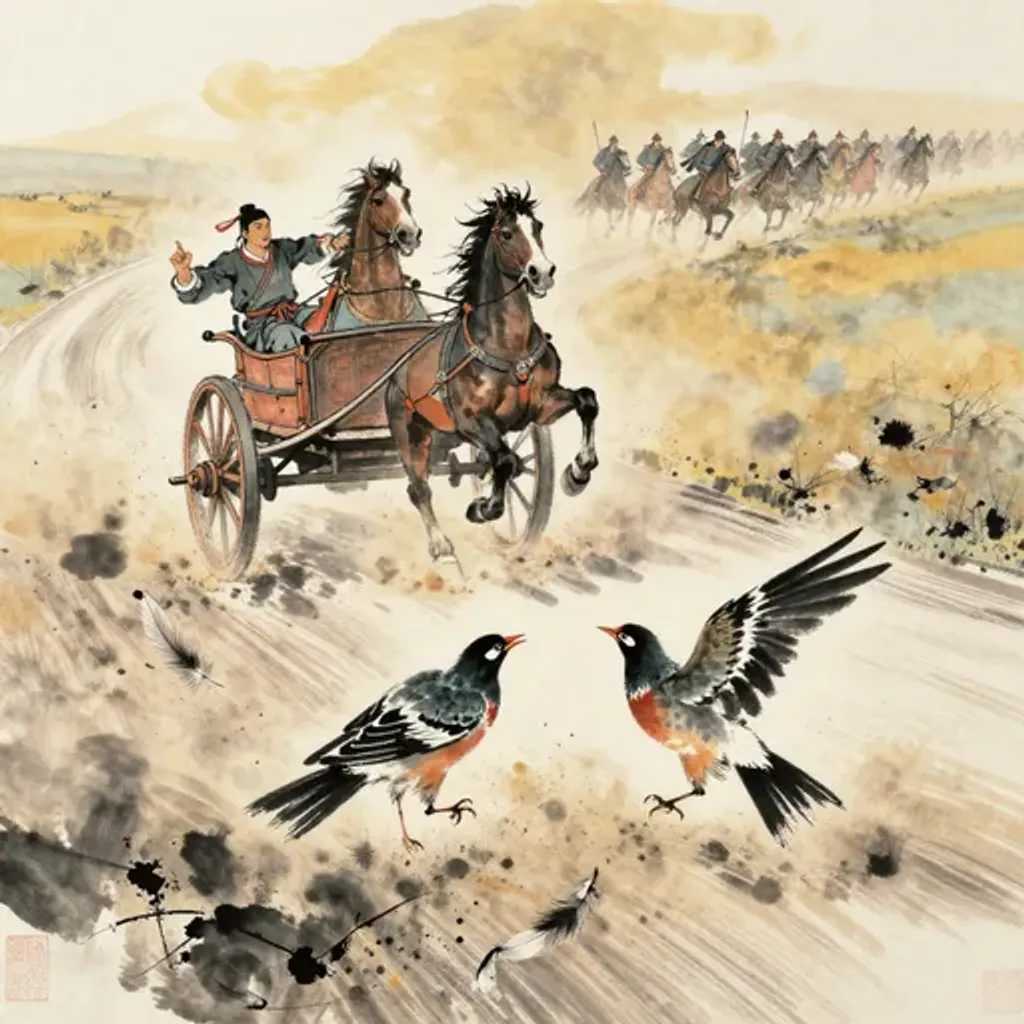
駕言出遊鳥鬬車前更相捽滅兵馬且來回車亟還可以無憂
Driving out for a journey, birds battle before the chariot, tearing at each other. Soldiers and brigands arrive at dawn; he turns the chariot and races back, and thus avoids all worry.
Read full commentary ↓
Thunder over water encounters itself — Deliverance meeting Deliverance. Driving out on a journey, birds fight before the carriage, tearing at each other. Then word comes that soldiers and bandits approach at dawn; one turns the carriage and races home, and thereby avoids worry. The verse dramatizes the instinct for timely retreat: omens appear (fighting birds), danger confirms (approaching troops), and the wise traveler does not hesitate to reverse course. From Deliverance to Deliverance, the pattern doubles rather than transforms. Release from one predicament comes through the release of attachment to the journey itself. Sometimes the most decisive act of deliverance is simply turning around.
中文註釋
雷雨作,解之自遇。駕行出遊——驅車出行。鳥鬭車前,更相捽滅——飛鳥在車前搏鬥撕扯,凶兆已現。兵寇旦來——晨間傳來賊兵消息。回車亟還——急忙掉頭回返。可以无憂——因此免於禍患。解遇解,雙重之解脫:第一重是識兆而退,第二重是放棄行程。不執著於原定之路,方能全身而退。最果斷之解脫有時不過是及時回頭。
This commentary was written against an earlier reading of the verse. Where the reading has since changed, the interpretation itself may no longer apply.
Jiao Shi Yi Lin 《焦氏易林》, manuscript from the Wenyuan Pavilion Siku Quanshu, Qianlong period, Qing dynasty.
National Palace Museum, accession nos. 故庫017987–017990
Fascicle 3, page 97
Read from the manuscript leaf
Shown unpunctuated, as in the manuscript.
About this reading
Read from the scanned leaf.
Related Hexagrams
Same upper trigram: Thunder (震)
Same lower trigram: Water (坎)