Upper Trigram
離 Lí
Fire — Clinging
Lower Trigram
坎 Kǎn
Water — Abysmal
Classical Texts
The Goal
Wei Ji is not failure. It is the condition of not-yet-complete — a state in which order has not yet settled, but completion remains possible. Fire (Li) above Water (Kan) reverses the workable arrangement of Ji Ji. There, water above fire lets the two elements perform a common function; here flame rises and water descends, so they move apart and cannot act on one another. All six lines occupy improper positions, and yet every firm line corresponds with a yielding one. The Tuan says so directly — 雖不當位,剛柔應也 — and explains the 亨 through the fifth line: 柔得中也, the yielding attains the centre. Disorder is real and it is not final. The structure remains capable of completion even though completion has not occurred. Its image is the young fox: 亨。小狐汔濟,濡其尾,无攸利 — "success; the young fox is at the verge of crossing and wets its tail; nothing furthers." 汔 places the action at the point of near-completion; Kong Yingda glosses it 將盡之名, the name for what is almost used up. The failure comes at the final stretch, not the outset. The tail is the last part of the fox to leave the water, and the line Image (小象) names the fault exactly: 不續終也 — it did not carry through to the end. The problem is not that the fox began, but that the strength or caution needed to finish ran out. The lines unfold that problem. 初六 wets its tail and receives 吝. 九二 echoes the opening line of Ji Ji — 曳其輪,貞吉, "dragging back the wheel; constancy brings good fortune" — progress depending first on restraint. 六三 is the hexagram's knot: 未濟,征凶,利涉大川 — "not yet across; advancing brings misfortune; it furthers to cross the great water." Eight characters holding two verdicts, and they are not the same verdict. Mere forward motion, undertaken from a position not equal to it, is disastrous; the great crossing, properly organised and supported, remains favourable. Moving is not the same as crossing. 九四 echoes the three-year campaign against the Gui Fang recorded at 既濟's 九三: 震用伐鬼方,三年有賞于大國. What appeared there as the difficulty of preserving an order already achieved appears here as part of the labour by which order is still being built. 六五 then reaches 君子之光,有孚吉 — "the light of the superior person; there is sincerity; good fortune." The light arrives at the fifth line, with the work unfinished. Clarity and worth do not wait for completion. The final line statement of the sixty-four hexagrams concerns celebration: 有孚于飲酒,无咎;濡其首,有孚失是 — "there is confidence in drinking wine: no blame. But if he wets his head, confidence has lost what is right." Drinking is permitted — the line says 无咎 — and losing all measure in it is not; the line Image (小象) gives the fault as 亦不知節也, not knowing measure. The submerged head recalls 既濟's top line. Confidence is not the error. The error is justified confidence turning into indulgence while vigilance disappears. The Image gives the corrective work: 火在水上,未濟;君子以慎辨物居方 — "fire above water: Not Yet Complete. The superior person carefully distinguishes things and lets each take its place." It answers the structure directly: because every line is out of position, the task is to discern differences and restore proper placement. That the I-Ching closes with Wei Ji rather than Ji Ji suggests completion can never be treated as permanently secured. Ji Ji warns that an accomplished order declines once it stops renewing itself; Wei Ji shows that disorder still contains the correspondences through which order can emerge. The sequence ends neither in failure nor in finality, but at the charged boundary where completion is possible and vigilance is still required. The cup may be raised — but not so deeply that the head follows it into the water.
The Judgment
Fulfillment. The little fox has almost crossed. Wetting its tail. No direction is supported. The last hexagram in the book. And it's not completion — it's before completion. The little fox almost made it across the frozen river and got its tail wet at the last moment. No direction supported. The I-Ching ends not with an answer but with a fox on thin ice. The whole book, sixty-four hexagrams, and the final word is: not yet. Still becoming. Always becoming.
The Image
Fire above water: before completion. The realized person accordingly carefully distinguishes things and places them in their proper position. Fire over water — they don't interact, they just sit in opposition. And the instruction is: distinguish. Sort. Place things where they belong. Because before completion, the work isn't action. It's discernment. The realized person who can tell what goes where before moving anything has the only skill that matters at the threshold: seeing clearly when nothing is settled.
The Lines
Line 1
Wetting the tail. Friction. The tail gets wet. Friction. The first line of the last hexagram, and you've barely started and already you're damp. Embarrassing but not dangerous. The text gives you friction — not adversity, not disaster. Just: the mild shame of the premature attempt. The fox that got its tail wet learned where the ice is thin. That's worth the wet tail.
Line 2
Dragging the wheels. Sustained orientation resolves well. Braking. Holding back. Resolves well. The second line: the mirror of the after-completion hexagram, where dragging wheels also appeared. But here the braking isn't caution after success — it's patience before it. The person who can hold back when the goal is visible has the one quality that separates the fox who crosses from the fox who drowns: timing.
Line 3
Before completion, advancing is adverse. Crossing the great river is supported. Don't advance — but cross the river. The third line and the most paradoxical instruction in the hexagram: movement is wrong, but the great crossing is right. Because they're different things. Advancing is pushing forward with what you have. Crossing the river is committing to a transformation with new allies. The person who knows the difference between a push and a crossing has found the only door in this line.
Line 4
Sustained orientation resolves well. Deviation detected dissolves. Shock used to campaign against the barbarous region. Three years, and great states award their rewards. Now. The fight begins. Three years, and at the end: recognition from the great states. The fourth line before completion is the moment the person who waited through three lines of patience finally acts — with shock, with force, with full commitment. Three years of war. But the rewards come from the highest level. Patience produced timing. Timing produced power. Power produced recognition.
Line 5
Sustained orientation resolves well. No deviation detected. The light of the realized person. Having sincerity: resolves well. Everything resolves well. No deviation. The light of the realized person shining clearly. Sincerity: resolves well. The fifth line of the last hexagram, and for one moment everything aligns. The character is complete, the light is real, the sincerity is genuine, and the future responds. This is the line where before-completion touches completion — just touches it — and the light is unmistakable.
Line 6
Having sincerity amid drinking wine. No fault. But wetting the head — even having sincerity, one loses it thereby. Drinking wine with friends. Sincere. No fault. But — if you let your head go under, even sincerity can't save you. The last line of the last hexagram of the I-Ching. And it ends with a party and a warning. Celebrate, but don't lose yourself in the celebration. Be sincere, but don't let sincerity become an excuse for excess. The book closes exactly where it should: between joy and discipline. Between the wine and the water. Not yet complete. Never complete. Still becoming.
Yilin: Forest of Changes
From Jiao Yanshou's Forest of Changes (焦氏易林) — the verse for Hexagram 64 in its unchanging form. A Han dynasty collection of four-character verses interpreting every hexagram transformation.
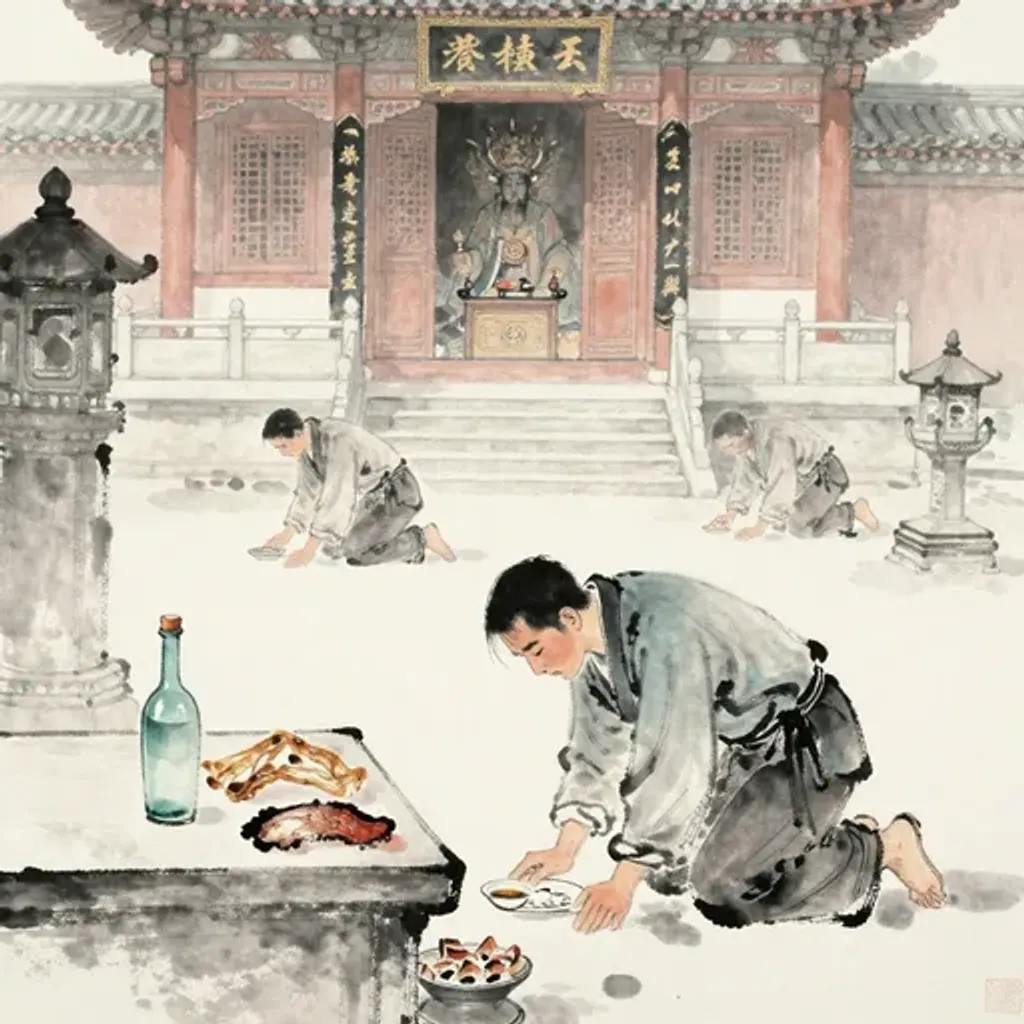
志慢未習單酒糗脯數至神前欲求所願反得大患
Devotion slack and rites unlearned; plain wine, dried meat and grain. Approaching the spirit again and again; seeking what one desires; instead receiving great calamity.
Read full commentary ↓
Fire above water, and the circle closes without resolution. The rites have been performed carelessly — the offerings are meager, just thin wine and dried meat. Repeated visits to the shrine seek divine favor, yet instead of blessings, great misfortune descends. The verse indicts ritual without sincerity: going through the motions with inferior offerings and expecting results. From Before Completion to Before Completion, the hexagram transforms into itself — the only pairing in the entire Yilin where source and target are identical. Nothing changes. The fire remains above the water, each element straining away from the other, forever. This is the Yi's ultimate statement on the cost of hollow devotion: when you bring nothing real to the altar, the cosmos returns you to exactly where you started.
中文註釋
火在水上,循環不解。忠慢未習——敬意怠慢,禮儀未備。單酒糗脯——薄酒乾肉,祭品寒酸。數至神前——反覆至神靈之前。欲求所顧——希冀神明眷顧。反得大患——反而招致大禍。此詩控訴無誠之祭——形式敷衍、祭品潦草而妄求福佑。從未濟至未濟——六十四卦各有其自變,而此變居四千零九十六之末。什麼都沒有改變。火仍在水上,各據非位,永無交合。此為《易》對虛偽之終極判語:帶空手至祭壇,宇宙只會將你送回原點。慎辨物居方——未濟之自警,永不過時。
Jiao Shi Yi Lin 《焦氏易林》, manuscript from the Wenyuan Pavilion Siku Quanshu, Qianlong period, Qing dynasty.
National Palace Museum, accession nos. 故庫017987–017990
Fascicle 4, page 206
Read from the manuscript leaf
Shown unpunctuated, as in the manuscript.
About this reading
Read from the scanned leaf.
Related Hexagrams
Same upper trigram: Fire (離)
Same lower trigram: Water (坎)