Upper Trigram
坎 Kǎn
Water — Abysmal
Lower Trigram
離 Lí
Fire — Clinging
Classical Texts
The Goal
Ji Ji is not success itself. It is the condition immediately after completion — when every line occupies its proper position, and the completed order can begin to deteriorate if it is treated as finished and no longer renewed. Water (Kan) above Fire (Li) forms a working arrangement: water heated from below, fire contained from above. Every firm line sits in a firm place and every yielding line in a yielding one. The structure is entirely correct, and for that reason the danger lies not in having achieved order but in assuming achieved order sustains itself. The Tuan puts the condition precisely: 終止則亂 — it is the stopping at completion, not the completion, that produces disorder. The judgment reads 亨小。利貞。初吉。終亂 — "constancy furthers; good fortune at the beginning, disorder at the end." The Tuan glosses 亨小 as 小者亨也: even the small has been brought through. That also names the work that remains. Once the principal task is accomplished, stability depends on attention to small things — the details, minor deviations and neglected maintenance by which disorder first returns. 初九 gives the posture: 曳其輪,濡其尾,无咎 — "dragging back the wheel, wetting the tail; no blame." The crossing has only just been made and the tail is not yet clear of the water. The operative act is 曳其輪: restraining further movement exactly when success invites haste. The line is blameless because it does not mistake arrival for permission to rush. 六二 loses her carriage-screen and is told 勿逐,七日得 — "do not pursue it; in seven days it returns." The seven-day measure echoes 復 and 震: what belongs to a cycle comes back through time rather than through anxious pursuit. Even inside a completed order, not everything should be recovered by immediate intervention. 九五 holds the hexagram's finest measure: 東鄰殺牛,不如西鄰之禴祭,實受其福 — "the eastern neighbour slaughters an ox; it does not equal the western neighbour's modest seasonal offering, which truly receives the blessing." At the summit of accomplishment, abundance cannot compensate for being out of time or lacking sincerity. The great sacrifice is inferior not because it is large but because the smaller one is better aligned with the moment and with the virtue of whoever offers it. Read that beside hexagram 41's 二簋可用享 and hexagram 45's 用大牲. The right scale of an offering depends on the situation. Economy is not inherently better than abundance, nor abundance than economy. What matters is proportion — the right act, in the right measure, at the right time. The Image gives the discipline of completion: 水在火上,既濟;君子以思患而豫防之 — "the superior person considers misfortune and takes precautions against it in advance." Completion is not merely a time for celebration. It is the moment to ask where the achieved order is likeliest to fail, and to strengthen it before the failure shows. 上六 shows what neglecting that costs: 濡其首,厲 — "the head is immersed; danger." At the first line only the tail was wet; at the last the whole head has gone under. The movement was carried too far and the restraint is gone. Ji Ji's purpose is therefore vigilance within achievement. Completion is neither a permanent destination nor an inevitable slide into chaos. It is a momentary equilibrium; once maintenance stops, it begins to turn toward disorder. What has been achieved may demand as much attention to keep as it took effort to make.
The Judgment
Fulfillment in small things. Sustained orientation is supported. At the beginning, resolve well. At the end, disorder. It's done. Complete. Everything in its right place. And the judgment says: small fulfillment, good start, chaotic end. The second-to-last hexagram in the book, and the text is already warning you that completion is the beginning of decay. The moment everything is perfect is the moment entropy begins. The person who finishes and relaxes has already started the next problem.
The Image
Water above fire: after completion. The realized person accordingly contemplates misfortune and prepares against it in advance. Water over fire — the two elements that destroy each other, in temporary balance. And the instruction is: think about what can go wrong. Now. While everything's working. The realized person who prepares for disaster during the moment of completion has understood something that takes most people a lifetime: the only time you can prepare for the fall is before it starts.
The Lines
Line 1
Dragging the wheels. Wetting the tail. No fault. Pulling back on the wheels. The tail gets wet. No fault. The first line after completion, and the instruction is: brake. Everyone else is surging forward into the post-completion euphoria, and you're dragging your wheels. The tail gets damp — some minor consequence — but no fault. Because the person who slows down when everyone speeds up is the only one who saw the water.
Line 2
The woman loses her carriage veil. Do not pursue it. In seven days, recovered. Something falls away — the veil, the screen, the covering. Don't chase it. Seven days and it returns. The second line: in times of completion, things you relied on disappear. The instinct is to chase them. The text says: wait. Seven days. The thing that was genuinely yours comes back without pursuit. The thing that wasn't yours was never the veil you needed.
Line 3
The illustrious ancestor campaigns against the barbarous region. Three years to conquer it. Do not employ petty people. A three-year campaign against the wilderness. The illustrious ancestor — someone of genuine stature — wages a long war against disorder on the borders. And the instruction: don't use small people. After completion, the margins still need work, and the work takes years, and the workers must be worthy of it. The person who sends petty agents to do noble work gets neither the territory nor the peace.
Line 4
Fine silk turns to rags. All day long, be watchful. Beautiful clothes becoming patches. All day: vigilance. The fourth line after completion, and the image is decay at its most elegant — the silk doesn't tear, it degrades. Slowly. Imperceptibly. And the only response is constant watchfulness. The person who notices the silk thinning before it tears is the person who stays dressed. Everyone else discovers the holes in public.
Line 5
The eastern neighbor slaughters an ox. This does not compare to the western neighbor's modest spring offering, which truly receives the blessing. The grand sacrifice versus the simple one. The ox versus the spring offering. And the blessing goes to the modest one. The fifth line after completion: the person who offers less with more sincerity receives more than the person who offers everything with less. The ox is impressive. The spring offering is real. After completion, the text trusts sincerity over spectacle.
Line 6
Wetting the head. Strained. The head goes under water. Strained. The last line of after completion — the tail was wet in line one, now the head is submerged. The person who crossed the river and then looked back is now drowning in what they already passed through. The text doesn't say adverse. It says strained. Because the danger here isn't the water. It's the backward glance. The completion was real. The relapse is optional.
Yilin: Forest of Changes
From Jiao Yanshou's Forest of Changes (焦氏易林) — the verse for Hexagram 63 in its unchanging form. A Han dynasty collection of four-character verses interpreting every hexagram transformation.
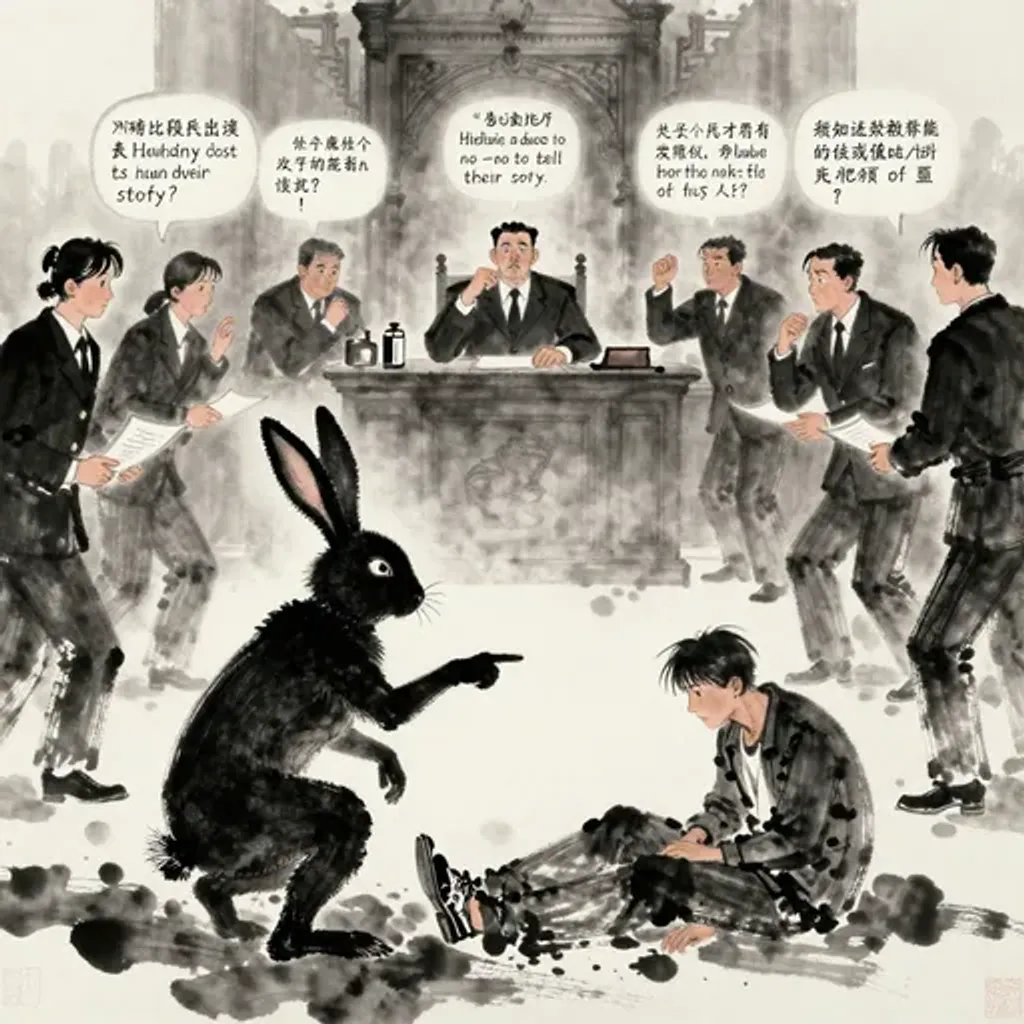
玄兔捐掌與足相視證訊詰問詿情自侶死誣難告口為身禍
The black rabbit points with its paw, hand and foot accusing each other. Careful interrogation and questioning; false charges straighten themselves out. Who will tell the wrongly dead? The mouth brings disaster to the body.
Read full commentary ↓
Water sits above fire — After Completion returning to itself. The dark hare points with its paw, relying on its feet for support. Under rigorous interrogation, false accusations are straightened out on their own. Yet the unjustly dead have no one to appeal to, for the mouth that should speak becomes the body's undoing. The verse oscillates between justice and its failure: inquiry can expose falsehood, but sometimes truth arrives too late, after the innocent are already dead. The mouth — instrument of both testimony and self-incrimination — is the pivot. From After Completion to After Completion, the hexagram meets its own mirror. There is no transformation, only the completed order confronting its own internal contradictions: the system that can both vindicate and destroy.
中文註釋
水在火上,既濟之象,復歸自身。玄兔指掌——黑兔以前足指示。與足相恃——前後足相互依恃。謹訊詰問——嚴加審訊追問。誣情自直——冤枉之情自然明白。冤死誰告——含冤而死者向誰申訴?口為身禍——能言之口反為自身招禍。正義與其失敗之間擺盪:審訊能辯明誣枉,但有時真相到來已太遲——冤者已死。口既為證詞之器,亦為自取其禍之源。既濟至既濟,卦與自身之鏡像相對。無變化可言,唯完成之秩序直面自身之內在矛盾:能平反亦能殺人之同一體制。
This commentary was written against an earlier reading of the verse. Where the reading has since changed, the interpretation itself may no longer apply.
Jiao Shi Yi Lin 《焦氏易林》, manuscript from the Wenyuan Pavilion Siku Quanshu, Qianlong period, Qing dynasty.
National Palace Museum, accession nos. 故庫017987–017990
Fascicle 4, page 195
Read from the manuscript leaf
Shown unpunctuated, as in the manuscript.
About this reading
Read from the scanned leaf.
Related Hexagrams
Same upper trigram: Water (坎)
Same lower trigram: Fire (離)