Upper Trigram
坎 Kǎn
Water — Abysmal
Lower Trigram
震 Zhèn
Thunder — Arousing
Classical Texts
The Goal
Zhun is not simply difficulty — it is the specific difficulty of emergence, the chaos that attends every genuine beginning. Seeds splitting underground, a nation forming from scattered tribes, a business in its first weeks. The hexagram shows Water (Kan) above Thunder (Zhen): danger above arousing movement below. Energy is present but has no clear path yet. The critical instruction is 勿用有攸往 — "do not venture forward." This is counterintuitive at a beginning, when momentum feels essential. But Zhun's goal is not progress; it is establishing the conditions that make progress possible. Sorting threads before weaving. Appointing helpers before marching. The text explicitly supports 利建侯 — "establishing feudal lords," meaning: delegate, organize, create structure. The chaos of emergence resolves through patient infrastructure, not heroic advance. The common mistake is treating the beginning as the moment for boldness. Zhun says the opposite: beginnings are when you are most vulnerable and least oriented. The goal is to survive emergence intact, with your resources organized and your alliances formed, so that when the path clarifies you can move without stumbling.
The Judgment
Supreme fulfillment. Sustained orientation is supported. Do not venture forward. Establishing priorities is supported. Everything's available — fulfillment, support, the works. And the first instruction is: don't go anywhere. The beginning of something big looks exactly like chaos. The move that works right now isn't the bold one. It's the boring one. Get organized. Find your people. The road shows up later.
The Image
Clouds and thunder: difficulty at the beginning. The realized person accordingly sorts the threads. Thunder and no rain. All that energy and nothing to show for it yet. You know what the realized person is doing? Sorting thread. Not leading a charge, not making a speech — sorting thread. Because later, when it finally rains, you either have something to weave or you don't.
The Lines
Line 1
Boulders obstruct the path, encircling. Abiding in sustained orientation is supported. Establishing priorities is supported. Rocks in every direction. Can't go forward. Two things are supported and neither one is 'push through the rocks.' Stay put. Get organized. You know what the beginning of a difficult situation is a terrible time for? Heroics. You know what it's a great time for? A list.
Line 2
Struggling as if turning back. A team of horses, arrayed but halted. This is not an assailant — it is a suitor. The young woman holds her position, does not accept. Ten years, then she accepts. Something shows up that looks threatening but is actually an offer. The line says: wait ten years. Not five. Not 'a while.' Ten years. Because right now you literally cannot tell the difference between the robber and the groom. They look identical. Ten years is how long the disguise takes to wear off.
Line 3
Pursuing deer without a forester. Only entering the forest's depths. The discerning person reads the signs — better to let it go. Continuing forward: friction. You see the deer. You want the deer. You have no guide. Here's the thing about forests: they don't care how much you want the deer. The deer is probably there. You are definitely lost. Knowing when the hunt is costing more than the deer is worth — that's not giving up. That's arithmetic.
Line 4
A team of horses, arrayed. Seeking a match. Going forward resolves well. Nothing that isn't supported. Same horses as line two, completely different situation. What changed? You're the one reaching out this time. Not being approached by something ambiguous — actively seeking. When you can name what you're looking for, every direction opens up. Funny how that works.
Line 5
Storing one's riches. Modest sustained orientation resolves well. Grand sustained orientation: adverse. You've got resources. Small bet works. Big bet doesn't. Same person, same resources, completely different outcomes depending on scale. The configuration can carry a canoe. Not a battleship. The person who matches the vessel to the water gets there. The person who doesn't, doesn't.
Line 6
A team of horses, arrayed but halted. Tears of blood streaming. No verdict. The text doesn't say 'resolves well.' Doesn't say 'no fault.' Just: horses going nowhere and someone crying blood. That's it. The difficulty at the beginning, at its absolute limit, is just grief. The text doesn't soften this. There's nothing to soften.
Yilin: Forest of Changes
From Jiao Yanshou's Forest of Changes (焦氏易林) — the verse for Hexagram 3 in its unchanging form. A Han dynasty collection of four-character verses interpreting every hexagram transformation.
兵征大宛北出玉關與胡寇戰平城道西七日絕糧身幾不全
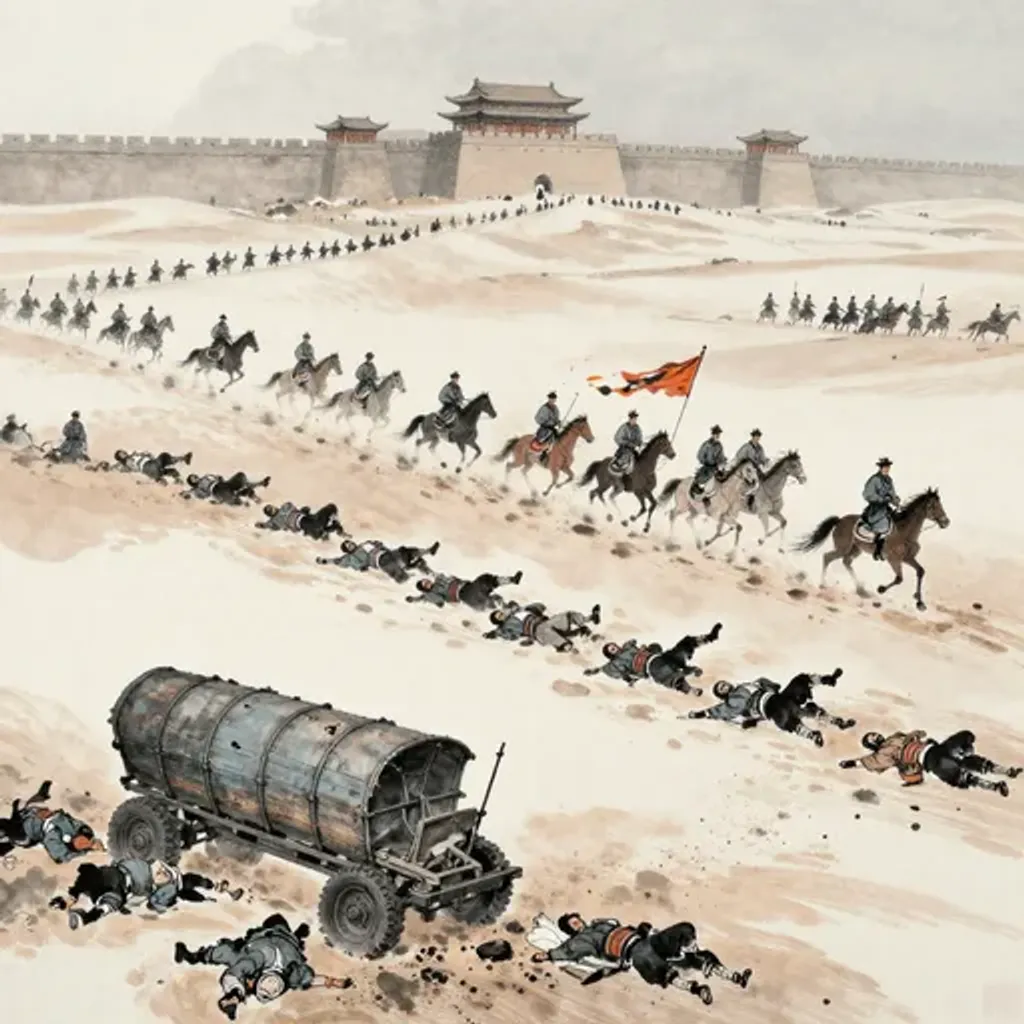
The army campaigns against Dayuan, going north out through Jade Gate. Battling the Xiongnu raiders west of Pingcheng; seven days without grain, the body nearly lost.
Read full commentary ↓
Difficulty doubles upon itself when the hexagram transforms into its own image. Troops march against Dayuan and venture north through the Jade Gate, only to clash with nomad raiders west of Pingcheng, cut off from supplies for seven days, their lives hanging by a thread. This references the Siege of Baideng in 200 BC, when Emperor Gaozu of Han rashly pursued the Xiongnu and was encircled by Modu Chanyu's forty thousand cavalry on Baideng Mountain for seven full days without provisions. Only Chen Ping's secret stratagem, bribing the Chanyu's consort, secured the emperor's escape. Zhun unchanging intensifies its own nature: the initial difficulty is not merely encountered but compounded, and reckless advance into hostile terrain magnifies every vulnerability.
中文註釋
屯之屯,困上加困,初始之難自我疊加。兵征大宛,北出玉關,與胡寇戰於平城之西,七日絕糧,身幾不全。此即漢高祖白登之圍(前200年):劉邦輕騎冒進,為冒頓單于四十萬精騎圍困於白登山,內無糧草,外無援軍。賴陳平獻計,以重寶賂閼氏,方得脫圍。屯變屯,不變即困愈深——冒進入險境,初難之勢自我倍增,所有弱點盡被放大。
Jiao Shi Yi Lin 《焦氏易林》, manuscript from the Wenyuan Pavilion Siku Quanshu, Qianlong period, Qing dynasty.
National Palace Museum, accession nos. 故庫017987–017990
Fascicle 1, page 35
Read from the manuscript leaf
Shown unpunctuated, as in the manuscript.
About this reading
Read from the scanned leaf.
Related Hexagrams
Same upper trigram: Water (坎)
Same lower trigram: Thunder (震)