Upper Trigram
震 Zhèn
Thunder — Arousing
Lower Trigram
艮 Gèn
Mountain — Stillness
Classical Texts
The Goal
Xiao Guo is not failure. It is the discipline of operating within diminished scope — accomplishing what can be accomplished when conditions do not support large undertakings. Thunder (Zhen) above Mountain (Gen) gives thunder caught among the peaks, unable to carry across open country. The shape inverts Zhong Fu: where Inner Truth has solid lines framing a hollow centre, Small Exceeding has yielding lines at the edges enclosing solid ones — weight in the middle, weakness at the extremities. Substance without reach. The judgment is more generous than the reading usually allows: 亨。利貞。可小事,不可大事。飛鳥遺之音,不宜上宜下,大吉 — "success; constancy furthers; small matters are possible, great matters are not; the flying bird leaves its call behind; it is not fitting to go up, fitting to go down; supreme good fortune." 大吉 sits at the end of a hexagram about doing only small things. The scope is reduced and the outcome is not. The bird carries the instruction. Its cry travels downward, and 不宜上宜下 makes that a rule rather than an observation. The two outer lines enforce it: 初六 — 飛鳥以凶, "the bird flies, and thereby misfortune"; 上六 — 弗遇過之,飛鳥離之,凶,是謂災眚, "not meeting but passing beyond; the flying bird is caught in the net; misfortune — this is called calamity." Both failures are upward and outward. Nothing in the hexagram punishes staying low. The Image names where excess is permitted: 山上有雷,小過;君子以行過乎恭,喪過乎哀,用過乎儉 — "in conduct, go too far in reverence; in mourning, too far in grief; in expenditure, too far in thrift." The permitted excess is an excess of care. Going further than expected in the small virtues is what remains when the large ones are out of reach. 六五 brings back a phrase from hexagram 9: 密雲不雨,自我西郊 — "dense clouds, no rain, from our western outskirts." The same suspended condition, gathered and not yet released, and the line continues 公弋取彼在穴, the duke takes his quarry from the cave: what he gets, he gets by reaching into a hole rather than by shooting at the sky. The goal of Xiao Guo is to calibrate ambition to capacity, and the common mistake is to treat reduced scope as licence for reduced effort. It asks for the reverse — more care, because the margin has narrowed.
The Judgment
Fulfillment. Sustained orientation is supported. Small things may be done; great things may not. The flying bird leaves its call behind. It is not fitting to ascend — it is fitting to descend. Great resolve well. Small things: yes. Great things: no. The bird's message comes from below, not above. Descend, don't climb. The preponderance-of-the-small hexagram reverses every ambitious instinct: go down, stay small, do the minor thing. And the punchline — great resolve well — goes to the person who accepted smallness. The great verdict for the small act. That's the whole teaching.
The Image
Thunder on the mountain: preponderance of the small. The realized person accordingly exceeds in reverence in conduct, exceeds in grief in mourning, exceeds in frugality in spending. Thunder on the mountain — it sounds louder than it is because of the elevation. And the instruction is: exceed in three specific directions. More reverent than necessary. More grieving than expected. More frugal than required. The text doesn't say 'be moderate.' It says exceed — but only downward. The excess that the hexagram supports is the excess of humility.
The Lines
Line 1
The flying bird meets with adversity. The bird flies. Adversity. The first line and the shortest explanation available: don't fly yet. The bird that takes off before it's ready meets exactly the thing it was trying to escape by flying. The text doesn't elaborate because the image is complete. Premature flight. Predictable crash.
Line 2
Passing by the grandfather, meeting the grandmother. Not reaching the ruler, meeting the minister. No fault. You miss the important person and meet the secondary one. Twice — grandfather/grandmother, ruler/minister. No fault. The second line: in times of smallness, you don't reach the top. You reach the tier below. And the text says: that's correct. The person who accepts the indirect channel instead of demanding the direct one has understood the hexagram. The grandmother has what you need. The minister has the answer.
Line 3
Not exceeding in defense against it — someone may approach from behind and strike. Adverse. You didn't overdo the defenses. And someone hit you from behind. Adverse. The third line is the penalty for insufficient caution in a time that demands excessive caution. The person who was too proud to over-prepare has a very specific kind of wound: the one in the back. The text warned you to exceed in smallness. You exceeded in confidence instead.
Line 4
No fault. Not exceeding, meeting it. Going forward is dangerous — necessarily requiring caution. Do not apply sustained persistence. No fault — but don't push it. The danger is real, caution is required, and sustained persistence is explicitly forbidden. The fourth line: the one time in the I-Ching where the text says don't persist. Because persistence in the wrong direction during a time of smallness doesn't produce breakthrough. It produces the cliff. Stop. Meet the situation as it is. Don't force it.
Line 5
Dense clouds but no rain from our western border. The duke hunts with tethered arrows, taking what is in the cave. Clouds everywhere. No rain. And the duke hunts with arrows on strings — he can retrieve them, the catch is modest, the prey is hiding in caves. No verdict. The fifth line: maximum potential (dense clouds) with no release (no rain). The duke adapts by hunting small game with recoverable arrows. He doesn't waste resources on what the sky won't give him. He works with what's available in the holes.
Line 6
Not meeting but passing by. The flying bird departs from it. Adverse. This is called disaster and harm. Missed completely. The bird flew too high and left the situation behind. Adverse — and the text adds something it almost never adds: 'This is called disaster.' Named it. Labeled it. The top of the preponderance-of-the-small, and the failure is the person who refused to stay small. Who kept climbing when the hexagram said descend. The bird that won't come down eventually finds the net.
Yilin: Forest of Changes
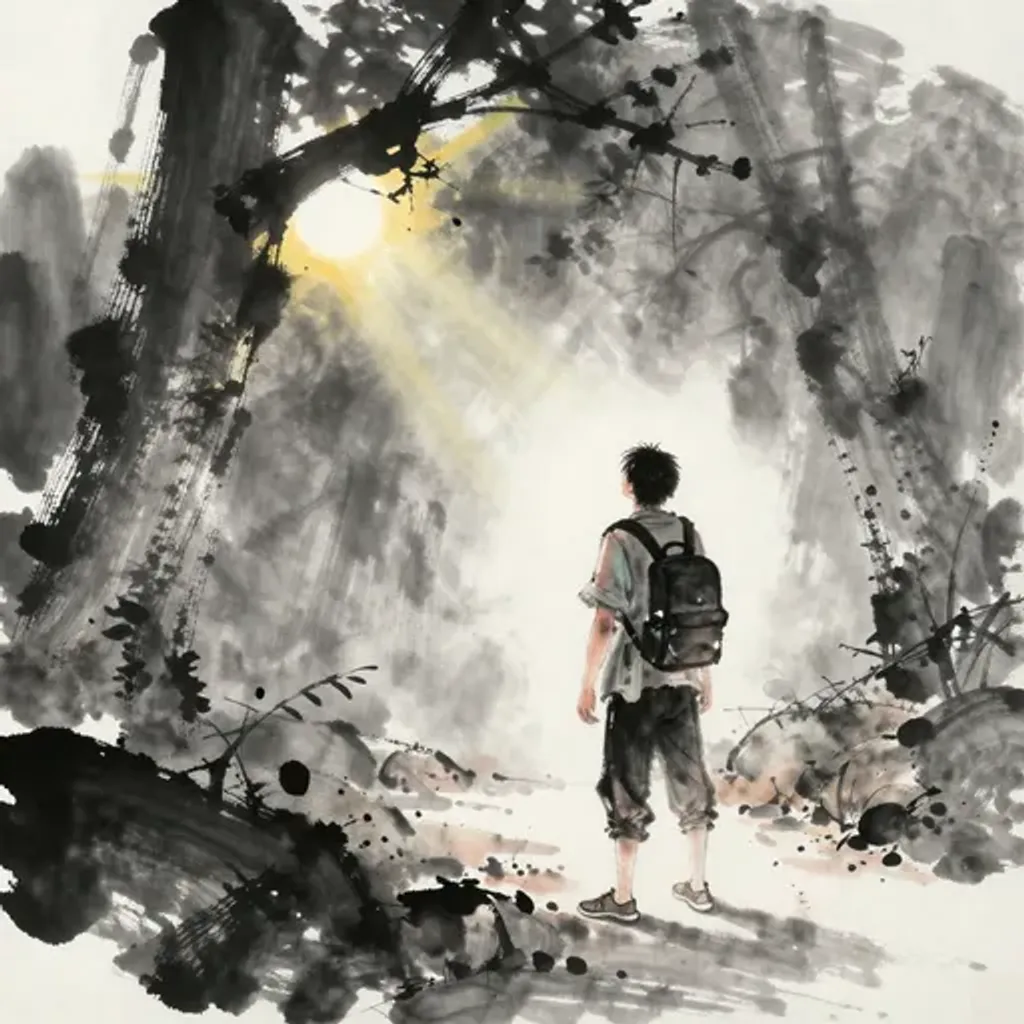
From Jiao Yanshou's Forest of Changes (焦氏易林) — the verse for Hexagram 62 in its unchanging form. A Han dynasty collection of four-character verses interpreting every hexagram transformation.
初雖驚惶後反無傷受其福慶永永其祥
At first, though alarmed and frightened; afterward, no harm comes; receiving blessings and good fortune.
Read full commentary ↓
Thunder rumbles above the mountain, returning to itself. At first there is alarm and fright, but afterward no harm comes — blessings and good fortune are received. The verse captures Small Exceeding's own nature in its purest form: the initial shock of exceeding one's proper bounds, followed by the discovery that the excess was benign all along. The thunder startles but does not strike; the mountain shakes but does not fall. When source and target are identical, the hexagram speaks to itself, revealing its core teaching: small transgressions, handled with humility, resolve into benefit rather than punishment. The bird that flies slightly too high discovers it can see farther. The one who bows too deeply earns unexpected respect. Excess in the direction of caution becomes its own reward.
中文註釋
山上有雷,小過復歸自身。初雖驚惶——起初驚恐不安,雷動山搖之際難免恐懼。後反无傷——然而事後發現並無損傷。受其福慶——反而得到福澤慶祥。此為小過之本義以最純粹之形式呈現:稍逾其分之初始驚恐,繼而發現此過本為善意。雷驚而不擊,山搖而不崩。源卦與變卦相同,卦自言其道:小小之逾越,以謙卑處之,化罰為福。飛略高之鳥發現望更遠,鞠過深之人反得意外敬重。朝謹慎方向之過度,本身即為獎賞。
This commentary was written against an earlier reading of the verse. Where the reading has since changed, the interpretation itself may no longer apply.
Jiao Shi Yi Lin 《焦氏易林》, manuscript from the Wenyuan Pavilion Siku Quanshu, Qianlong period, Qing dynasty.
National Palace Museum, accession nos. 故庫017987–017990
Fascicle 4, page 186
Read from the manuscript leaf
Shown unpunctuated, as in the manuscript.
About this reading
Read from the scanned leaf.
Related Hexagrams
Same upper trigram: Thunder (震)
Same lower trigram: Mountain (艮)