Upper Trigram
乾 Qián
Heaven — Creative
Lower Trigram
震 Zhèn
Thunder — Arousing
Classical Texts
The Goal
Wu Wang is not naivety. It is the state of acting without ulterior calculation — doing what is right because it is right, not because of expected reward. The character 妄 means reckless or false; 无妄 negates it, yielding "without falseness." Heaven (Qian) above Thunder (Zhen): the creative principle directing the arousing force. When initiative arises from alignment with heaven's pattern rather than from personal scheming, action is innocent in the deepest structural sense. The judgment carries 元亨利貞 and then attaches a severe condition: 其匪正有眚,不利有攸往 — "if one is not correct, there is blight; it is not favorable to have somewhere to go." This bifurcation is the hexagram's architecture. Wu Wang does not promise that innocence will be rewarded — it holds that innocence is the only viable orientation. The moment calculation enters, the moment one wears Wu Wang's appearance while harboring strategic intent, the hexagram's protection is gone. The Tuan does not describe 眚 as a penalty imposed by an offended authority; it says 天命不祐 — heaven's decree does not aid such a course. Falseness is not struck down. It is simply unsupported by an order that runs on sincerity. The Image sets the standard the hexagram measures against: 天下雷行,物與無妄;先王以茂對時育萬物 — "thunder rolls beneath heaven, and all things are given their integrity. The ancient kings, in rich accord with the season, nurtured the ten thousand things." What is asked of a person is what things do already: answer the time as it actually is. The fifth line shows the cost of that standard falling on someone blameless — 无妄之疾,勿藥有喜, "illness that comes without falseness; do not medicate, and there will be joy." Some misfortune is not a signal to intervene. The top line refuses the last shelter: 无妄,行有眚,无攸利 — "without falseness; to act brings blight; nothing is favorable." Innocence does not license action at the wrong moment. The common misreading treats Wu Wang as good luck for the pure-hearted; its actual teaching is that one must act correctly even when correctness produces no visible advantage, and must also decline to act when the time refuses it. Wu Wang's goal is an orientation so aligned with reality's own pattern that personal calculation becomes not merely unnecessary but actively harmful.
The Judgment
Supreme fulfillment. Sustained orientation is supported. If not upright, there is calamity. Going forward is not supported. Without pretense. Without falseness. That's what earns supreme fulfillment. But the moment you deviate — the moment your motive isn't straight — calamity, and no direction works. The text splits the world in two: genuine and not. Everything follows from which side you're on.
The Image
Thunder moves beneath heaven, all things without pretense. The ancient kings accordingly nourished all beings in alignment with the seasons. Thunder under the sky and everything just being what it is. No performance, no strategy. The ancient kings' job was to match the nourishment to the season — not to force growth, but to align with it. You don't make things real. You stop making them fake.
The Lines
Line 1
Without pretense. Going forward resolves well. Genuine. Go. That's it. The first line of the innocence hexagram and the instruction is the simplest one in the book. No pretense, move forward, resolves well. The moment you start calculating how to be innocent, you've left this line.
Line 2
Not plowing for the harvest. Not clearing for the cultivated field. Then going forward is supported. Don't plow for the harvest. Don't clear the land for what you'll plant later. Just do the work without the projection. The text is describing the opposite of strategic thinking — action without a spreadsheet. When you stop measuring the return on every investment of effort, the going forward opens up.
Line 3
Innocence encounters misfortune. A tethered ox — the traveler's gain is the townsperson's loss. You did nothing wrong and something bad happened. The ox was tied up properly and somebody took it. The traveler's lucky find is your loss. This is the line that makes people angry at the book. Innocence doesn't protect you from misfortune. It just means the misfortune isn't your fault. Those are two separate things.
Line 4
Sustained orientation is invited. No fault. Hold your ground. No fault. The fourth line in the innocence hexagram and the instruction is to be holdable — to be the kind of person sustained orientation actually fits. No fault. In a hexagram about genuineness, position four is: just keep being what you are. Everything else is noise.
Line 5
An illness without pretense. Do not medicate. There will be happiness. You're sick and you didn't cause it. Don't treat it. The illness will pass. This is the most counterintuitive line in the book — you're unwell and the instruction is: hands off. Because the illness isn't rooted in you. Medicating something that's passing through just gives it a reason to stay. Wait. Happiness arrives.
Line 6
Without pretense, yet action brings calamity. No direction is supported. Innocent and still: nothing works. No direction, no support, no favorable move. The top of the innocence hexagram and the hardest truth in it: being genuine doesn't mean the timing is right. You can be completely without pretense and the configuration can still say no. Innocence is necessary. It is not sufficient.
Yilin: Forest of Changes
From Jiao Yanshou's Forest of Changes (焦氏易林) — the verse for Hexagram 25 in its unchanging form. A Han dynasty collection of four-character verses interpreting every hexagram transformation.
夏臺美里湯文厄處皐陶聽斷岐人悅喜西望華首東歸无咎
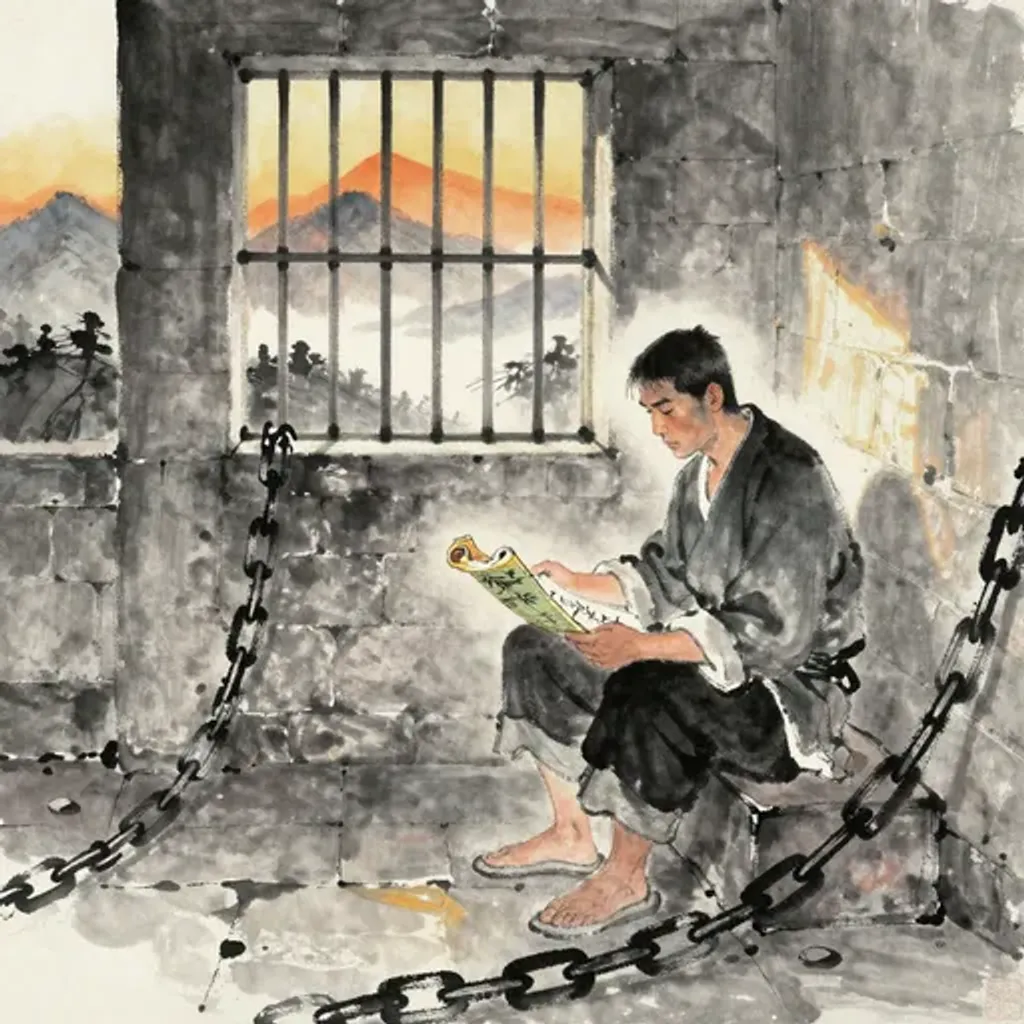
Xia Tai and Youli; where Tang and Wen met their trials. Gao Yao judged with discernment; the people of Qi rejoiced. Looking west toward Huaxia; returning east, no fault.
Read full commentary ↓
Xiatai and Youli — the prisons where King Tang and King Wen endured unjust captivity before founding their dynasties. Gao Yao, the legendary minister of justice, listens and adjudicates, and the people of Qi rejoice. Looking west toward the central kingdoms, then returning east without blame. From Innocence to Innocence, the self-referential transformation doubles the hexagram's meaning. Tang and Wen suffered innocent misfortune — the very essence of Wuwang — yet their imprisonment became the crucible of dynastic virtue. Gao Yao's just hearing restores order. The verse encodes Wuwang's complete cycle: the innocent suffer, justice eventually prevails, and one returns home without fault.
中文註釋
夏臺羑里——商湯囚於夏臺,文王囚於羑里,皆無辜受難而終成大業。皋陶聽理——上古法官秉公審判——岐人悅喜。西望華夏,東歸無咎。從無妄至無妄,自指之變卦將卦義加倍。湯、文之獄正是無妄之極致——無辜受災——然囹圄反成鍛造王業之熔爐。皋陶之公正聽斷恢復秩序。詩編碼無妄之完整循環:無辜受難,正義終至,歸而無咎。
The commentary reflects an earlier reading and may refer to wording the manuscript does not carry.
Jiao Shi Yi Lin 《焦氏易林》, manuscript from the Wenyuan Pavilion Siku Quanshu, Qianlong period, Qing dynasty.
National Palace Museum, accession nos. 故庫017987–017990
Fascicle 2, page 54
Read from the manuscript leaf
Shown unpunctuated, as in the manuscript.
About this reading
Read from the scanned leaf.
Related Hexagrams
Same upper trigram: Heaven (乾)
Same lower trigram: Thunder (震)