Upper Trigram
乾 Qián
Heaven — Creative
Lower Trigram
巽 Xùn
Wind — Gentle
Classical Texts
The Goal
Gou is not seduction. It is the structural principle of encounter from below — the moment when a single dark line re-enters a fully bright situation and begins working from within. Heaven (Qian) above Wind (Xun) shows five yang lines resting above one yin that has appeared at the base. This is the solstice hexagram: light has peaked, and the first shadow returns on schedule. The judgment is blunt: 女壯,勿用取女 — "the woman is strong; do not take such a woman." Read as advice about women it is unpleasant and not very interesting. Read structurally it is the hexagram's whole thesis: what arrives uninvited, presents itself as small, and enters through the gap carries disproportionate power precisely because it is underestimated. One yin among five yang looks negligible. It is the reason the other five will not stay. The Image moves the frame from encounter to governance: 天下有風,姤;后以施命誥四方 — "under heaven there is wind: Coming to Meet. The sovereign issues commands and proclaims them to the four quarters." Wind beneath heaven reaches everywhere without being seen, and the hexagram notes that the same penetrating structure serves either infiltration or transmission. What gets in unnoticed and what gets out to every corner travel the same way. 初九 gives the countermeasure and its timing: 繫于金柅,貞吉 — "checked by a brake of bronze; constancy brings good fortune" — followed by 羸豕孚蹢躅. Wang Bi unpacks both words: 羸豕,謂牝豕也。群豕之中,豭強而牝弱 — the sow, weak beside the boar — and 孚,猶務躁也, 孚 here being agitation rather than confidence. A weak animal, pacing. Not a fat pig later; a thin one now, already restless. The line's point is that the force is weak and agitated at exactly the moment it can still be checked, and that it must be met with something harder than itself. 九五 shows the mature form of the same restraint: 以杞包瓜,含章,有隕自天 — "a melon wrapped in willow leaves; the pattern held within; something falls from heaven." What is strong and principled can afford to contain rather than confront — but only while 含章 holds, the inner pattern intact and the awareness unbroken. Gou follows Guai and inverts it: five strong lines expelling one weak from above becomes one weak line entering from below among five strong. The breakthrough's victory creates the conditions for the next infiltration. The goal is to recognize the moment of entry and act while the thing entering is still thin.
The Judgment
The maiden is powerful. Do not take this maiden. The maiden is strong — and the instruction is: don't marry her. Not because strength is wrong in a woman. Because this is the dark force presenting itself as attractive. The coming-to-meet hexagram is about the thing that approaches uninvited and looks wonderful. The text says: no. Don't let it in. The seduction is the warning.
The Image
Beneath heaven there is wind: coming to meet. The ruler accordingly issues commands and proclamations to the four directions. Wind under heaven — it reaches everywhere, touches everything. And the ruler's response is to broadcast widely. Not to chase the wind — to match its reach. When something infiltrates from below, the answer isn't to pursue it. The answer is to make your own message travel just as far.
The Lines
Line 1
Checked with a metal brake. Sustained orientation resolves well. If there is somewhere to go, the adverse appears. A tethered lean pig kicks and struggles. Brake it. Now. Metal brake — the strongest kind. The lean pig is thrashing, kicking, trying to get free. It's small, it's weak, it looks harmless. That's the whole problem. The text knows that the thing you don't bother restraining because it seems insignificant is the thing that takes over. Check it at the first sign. Not the third.
Line 2
There is a fish in the wrapping. No fault. Does not serve the guests. A fish in the package — contained, controlled, useful. No fault. But don't share it with the guests. The inferior element is managed, and the instruction is: keep the containment private. The moment you let other people interact with the thing you're managing, you've lost control of it. The fish stays in your kitchen.
Line 3
No skin on the buttocks. Walking halts and stumbles. Strained. No great fault. Raw, stumbling, strained. But no great fault. The third line: you're tempted by the approaching force, you can't quite engage with it, and the discomfort is intense. But the inability to act is actually protecting you. The person who can't sit down comfortably in the wrong chair has been saved by their own awkwardness.
Line 4
No fish in the wrapping. Rising: adverse. The fish is gone. The thing you were supposed to be containing has escaped. And whatever starts from here: adverse. The fourth line of coming-to-meet, and the container is empty. The tolerant approach that worked in line two failed because you stopped paying attention. The fish left. Now what rises from the empty wrapping is the consequence.
Line 5
Using willows to wrap the melon. Containing the pattern. Something drops from heaven. Willow leaves over a melon — the strong wrapping the sweet, the firm containing the ripe. The hidden pattern. And then: something falls from heaven. No verdict, just the image. The person who contains the approaching force with grace rather than with force receives something unexpected from above. The heavenly gift goes to the person who figured out that wrapping is better than fighting.
Line 6
Coming to meet with horns. Friction. No fault. Meeting the world with your horns out. Friction — but no fault. The top of the coming-to-meet hexagram, withdrawn from the world, and the response to anything that approaches is a wall of antlers. Not elegant. Not welcoming. But when you're at the top and the approaching force has already infiltrated everywhere else, the horns are what's left. No fault for the porcupine.
Yilin: Forest of Changes
From Jiao Yanshou's Forest of Changes (焦氏易林) — the verse for Hexagram 44 in its unchanging form. A Han dynasty collection of four-character verses interpreting every hexagram transformation.
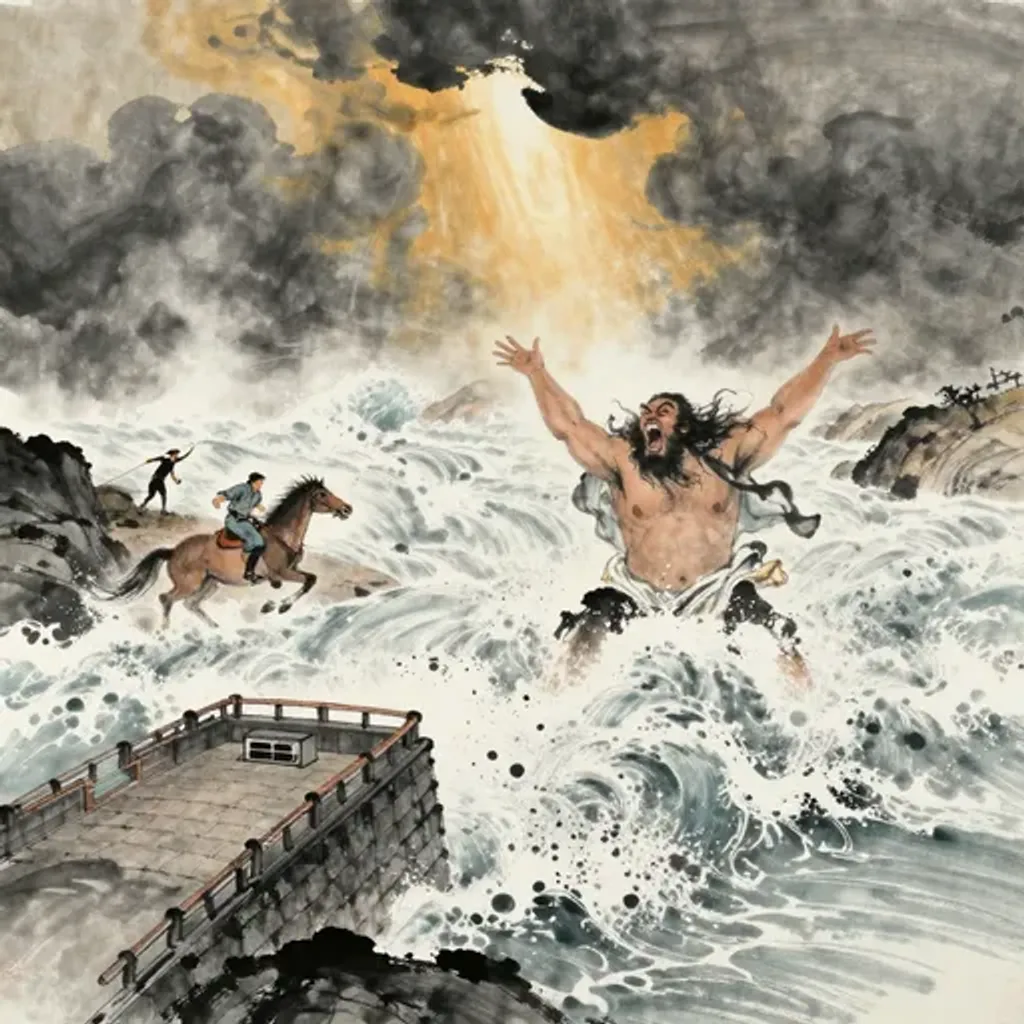
河伯大呼津不可渡往復示故乃無大悔
The River Lord cries out in warning; the ford cannot be crossed. Going and returning to one's former way; thus there is no great regret.
Read full commentary ↓
Wind beneath heaven doubles upon itself — Gou encountering Gou. The Earl of the River bellows a great cry: the ford cannot be crossed! One goes back and forth, retracing old paths, and thereby avoids great regret. The river god Hebo's warning halts forward movement, and the traveler wisely retreats to familiar ground rather than forcing a dangerous crossing. When the same hexagram meets itself, the pattern reinforces rather than transforms: the encounter remains an encounter, permanently suspended. From Coming to Meet to Coming to Meet, the yin line that entered from below neither advances nor retreats but dwells at the threshold, eternally arriving, never fully arrived.
中文註釋
天下有風,風遇風,姤之又姤。河伯大呼——河神放聲高喊:「津不可渡!」渡口不可通行。「往復爾故」——來回走老路,退回原處;「乃無大悔」——因此免於大的悔恨。河伯之警告阻止了強行渡河,旅人明智地退返熟悉之途。姤遇姤,同卦相疊,格局自我強化而不轉化:遇合永遠停留在遇合的狀態,既不深入亦不消退。一陰初入之勢既不進亦不退,永恆地停在門檻上——永遠在到來,從未真正抵達。
The commentary reflects an earlier reading and may refer to wording the manuscript does not carry.
Jiao Shi Yi Lin 《焦氏易林》, manuscript from the Wenyuan Pavilion Siku Quanshu, Qianlong period, Qing dynasty.
National Palace Museum, accession nos. 故庫017987–017990
Fascicle 4, page 3
Read from the manuscript leaf
Shown unpunctuated, as in the manuscript.
About this reading
Read from the scanned leaf.
Related Hexagrams
Same upper trigram: Heaven (乾)
Same lower trigram: Wind (巽)