Upper Trigram
兌 Duì
Lake — Joyous
Lower Trigram
坤 Kūn
Earth — Receptive
Classical Texts
The Goal
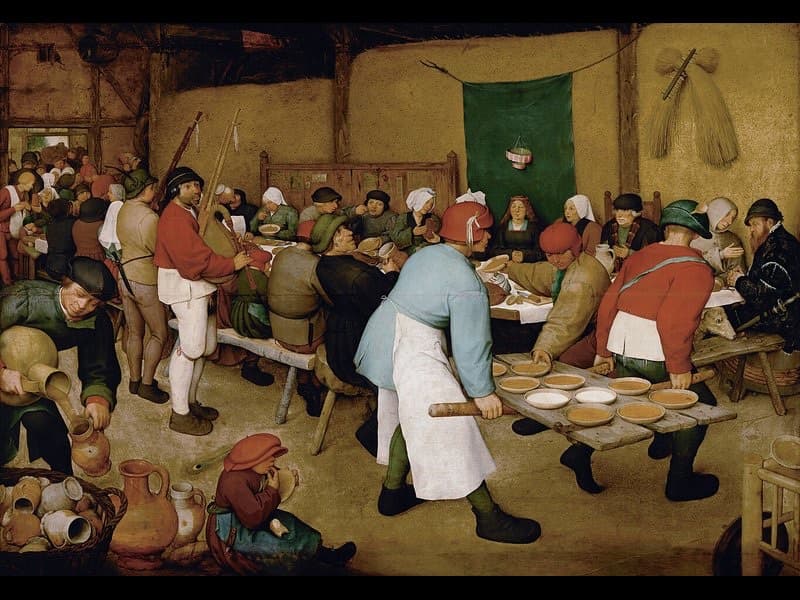
Cui is not mere assembly. It is the gathering of people around a centre that holds — and the hexagram's concern is what makes a centre worth gathering around. Lake (Dui) above Earth (Kun) shows water collecting in a natural depression, joy pooling on receptive ground. The judgment is unusually dense: 亨。王假有廟。利見大人。亨,利貞。用大牲吉。利有攸往 — "success; the king approaches his temple; it furthers to see the great person; success, constancy furthers; using a great sacrificial animal brings good fortune; it furthers to have somewhere to go." The temple gives the assembly an axis, the great person gives it a human centre, the offering gives it material cost. Without all three, a gathering is a crowd. That 用大牲 is worth holding against hexagram 41, where the answer to 曷之用 is 二簋可用享 — two bowls will serve. The two are not in conflict; they are the same principle measured against different occasions. Decrease asks what suffices when the point is to reduce. Gathering asks what a shared commitment must cost to be credible to everyone present. An offering nobody feels binds nobody. And the hexagram holds both scales at once: 六二 has 孚乃利用禴, the thin spring offering, which Wang Bi allows because 處於中正,而行以忠信,故可以省薄薦於鬼神. What decides is never the size. Wang Bi is blunt about the 大牲 too — 聚道不全,而用大牲,神不福也: a great victim offered while the gathering is still broken buys nothing. The Image delivers an unexpected instruction: 澤上於地,萃;君子以除戎器,戒不虞 — "the lake above the earth: Gathering. The superior person puts his weapons in order and guards against the unforeseen." Where people gather, conflict follows; where resources concentrate, predation arrives. The hexagram does not romanticize congregation. 初六 shows the ungathered state: 有孚不終,乃亂乃萃 — "sincerity that does not last; now disorder, now gathering" — a group oscillating between fragmentation and assembly without ever setting. Its remedy is immediate and physical: 若號一握為笑, "if you call out, one clasp of hands and there is laughter again." And 九五 gives the test of a legitimate centre: 萃有位,无咎匪孚,元永貞,悔亡 — "gathering in a position of authority; no blame though not all are sincere; supreme and lasting constancy; remorse vanishes." Not everyone who gathers is loyal. The centre holds through constancy rather than charm, earning over time what it cannot demand at once.
The Judgment
Fulfillment. The king approaches the ancestral temple. Seeing the great person is supported. Fulfillment. Sustained orientation is supported. Using great sacrificial offerings resolves well. Going forward is supported. The king goes to the temple. Everything is supported — seeing the great person, persistence, great offerings, going forward. The gathering hexagram assembles every positive signal available. But it starts at the temple. Not the marketplace, not the battlefield. The temple. Because a gathering without a center of meaning is just a crowd.
The Image
The lake rises above the earth: gathering together. The realized person accordingly sets aside weapons and tools, and guards against the unexpected. The lake swelling above the earth — gathering rising to the point of overflow. And the instruction is: prepare your defenses. Not because the gathering is hostile. Because wherever people collect, friction follows. Wherever wealth accumulates, theft arrives. The realized person who arms before the trouble starts has understood that gathering is both the achievement and the risk.
The Lines
Line 1
Having sincerity but not to the end. Confusion, then gathering. If you call out, one handclasp restores laughter. Do not worry. Going forward: no fault. Sincerity that wavers — you're in, then you're confused, then you're in again. And the fix is embarrassingly simple: call out, and one handshake brings back the laughter. Don't worry. Go forward. The first line of gathering knows that most wavering isn't about conviction. It's about loneliness. One hand reaching back is enough to resolve it.
Line 2
Being drawn in resolves well. No fault. If sincere, then even the modest spring offering is supported. Let yourself be drawn. Don't overthink the pull — just go toward it. Resolves well. And if you're sincere, even the smallest offering works. The second line: you don't need to earn your place in the gathering. You need to show up with whatever you have. The modest offering from a sincere person outranks the grand offering from a calculating one.
Line 3
Gathering amid sighs. No direction is supported. Going forward: no fault. Small friction. Sighing at the gathering — you're on the outside looking in. No direction works from here, but going forward isn't wrong either. Small friction. The third line is the person who arrives late to a group that's already formed. Awkward. Not catastrophic. The text gives you the kindest possible version of 'just deal with the embarrassment and keep moving.'
Line 4
Great resolve well. No fault. Four characters. Great resolve well. No fault. The fourth line of gathering and the verdict is: this is right. No elaboration, no conditions, no caveats. When the gathering is real and you're working for it without personal ambition, the text doesn't waste words. It just says: yes.
Line 5
Gathering has position. No fault. If some are not yet sincere, supremely enduring sustained orientation — then deviation detected dissolves. You have authority in the gathering. No fault. But some people aren't sincere yet — they're here for the position, not the purpose. The solution: supreme, enduring persistence. Not confrontation. Not purging. Just being so consistently genuine that the insincere ones either become sincere or become visible. Patience as a filter.
Line 6
Offering counsel amid tears and weeping. No fault. Crying at the gathering. Offering advice through tears. No fault. The top of the gathering hexagram and the image is grief mixed with contribution. Because sometimes the sincerest thing you can bring to a gathering is your sorrow. The person who shows up broken and still offers what they have? The text calls that faultless. Because it is.
Yilin: Forest of Changes
From Jiao Yanshou's Forest of Changes (焦氏易林) — the verse for Hexagram 45 in its unchanging form. A Han dynasty collection of four-character verses interpreting every hexagram transformation.
蒙慶受福有所獲得不利出城疾人困極
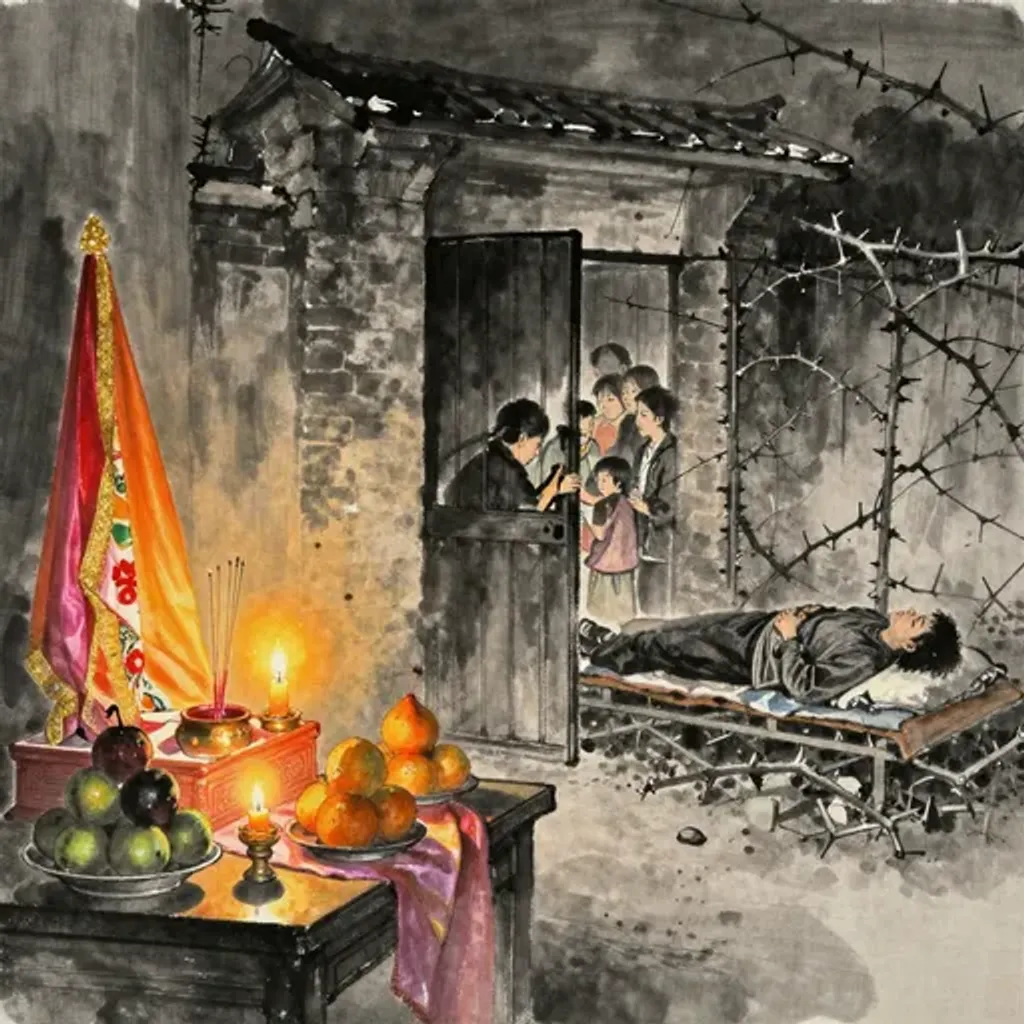
Receiving blessings and fortune, there are gains to be had. Yet it is ill to venture beyond the walls; the sick man is trapped among thorns.
Read full commentary ↓
Lake upon earth remains lake upon earth, Gathering unchanged. Blessed with grace and receiving fortune, there is something gained. But it is not favorable to leave the city walls; the sick person is trapped in thorns. The verse splits cleanly between inside and outside: within the gathered space, blessings arrive; beyond its walls, danger waits. The sick person's predicament intensifies this: illness pins one to a place even as the place itself becomes confining rather than protecting. From Gathering to itself, the transformation is stasis. The community sustains those within but cannot extend its protection beyond its own boundaries. What gathers here cannot be exported, and those who need to move find themselves held fast by the very forces that should help them.
中文註釋
澤上於地,萃也,變而仍為萃。蒙慶受福——承蒙恩澤,有所獲得。不利出城——出城則不利,城外有險。病人困棘——患者困於荊棘之中,動彈不得。詩意截然兩分:城內有福,城外有禍;聚合之處有庇護,離散之途有荊棘。病者之困境更深一層:疾病使人不得不留於原地,而原地之聚合漸成桎梏。從萃至萃,聚合凝固為靜止。社群能護其內而不能及其外,聚合之力不可輸出。需要離開者卻被困住,保護反成囚禁。
This commentary was written against an earlier reading of the verse. Where the reading has since changed, the interpretation itself may no longer apply.
Jiao Shi Yi Lin 《焦氏易林》, manuscript from the Wenyuan Pavilion Siku Quanshu, Qianlong period, Qing dynasty.
National Palace Museum, accession nos. 故庫017987–017990
Fascicle 4, page 12
Read from the manuscript leaf
Shown unpunctuated, as in the manuscript.
About this reading
Read from the scanned leaf.
Related Hexagrams
Same upper trigram: Lake (兌)
Same lower trigram: Earth (坤)