Upper Trigram
巽 Xùn
Wind — Gentle
Lower Trigram
坤 Kūn
Earth — Receptive
Classical Texts
The Goal
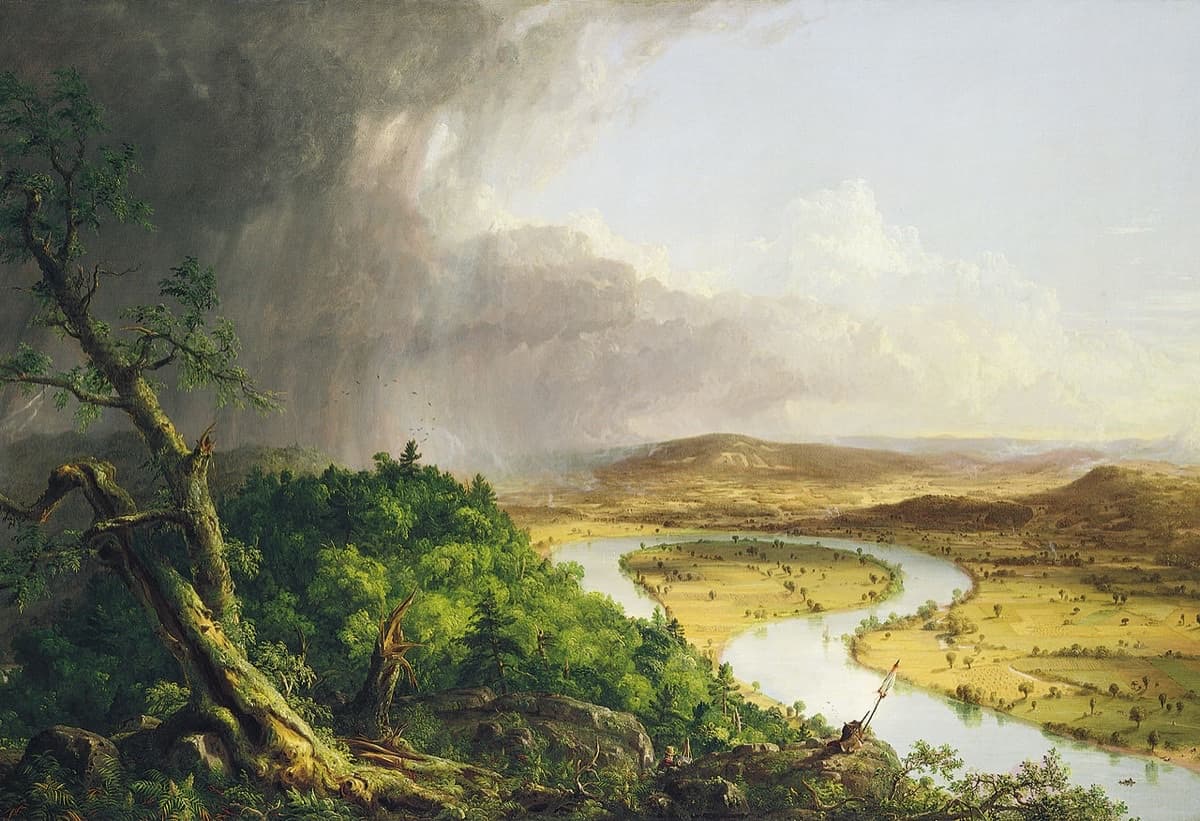
Guan is not passive observation. It is the act of being seen while seeing — the mutual visibility between those who lead and those who are led. The hexagram places Wind (Xun) above Earth (Kun): the penetrating force moving over the vast receptive surface, reaching everywhere, concealing nothing. Two yang lines stand atop four yin lines like a watchtower over open terrain, and the view works in both directions. The judgment's imagery is ritual: 盥而不薦,有孚顒若 — "the ablution has been made, but not yet the offering; there is sincerity, and it is looked upon with reverence." This is the precise moment of contemplation: after purification, before action. The hands are washed, the attention is gathered, the sacrifice has not begun. Guan locates its power in that interval. 顒若 belongs to the other side of the watching — those below are moved by seeing genuine inner alignment made visible, and need not be commanded. The Image shows that the watching is not only inward: 風行地上,觀;先王以省方觀民設教 — "wind moves over the earth: Contemplation. The ancient kings surveyed the regions, observed the people, and established their teaching." Observation here is a governing act. The ruler goes out, looks at how people actually live, and shapes instruction to what is found rather than to what was assumed. Contemplation that never surveys the ground produces teaching that fits nobody. The common misreading reduces Guan to "look before you leap." Its actual architecture is more demanding. This is the hexagram of exemplary presence — the teaching that leadership operates through what is displayed at least as much as through what is decreed. The wind over earth reaches everywhere without force. The tower is visible from all directions. Guan's goal is an inner state coherent enough that, when witnessed, it serves as a model, joined to a habit of looking closely enough that the model answers to real conditions. Both directions of the contemplation must be worthy of the other.
The Judgment
The hands are cleansed but the offering not yet made. Sincerity present, dignified and impressive. The hands are clean. The sacrifice hasn't happened yet. And already the room is different — because the sincerity is so real it fills the space before the ritual begins. The judgment is about the moment between preparation and action. The power is in the pause, not the performance.
The Image
Wind moves over the earth: contemplation. The ancient kings accordingly visited the regions, observed the people, and established teaching. Wind traveling over everything — touching all of it, attached to none of it. That's contemplation. The kings didn't sit on thrones and think. They traveled, observed, then taught. Contemplation in the original text is a field activity, not a desk activity. You see by going, not by sitting.
The Lines
Line 1
Childlike contemplation. For the lesser person, no fault. For the noble one, friction. A child's way of seeing. Fine for a child. For the noble one? Friction. Same quality, two different people, two different verdicts. The text isn't down on children. It's down on adults who see like children. Surface observation from someone who doesn't know better: no fault. From someone who does: the beginning of stuckness.
Line 2
Peeping through the crack. The woman's sustained orientation is supported. Peering through the door crack. A restricted view from a protected position. The line supports this for someone in a constrained situation — you see what you can from where you are. But it's explicitly a peep, not a view. The configuration supports this only when your constraints are real. If you're choosing the crack when the door is open, that's a different line.
Line 3
Contemplating my own life — advance or retreat. Looking at your own life to decide: forward or back. No verdict. The hinge line, and the entire instruction is self-examination. Not contemplating the situation, the market, the other people — your life. The advance-or-retreat decision that actually works starts with the mirror, not the window.
Line 4
Contemplating the light of the realm. Being a guest of the sovereign is supported. You can see the whole kingdom now. The light, the order, how it all works. And the supported move is: be a guest. Not a ruler, not a critic — a guest. At this position, the person who observes with the courtesy of a visitor learns more than the one who observes with the authority of an inspector.
Line 5
Contemplating my own life. The noble one: no fault. Same self-examination as line three, but elevated. The noble one at the fifth position — maximum influence — examines their own life and the verdict is no fault. Not 'resolves well.' No fault. Because at this height, the contemplation isn't about what to do next. It's about whether your existence is causing harm. The answer: it isn't.
Line 6
Contemplating their life. The noble one: no fault. One word changed from line five: 'my' becomes 'their.' You're no longer looking at your own life. You're seeing life itself — someone else's, everyone's. The contemplation has gone past the personal. At the top of the hexagram, the view widens until there's no self in the frame. And still: no fault.
Yilin: Forest of Changes
From Jiao Yanshou's Forest of Changes (焦氏易林) — the verse for Hexagram 20 in its unchanging form. A Han dynasty collection of four-character verses interpreting every hexagram transformation.
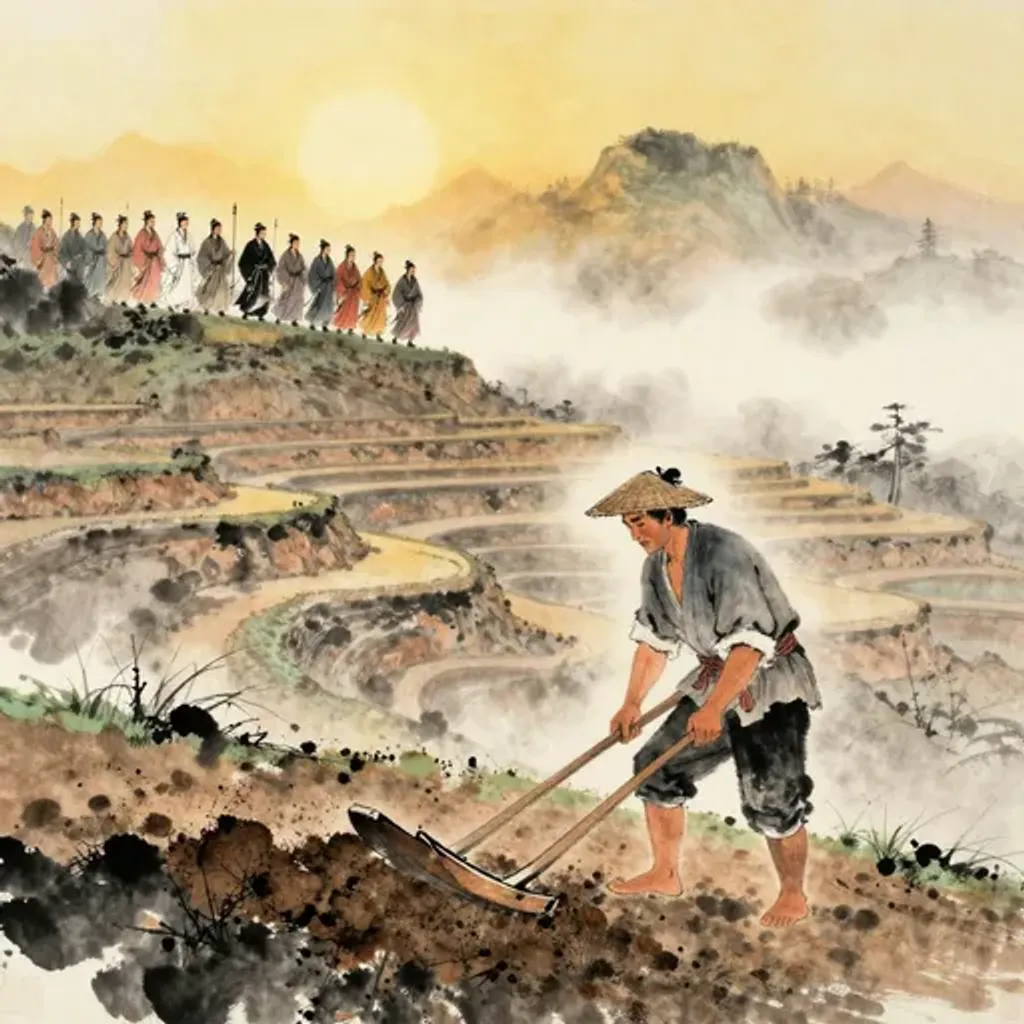
歷山之下虞唐所處躬耕致孝名聞四海為堯所薦禪位天子
Below Mount Li, where Shun of Yu once dwelt; he plowed the land himself in filial devotion, and his name was heard across the four seas. Recommended by Yao, he succeeded to the throne of the Son of Heaven.
Read full commentary ↓
Wind over earth, doubled: Contemplation gazing upon itself. Beneath Mount Li, Shun the humble farmer tills the soil and practices supreme filial piety. His renown spreads across the four seas despite his lowly station. Emperor Yao hears of him, recommends him, and Shun ascends to the throne of the Son of Heaven. According to tradition, Shun's father Gu Sou was blind and cruel, his stepmother malicious, yet Shun served them without resentment until his virtue became impossible to conceal. From Contemplation to Contemplation, the pattern is self-referential: the observer becomes the observed. Shun's quiet cultivation at Li was itself a form of contemplation that drew heaven's gaze downward, transforming the watcher into the watched, the farmer into the sovereign.
中文註釋
風行地上,觀之重卦,觀觀自身。歷山之下,虞舜躬耕而致孝。父頑母嚚弟傲,然舜事之無怨,名聞四海。為堯所識薦,終纘天子之位。據《史記·五帝本紀》,舜耕於歷山,鄰人感其德而讓畔。從觀至觀,自我映照之卦象:觀者成為被觀者。舜之躬耕致孝本身即是一種觀照,其德行引天目下視,使農夫化為天子,使被省察者成為省察萬方之人。
Jiao Shi Yi Lin 《焦氏易林》, manuscript from the Wenyuan Pavilion Siku Quanshu, Qianlong period, Qing dynasty.
National Palace Museum, accession nos. 故庫017987–017990
Fascicle 2, page 3
Read from the manuscript leaf
Shown unpunctuated, as in the manuscript.
About this reading
Read from the scanned leaf.
The leaf reads 虞唐所處
A note beside it 唐當作舜
Adopted editorially, not into the verse itself: 舜
Related Hexagrams
Same upper trigram: Wind (巽)
Same lower trigram: Earth (坤)