Upper Trigram
巽 Xùn
Wind — Gentle
Lower Trigram
離 Lí
Fire — Clinging
Classical Texts
The Goal
Jia Ren is not a description of domestic arrangements. It is a treatise on how influence propagates from interior to exterior — how the order inside a contained system shapes everything that system touches. Wind (Xun) above Fire (Li): 風自火出, wind comes forth from fire. Heat generates movement, and the movement carries outward whatever the fire actually is. The judgment is three characters — 利女貞, "the constancy of the woman furthers" — and 六二 shows what the text has in mind by it: 无攸遂,在中饋,貞吉, "she does not follow her own pursuits; she attends to the food within; constancy brings good fortune." That is a Zhou household, stated plainly, and the goal does not improve by pretending otherwise. What survives the distance is the structural claim underneath: the system is held together by consistent maintenance rather than by dramatic authority, and the hexagram assigns that maintenance the decisive position rather than a subordinate one. The Image sets two requirements: 風自火出,家人;君子以言有物,而行有恆 — "the superior person makes his words have substance and his conduct have constancy." Speech grounded in something real (言有物), behaviour sustained over time (行有恆). The family is the smallest unit where both can actually be observed, which is why it is the test case. 九三 states the central tension: 家人嗃嗃,悔厲吉;婦子嘻嘻,終吝 — "when the family is stern, there is remorse and danger, yet good fortune; when wife and children are giddy, in the end regret." Proper order sometimes produces discomfort, and the hexagram judges that discomfort preferable to what follows undisciplined ease. The goal of Jia Ren is to regulate the relation between inner coherence and outer influence. It follows Ming Yi in the sequence: after the outer world turns hostile, one withdraws to the sphere where formation can continue. 九五 marks the scale it reaches — 王假有家, "the king approaches his family" — the same order, at the top of the state. And 上九 names the source of its authority: 有孚威如,終吉, "sincerity and dignity; in the end good fortune." Authority here derives from the character of those who hold it, not from the rules they announce. Wind carries what fire actually produces. If the flame gutters, no arrangement of the structure compensates.
The Judgment
The woman's sustained orientation is supported. The family. And the configuration supports the woman's persistence specifically. Not because women belong at home — because the family functions from the center outward, and the person who holds the center holds everything. The text isn't assigning roles. It's describing physics. The center position is the load-bearing one.
The Image
Wind comes forth from fire: the family. The realized person accordingly speaks with substance and acts with consistency. Wind born from fire — the warmth creates the movement. And the instruction is: say real things, do consistent things. That's it. The entire philosophy of family in two instructions. Words with substance, actions with duration. The family that has both of these doesn't need rules. The family that has neither can't be saved by them.
The Lines
Line 1
Establishing boundaries for the household. Deviation detected dissolves. Boundaries first. Before anything else goes wrong. Deviation dissolves — because early structure prevents the problems that later structure can only contain. The person who sets the rules on day one looks controlling. The person who sets them on day three hundred looks desperate. Same rules. Different timing. Completely different outcome.
Line 2
No outside pursuits to follow. Attending to the nourishment within. Sustained orientation resolves well. No grand missions. Stay inside and prepare the food. Resolves well. The second line of the family hexagram, and it describes the most undervalued position in any system: the person who feeds everyone. No glory, no credit, no special pursuits. Just the center, doing center things. And everything resolves well because of it.
Line 3
The family members scold sharply. Regrettable severity, but resolves well. Wife and children giggling: ends in friction. Two families, two outcomes. The harsh one where people shout: regrettable, but resolves well. The relaxed one where everyone giggles: ends in friction. The text is not subtle here. Discipline that hurts feelings is better than leniency that loses structure. You'll regret the harshness. You'll regret the softness more.
Line 4
Enriching the family. Great resolve well. Making the family wealthy. Great resolve well. Four characters, the highest verdict, and it goes to the person who provides. Not the person who leads. Not the person who disciplines. The person who fills the house with what it needs. The faithful steward. The text doesn't give 'great resolve well' to many things. It gives it to this.
Line 5
As a king approaches his family. Do not worry. Resolves well. The king goes home. Don't worry. Resolves well. You know why the text says 'don't worry'? Because a king approaching his family creates anxiety — will it be an inspection? A judgment? No. The king who comes home as family, not as authority, is the one who resolves well. The crown stays at the office.
Line 6
There is sincerity, impressive in its bearing. In the end, resolves well. Sincerity that impresses without trying to impress. And: resolves well in the end. The top of the family hexagram and the final instruction is character. Not rules, not structure, not roles — the character of the person at the top. Because a family follows what it sees. And if what it sees is genuine, the ending writes itself.
Yilin: Forest of Changes
From Jiao Yanshou's Forest of Changes (焦氏易林) — the verse for Hexagram 37 in its unchanging form. A Han dynasty collection of four-character verses interpreting every hexagram transformation.
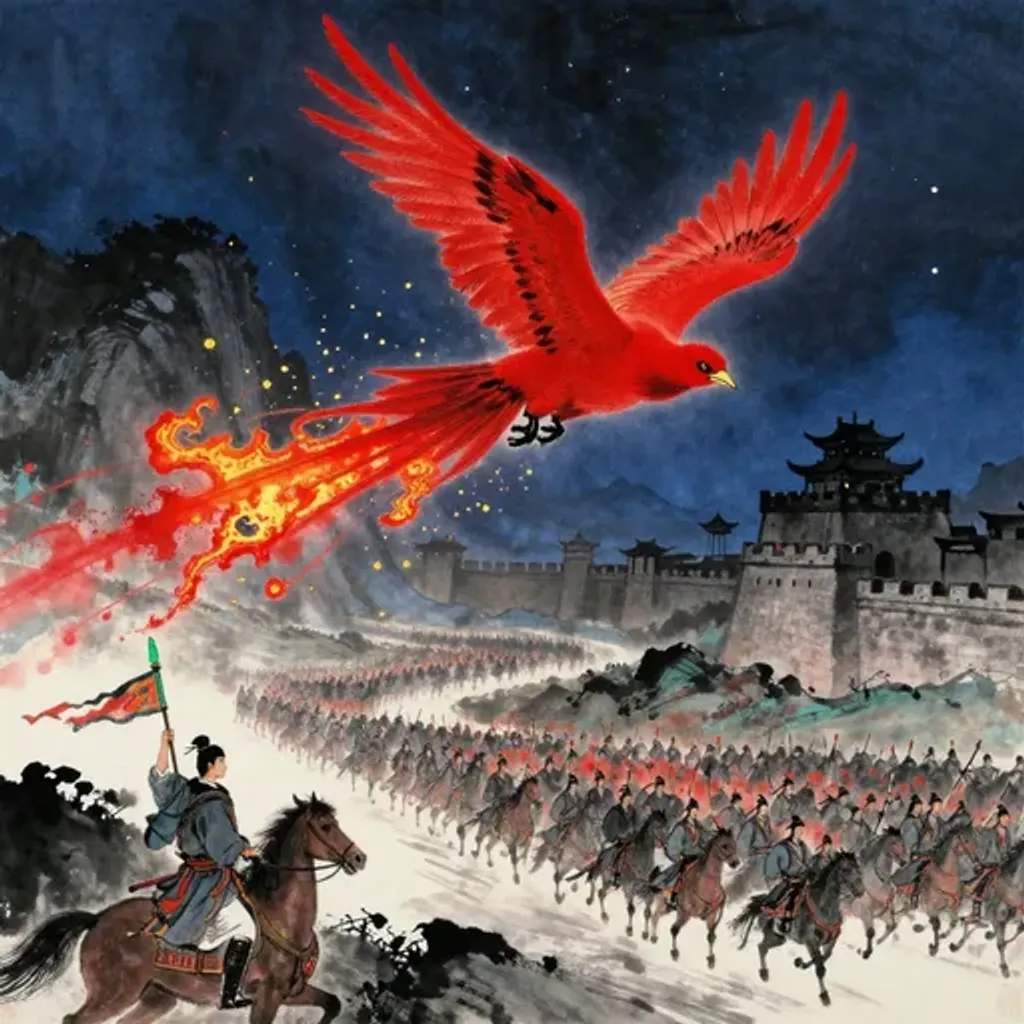
王命赤烏與君徼期征伐無道誅其君傲居止何憂
Heaven commands the red bird, setting the appointed time with the lord. He campaigns against the lawless, executing their arrogant ruler. Where he dwells and rests, what worry is there?
Read full commentary ↓
Wind from fire returns to its own hearth: The Family transforms into itself. Heaven sends the Red Crow as an omen, granting the ruler a fixed appointment. He marches to punish the lawless and executes the arrogant tyrant — then settles peacefully with nothing to fear. The Red Crow (赤烏) is a celebrated portent associated with King Wu of Zhou's conquest of Shang: according to tradition, a fiery bird descended upon the king's tent as confirmation of heaven's mandate. The verse recapitulates the founding myth of proper governance: divine sanction, righteous conquest, and domestic peace. When The Family returns to itself, the message is that true household order rests on mandate from above, executed with justice, and culminating in the simple security of home.
中文註釋
風自火出,家人歸於本位。天命赤烏——天降赤色神鳥為兆,與君徼期——授予君主確定之天命。征伐無道——討伐不義之邦,誅其君傲——誅滅驕橫之暴君。居止何憂——安居而無所憂。赤烏為周武王伐紂時之著名祥瑞:據傳火鳥降於武王帳前,確證天命所歸。此詩重述正統治理之開國神話:天命、義征、居安。家人歸於自身,訓示真正之家國秩序立基於天命、行之以正義、歸結為安居之樸素平安。
Jiao Shi Yi Lin 《焦氏易林》, manuscript from the Wenyuan Pavilion Siku Quanshu, Qianlong period, Qing dynasty.
National Palace Museum, accession nos. 故庫017987–017990
Fascicle 3, page 66
Read from the manuscript leaf
Shown unpunctuated, as in the manuscript.
About this reading
Read from the scanned leaf.
Related Hexagrams
Same upper trigram: Wind (巽)
Same lower trigram: Fire (離)