Upper Trigram
巽 Xùn
Wind — Gentle
Lower Trigram
震 Zhèn
Thunder — Arousing
Classical Texts
The Goal
Yi 益 (Increase) is not accumulation. It is the structural condition in which what is above gives to what is below. The Tuan states it as the exact inverse of Sun: 損上益下,民說无疆 — "the upper is diminished, the lower augmented; the people's joy is without bound." Wind (Xun) above Thunder (Zhen) shows gentle penetration riding on arousing movement: benefit distributed through activation rather than handed down as a gift. The judgment says 利有攸往,利涉大川 — "it furthers to have somewhere to go; it furthers to cross the great water." Both are permissions granted by the time itself, and the time does not stay open indefinitely. The Image specifies what increase is for: 風雷,益;君子以見善則遷,有過則改 — "wind and thunder: Increase. The superior person, seeing good, moves toward it; having faults, corrects them." The two verbs — 遷 and 改 — make increase a moral operation rather than a material one. What grows under this hexagram is character; holdings are the occasion, not the point. Wang Bi adds the limit that keeps increase from being simply more: 益之為用,施未足也;滿而益之,害之道也 — increase supplies what is short, and adding to what is already full is the way to harm. 九五 shows what that looks like at the top of the system: 有孚惠心,勿問元吉 — "sincerity in a giving heart; do not even ask, supreme good fortune." The good fortune is not contingent on outcome and needs no divination, because a disposition to benefit others is already the thing the hexagram is trying to produce. 上九 shows the failure: 莫益之,或擊之,立心勿恆,凶 — "no one augments him; someone strikes him; his heart is set without constancy; misfortune." Whoever receives increase and does not pass it on eventually attracts not more increase but hostility. The goal of Yi is to govern the flow of benefit from those who have toward those who need, and to ensure the recipient spends it on something larger than personal advantage. 初九 says what to do first: 利用為大作,元吉无咎 — "it furthers to undertake great works." Increase that arrives must be put to work; hoarded or savoured, it turns into a liability. The hexagram follows Sun in the sequence — what was reduced returns enriched — and the return carries an obligation: increase received must become increase given, or the cycle breaks.
The Judgment
Going forward is supported. Crossing the great river is supported. Everything opens. Go forward, cross the river, take the risk. The increase hexagram gives the shortest, most permissive judgment available: both directions supported, no conditions attached. The window is open. The text is practically pushing you through it. Don't stand here reading about increase. Go.
The Image
Wind and thunder: increase. The realized person accordingly moves toward the good upon seeing it, and corrects faults upon having them. Wind and thunder strengthening each other — the two most mobile forces in nature, amplifying. And the instruction is deceptively simple: see good, move toward it. Have faults, fix them. That's the entire method of increase. Not strategy, not accumulation. Just: toward good, away from bad. The person who does this consistently doesn't need a plan for increase. They are the plan.
The Lines
Line 1
It is supported to accomplish great works. Supremely resolves well. No fault. Great works. Not small adjustments, not careful steps — great works. Supremely resolves well. The first line of increase and the instruction is to go big. Because increase at the beginning is like a wave forming — the energy is there, the support is there, and the only mistake is thinking small. This is the line that gives you permission to attempt the thing you've been afraid of.
Line 2
Someone increases this one by ten pairs of tortoise shells. One cannot refuse. Enduring sustained orientation resolves well. The king makes an offering to the supreme: resolves well. The same tortoise shells from the decrease hexagram — appearing again, irrefusable again. But now with an addition: the king offers to heaven. Resolves well. When increase arrives this completely, the only appropriate response is to pass it upward. The person who receives an irrefusable gift and dedicates it to something higher has understood what increase is for.
Line 3
Increased through unfortunate events. No fault. Having sincerity, walking the middle way, and reporting to the prince with the seal of office. Bad things happen and they increase you. No fault. The paradox line — the one that makes no sense until it does. Misfortune that arrives while you're walking the middle path becomes material for growth. Not because suffering is good. Because the sincere person metabolizes everything. The seal of office means authority earned through difficulty, not despite it.
Line 4
Walking the middle way and reporting to the prince, who follows. It is supported for use in relocating the capital. The prince follows your counsel. You're trusted enough to move the capital — the biggest structural decision a state can make. And the basis of this trust? Walking the middle. Not brilliance, not daring. Balance. The person in the middle who can be trusted to relocate the center of power? That's influence at its most invisible and most real.
Line 5
Having sincerity and a kind heart. Do not ask — supremely resolves well. Having sincerity, kindness returned as one's character. Kind heart, sincere intention, don't even ask about the outcome. Supremely resolves well. The fifth line of increase and the instruction is to stop measuring. The kindness that calculates its return is commerce. The kindness that doesn't ask is the one that receives the highest verdict in the book. Don't ask. Just be kind. The math handles itself.
Line 6
No one increases this one. Someone even strikes. The heart is not constant. Adverse. Nobody helps. Someone attacks. The heart wasn't steady. Adverse. The top of the increase hexagram and the only line that fails — because the heart wasn't constant. Not because the world was hostile, not because the timing was wrong. The heart. Six lines of increase and the one thing that ruins it all is inconstancy in the one place it matters most.
Yilin: Forest of Changes
From Jiao Yanshou's Forest of Changes (焦氏易林) — the verse for Hexagram 42 in its unchanging form. A Han dynasty collection of four-character verses interpreting every hexagram transformation.
文王四乳仁愛篤厚子畜十男無有夭折
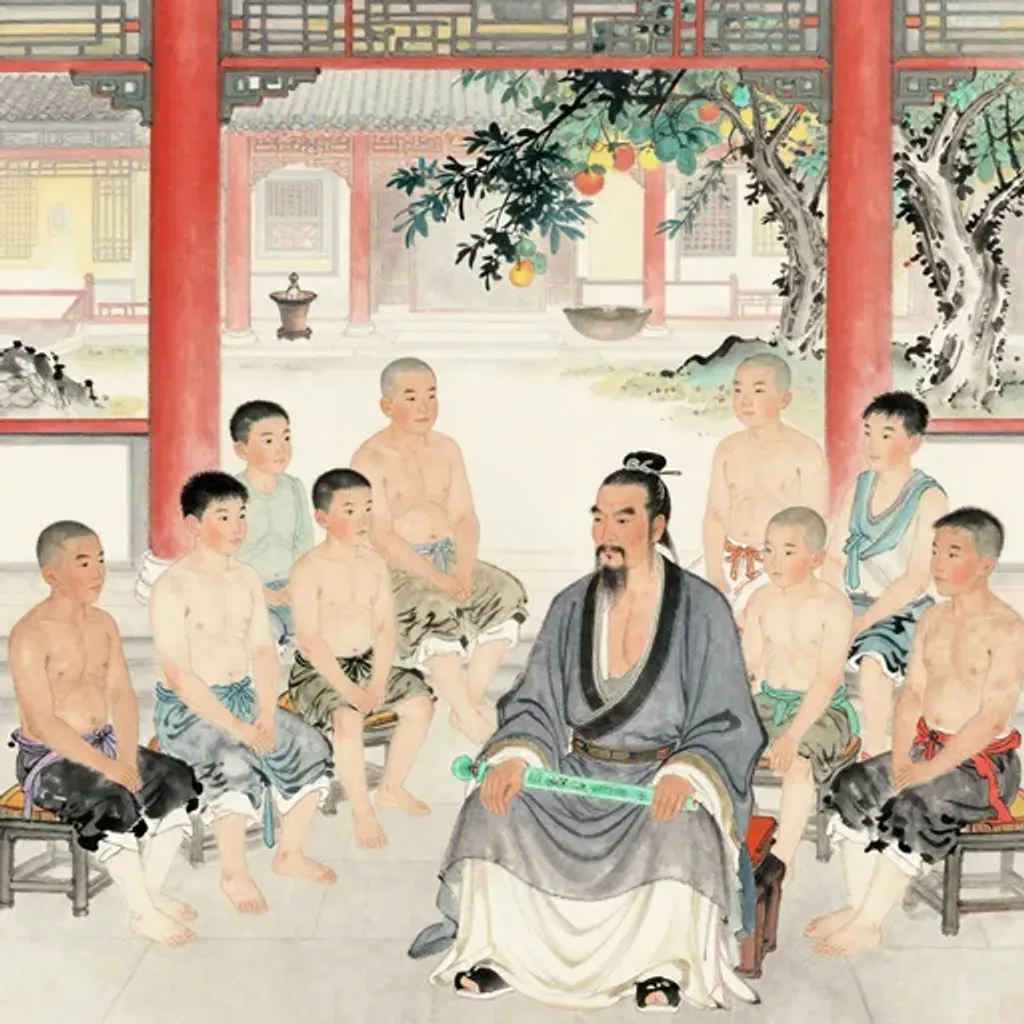
King Wen with his four breasts, benevolent love deep and generous. He reared ten sons; not one met an early death.
Read full commentary ↓
Wind and thunder bestow increase, and the transformation returns to itself — Increase upon Increase, the hexagram doubled. King Wen possessed four nipples, a sign of profound benevolence and sagely compassion. He raised ten sons, and not one suffered an early death. According to the Huainanzi, 'King Wen had four nipples; this is called great benevolence — all under heaven turn to him, and the hundred clans draw near.' The four nipples were understood as a bodily mark of superabundant virtue, an outward sign that this ruler could nourish more than ordinary men. From Increase to Increase, the verse celebrates the pure archetype of the hexagram: generosity so complete that it reproduces itself across generations without diminishment. The sage's body itself overflows with the capacity to sustain.
中文註釋
風雷益,變為益——增益之卦疊加自身。文王四乳,仁愛篤厚——周文王天生四乳,《淮南子》云:「文王四乳,是謂大仁,天下所歸,百姓所親。」四乳為聖德外顯之異相,示其滋養之能超乎常人。子畜十男,無有折夭——養育十子皆無夭折。從益至益,增益之純粹原型:慷慨如此充沛,代代自行繁衍而不減損。聖人之身本身即溢滿養育之力。
Jiao Shi Yi Lin 《焦氏易林》, manuscript from the Wenyuan Pavilion Siku Quanshu, Qianlong period, Qing dynasty.
National Palace Museum, accession nos. 故庫017987–017990
Fascicle 3, page 116
Read from the manuscript leaf
Shown unpunctuated, as in the manuscript.
About this reading
Read from the scanned leaf.
Related Hexagrams
Same upper trigram: Wind (巽)
Same lower trigram: Thunder (震)