Upper Trigram
巽 Xùn
Wind — Gentle
Lower Trigram
巽 Xùn
Wind — Gentle
Classical Texts
The Goal
Xun is not weakness. It is penetrating influence — achieving through persistence what force cannot achieve at all. Wind entering every crack, an idea permeating a culture so gradually that no one can name the moment it took hold. Wind doubled on itself gives ceaseless, directional pressure; unlike Thunder's single shock, its power lies in continuity. The judgment is 小亨。利有攸往。利見大人 — "small success; it furthers to have somewhere to go; it furthers to see the great person." The success is 小 not because the results are small but because the method works in small sustained increments, and the two clauses that follow supply what the method needs: a direction, and someone whose authority gives the influence somewhere to attach. 初六 names the central danger: 進退 — "advancing and retreating," the oscillation of someone too gentle to commit. Wind that keeps changing direction disperses its own force. The line's remedy is startling for the Gentle hexagram: 利武人之貞, "the constancy of a soldier furthers." 九三 shows the other way it fails — 頻巽,吝. Wang Bi glosses 頻 as 頻蹙, the knitted brow: 不樂而窮,不得已之謂也, submission offered without gladness, from exhausted resources, because there is no alternative. The line Image (小象) says 志窮也, the will is at its end. This is not indecision but compliance with nothing left behind it — and the hexagram counts it a failure of Xun just as much as the wavering does. The hexagram's sharpest lesson is that the same posture can be either. 九二 and 上九 use identical words — 巽在牀下, "kneeling beneath the bed" — and reach opposite verdicts. 九二 adds 用史巫紛若,吉,无咎: with the historians and shamans in numbers, good fortune, no blame. Submission that goes through the proper channel and serves something works. 上九 adds 喪其資斧,貞凶: he loses his means and his axe, and constancy brings misfortune. Submission with nothing behind it is just self-abandonment. Nothing distinguishes them but what the submission is for. 九五 shows the resolution: 貞吉悔亡,无不利,无初有終,先庚三日,後庚三日,吉 — "constancy brings good fortune, remorse vanishes, nothing is unfavorable; no beginning but an end; three days before the day 庚, three days after; good fortune." 无初有終 is Xun's signature as we read it — influence so pervasive that its origin cannot be located, only its result, which is what wind does to a landscape. Wang Bi reads the same four characters as a sequence in time: 化不以漸,卒以剛直用加於物,故初皆不說也。終於中正,邪道以消,故有終也 — change applied abruptly pleases nobody at first and comes right at the end. His reading fits 九五's position; ours fits the trigram. The line sustains both. And the 先庚/後庚 counting is the same procedure hexagram 18 states as 先甲三日,後甲三日. Kong Yingda spells it out here: 申命令謂之庚,民迷固久,申不可卒,故先申之三日,令著之後,復申之三日,然後誅之,民服其罪,无怨而獲吉 — the order is announced three days before, repeated three days after it is posted, and only then is it enforced, so that people accept the penalty without resentment. The counting is not numerology. It is the interval that makes an order legitimate before it is applied. The goal of Xun is lasting change through influence rather than imposition. The Image: 隨風,巽;君子以申命行事 — "wind following wind: the Gentle. The superior person repeats his commands and carries out his affairs." 申 is to state again. The danger is never insufficient force; it is insufficient resolve. Xun fails only when it wavers.
The Judgment
Small fulfillment. Going forward is supported. Seeing the great person is supported. Small fulfillment again — the gentle force doesn't produce dramatic results. But going forward is supported, and seeing the great person is supported. Two doors open. Not with a bang — with a whisper. The wind penetrates by being persistent, not by being loud. The person who needs to see the result immediately has chosen the wrong hexagram.
The Image
Following winds: the gentle. The realized person accordingly reiterates commands and carries out undertakings. Wind following wind — the same message, repeated. And the instruction is: reiterate. Say it again. Carry it through. Because a single gust changes nothing. A sustained wind reshapes the landscape. The realized person who says the important thing once and expects it to land has never watched how wind actually works.
The Lines
Line 1
Advancing and retreating. The warrior's sustained orientation is supported. Forward, back. Forward, back. The indecision of the gentle nature — and the fix is the warrior's discipline. Sustained orientation supported. The first line says: if you're naturally gentle and you can't decide, borrow the warrior's resolve. Not the warrior's violence. The resolve. The gentle person with a warrior's commitment to direction is unstoppable. The gentle person without it oscillates forever.
Line 2
Penetration beneath the bed. Using scribes and diviners in great number. Resolves well. No fault. Something lurking under the bed. And the response: bring in the experts. All of them. Scribes, diviners, the whole crew. Resolves well. The second line is about hidden influences that can't be addressed directly. You need specialists for what hides in the dark corners. The person who tries to handle the thing under the bed alone misunderstands the nature of what's hiding there.
Line 3
Repeated penetration. Friction. Penetrating again and again. And the result is friction, not insight. Two characters for the problem, one for the consequence. The third line: overthinking. The gentle approach pushed past usefulness into paralysis. The person who analyzes the same thing for the fourth time isn't being thorough. They're stalling. The penetration that refuses to become a decision becomes its own obstruction.
Line 4
Deviation detected dissolves. In the field, capturing three kinds of game. The regret disappears. Three kinds of game caught in the field. The fourth line: the gentle approach finally produces abundance. Not through force — through accumulated skill. The three kinds of game represent complete provision: sacred, social, and practical. The person who has been gently, persistently present in the field catches everything they need.
Line 5
Sustained orientation resolves well. Deviation detected dissolves. Nothing that is not supported. No beginning, but an end. Three days before the change, three days after. Resolves well. Everything supported. No beginning — but an end. The change needs three days of preparation and three days of follow-through. Resolves well. The fifth line is the master class in gentle transformation: you can't point to when it started, but you can point to when it finished. The change was so gradual it has no origin. It just has a completion.
Line 6
Penetration beneath the bed. Losing resources and the ax. Sustained orientation: adverse. Under the bed again — but this time you lose everything. Resources gone. Ax gone. Sustained orientation: adverse. The top of the gentle hexagram, and the penetrating insight that served you in line two has turned destructive. You went too deep, too long, into territory you can't control. The person who looks under every bed eventually finds the one that swallows them.
Yilin: Forest of Changes
From Jiao Yanshou's Forest of Changes (焦氏易林) — the verse for Hexagram 57 in its unchanging form. A Han dynasty collection of four-character verses interpreting every hexagram transformation.
温山松栢常茂不落鸞鳳以芘得其歡樂
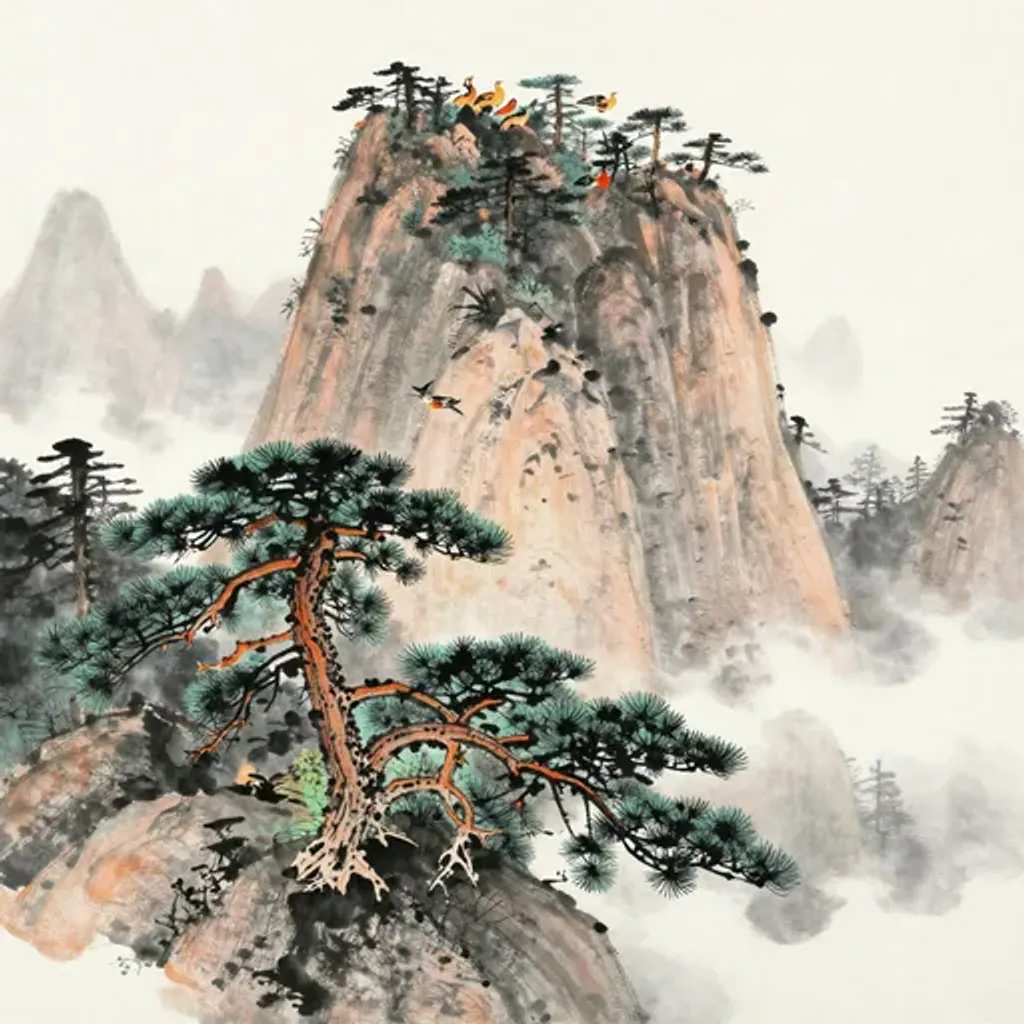
Pine and cypress on Wen Mountain; ever flourishing, never falling. Phoenix and luan find shelter there; gaining their joy and delight.
Read full commentary ↓
Wind upon wind returns to wind upon wind: the Gentle remains itself. On the warm mountain, pine and cypress stand evergreen, never shedding their leaves. Phoenix and luan birds shelter among them, finding their joy and contentment. The doubled wind of Xun sustaining itself produces an image of permanence within flexibility. Pine and cypress are classical symbols of constancy — they endure winter's harshest blasts while deciduous trees go bare. The phoenix choosing to roost among them validates their worthiness: only the noblest tree attracts the noblest bird. From The Gentle to The Gentle, the pattern is self-reinforcing: wind follows wind without interruption, commands issued and carried through. Steady virtue, like the evergreen, needs no revolution — only persistence.
中文註釋
隨風巽,巽復為巽,風行不息。溫山松柏,常茂不落——溫潤之山上松柏長青,四季不凋。鸞鳳以庇,得其歡樂——鸞鳳棲息其間,怡然自得。巽風自行相續,生成柔韌中之恆常。松柏為堅貞之經典象徵——寒冬凜冽中挺立不凋,落葉木盡褪而松柏獨青。鳳凰擇此而棲,正驗其高潔——唯最尊之木方引最貴之禽。從巽復歸於巽,此為自我強化之格局:風繼以風,號令既出必行。恆常之德如松柏,無需革新,唯在不輟。
This commentary was written against an earlier reading of the verse. Where the reading has since changed, the interpretation itself may no longer apply.
Jiao Shi Yi Lin 《焦氏易林》, manuscript from the Wenyuan Pavilion Siku Quanshu, Qianlong period, Qing dynasty.
National Palace Museum, accession nos. 故庫017987–017990
Fascicle 4, page 131
Read from the manuscript leaf
Shown unpunctuated, as in the manuscript.
About this reading
Read from the scanned leaf.
Related Hexagrams
Same upper trigram: Wind (巽)
Same lower trigram: Wind (巽)